
Pecron E Series Comparison
The E series ranges from 614Wh compact power to 3.8kWh home-backup systems, but generations differ significantly in charging, app features and expansion batteries.
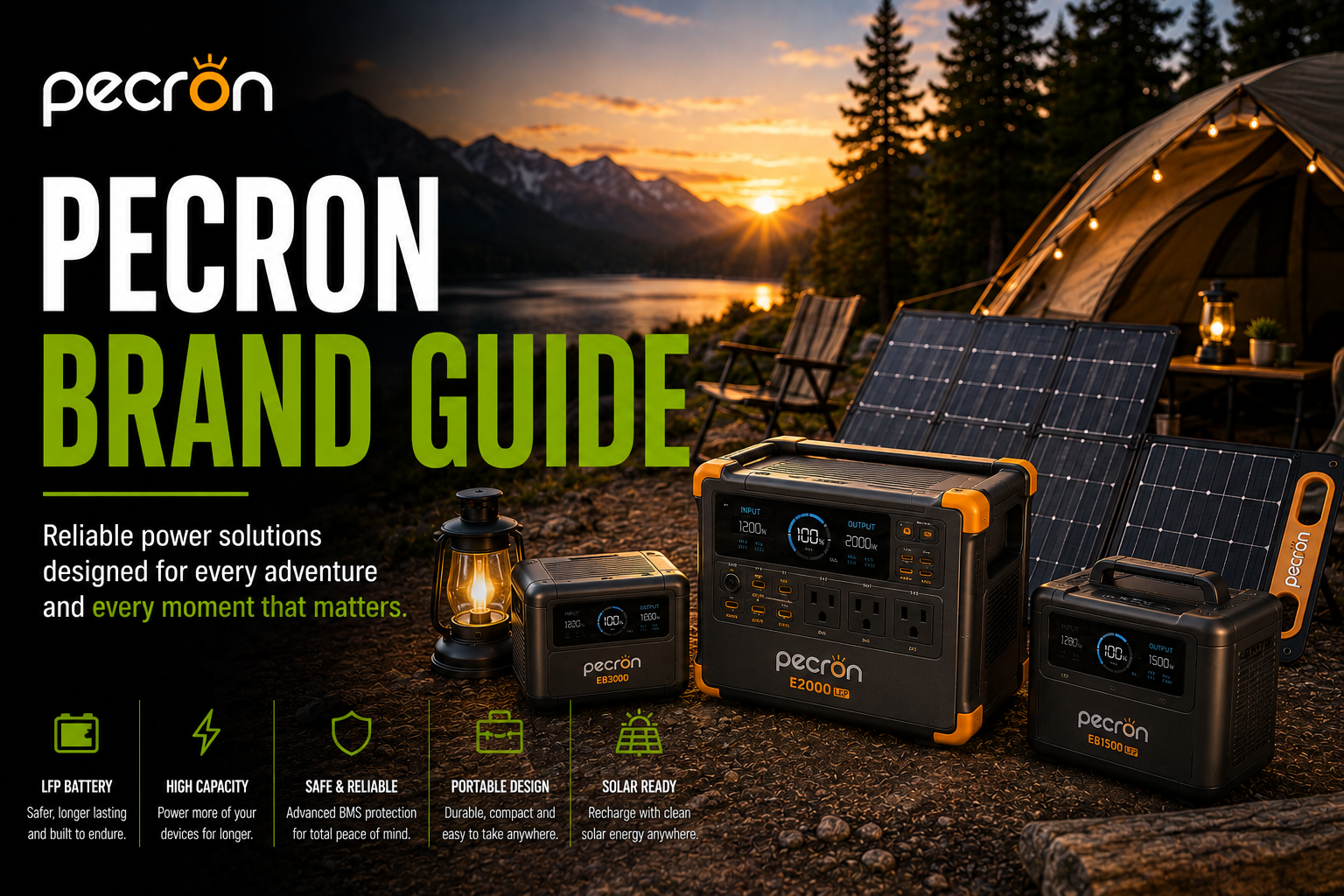
The E series ranges from 614Wh compact power to 3.8kWh home-backup systems, but generations differ significantly in charging, app features and expansion batteries.
Pecron’s E-series lineup should be read as several related platforms rather than one fully interchangeable family.
This comparison explains the practical differences in capacity, output, expansion and portability.
E1000LFP Is Best Entry, E2400LFP Best 2kWh, E3600LFP Best Home Model
E1500LFP remains the expansion sweet spot, while E2000LFP is mainly compelling at a strong discount.
Series Verdict
New buyers should favor E1000LFP, E1500LFP, E2400LFP or E3600LFP based on size. Older models require extra compatibility research.
Pecron E Series Comparison
| Model | Capacity | Output | Solar/Charging | Expansion | Best Use |
|---|---|---|---|---|---|
| E600LFP | 614Wh | 1,200W | 350W solar | Limited | Compact |
| E1000LFP | 1,024Wh | 1,800W | 600W solar / 1,000W AC | Model dependent | 1kWh value |
| E1500LFP | 1,536Wh | 2,200W | Fast AC | Up to 9,216Wh | Expandable |
| E2000LFP | 1,920Wh | 2,000W | Dual PV channels | Up to 8,064Wh | Runtime |
| E2400LFP | 2,048Wh | 2,400W | 1,800W AC | Platform dependent | Modern 2kWh |
| E3600LFP | 3,072Wh | 3,600W | 2,400W solar / 3,200W AC | Large + paired 240V | Home backup |
| E3800LFP | 3,840Wh | 4,200W class | High-input class | Large | Maximum base |
Generation Differences
The E series includes multiple electrical architectures. E2000LFP uses a dedicated 24V battery family, while E1500LFP and several newer systems use 48V expansion packs. The newest large models add much faster charging and paired 240V capability.
Portability by Class
Sub-1kWh
E600LFP is the only truly easy carry.
1kWh
E1000LFP remains manageable.
1.5–2kWh
E1500, E2000 and E2400 are movable but heavy.
3kWh
E3600LFP needs wheels or two people.
3.8kWh
E3800LFP is primarily stationary.
Expanded Systems
Plan permanent or semi-permanent placement.
Best Model by Buyer
New Camper
E600LFP.
Home Essentials
E1000LFP.
Expandable RV
E1500LFP.
Discounted Long Runtime
E2000LFP.
Modern 2kWh Buyer
E2400LFP.
Home Backup
E3600LFP or E3800LFP.
What Matters in Real-World Use
The useful way to approach pecron e series comparison is to identify which differences change real appliance compatibility, runtime, recharge time or portability. A comparison table is a starting point, not the decision itself; the best choice is the one whose strengths overlap with the way you will actually use the system.
Calculate the load before comparing capacity. Add the continuous watts of devices that may operate at the same time, then allow separately for startup surges from refrigerators, pumps, compressors or tools. After that, estimate watt-hours from the expected runtime. This prevents paying for capacity when output is the limiting factor—or the reverse.
When both choices satisfy the electrical requirement, compare practical ownership: weight, physical size, AC and solar recharge options, expansion support, port selection, noise, app dependence and warranty/service. A small specification win can be irrelevant if the competing system is easier to move, recharge or support.
Finally, compare the current total-system price. Promotions can change the value equation quickly, especially among portable power stations. Include any battery modules, panels, adapters or cables needed for the intended setup rather than comparing base-unit prices in isolation.
A Better Way to Decide
1. Define the load
List simultaneous devices, continuous watts and startup surges before deciding what size station you need.
2. Define runtime
Estimate required watt-hours from actual hours of operation and leave reserve for conversion losses and changing loads.
3. Compare complete cost
Include solar, expansion batteries, adapters and other accessories required for the intended configuration.
4. Weight support and convenience
Recharge time, portability, noise, warranty handling and accessory availability can outweigh modest spec differences.
Common Buying Mistakes to Avoid
Frequently Asked Questions
Who should buy the Pecron E series?
Buy it when Pecron’s combination of capacity, inverter output, solar input and expansion value matches your real load and runtime requirements.
Who should skip the Pecron E series?
Skip it when lower weight, a simpler nationwide retail network, native 240V from one unit or a more polished app ecosystem matters more.
How should Pecron runtime be estimated?
Multiply rated watt-hours by roughly 0.80 to 0.90 for practical AC energy, then divide by the appliance’s average running watts.
Can Pecron run a refrigerator?
E1000LFP and larger models can generally run refrigerators when compressor startup remains within the inverter’s surge rating.
Can Pecron charge from third-party solar panels?
Yes, when panel open-circuit voltage, current, polarity and connectors remain within the exact model’s input limits.
Do Pecron stations work as a UPS?
Several current E-series models advertise UPS functionality, but transfer behavior should be checked for sensitive servers or medical devices.
How long do Pecron batteries last?
Many current Pecron LiFePO4 models are rated around 3,500 cycles to 80% remaining capacity under stated conditions.
Are Pecron expansion batteries universal?
No. E2000LFP uses the 24V EB3000 system, while E1500LFP and newer 48V platforms use different compatible packs.
How should a Pecron station be stored?
Store it cool and dry, avoid extreme heat, maintain charge according to the manual and protect ports from moisture and debris.
What is the most common Pecron buying mistake?
Assuming every E-series model uses the same expansion battery, charging input and accessory cable.
Which E-series model is best overall?
E2400LFP for most current 2kWh buyers.
Which E-series model expands the most?
E1500LFP and E3600LFP support large 48V battery systems, depending on pack configuration.