
Geneverse vs BLUETTI
Geneverse prioritizes simple appliance backup; BLUETTI offers higher output, faster app-connected operation and a much broader current lineup.
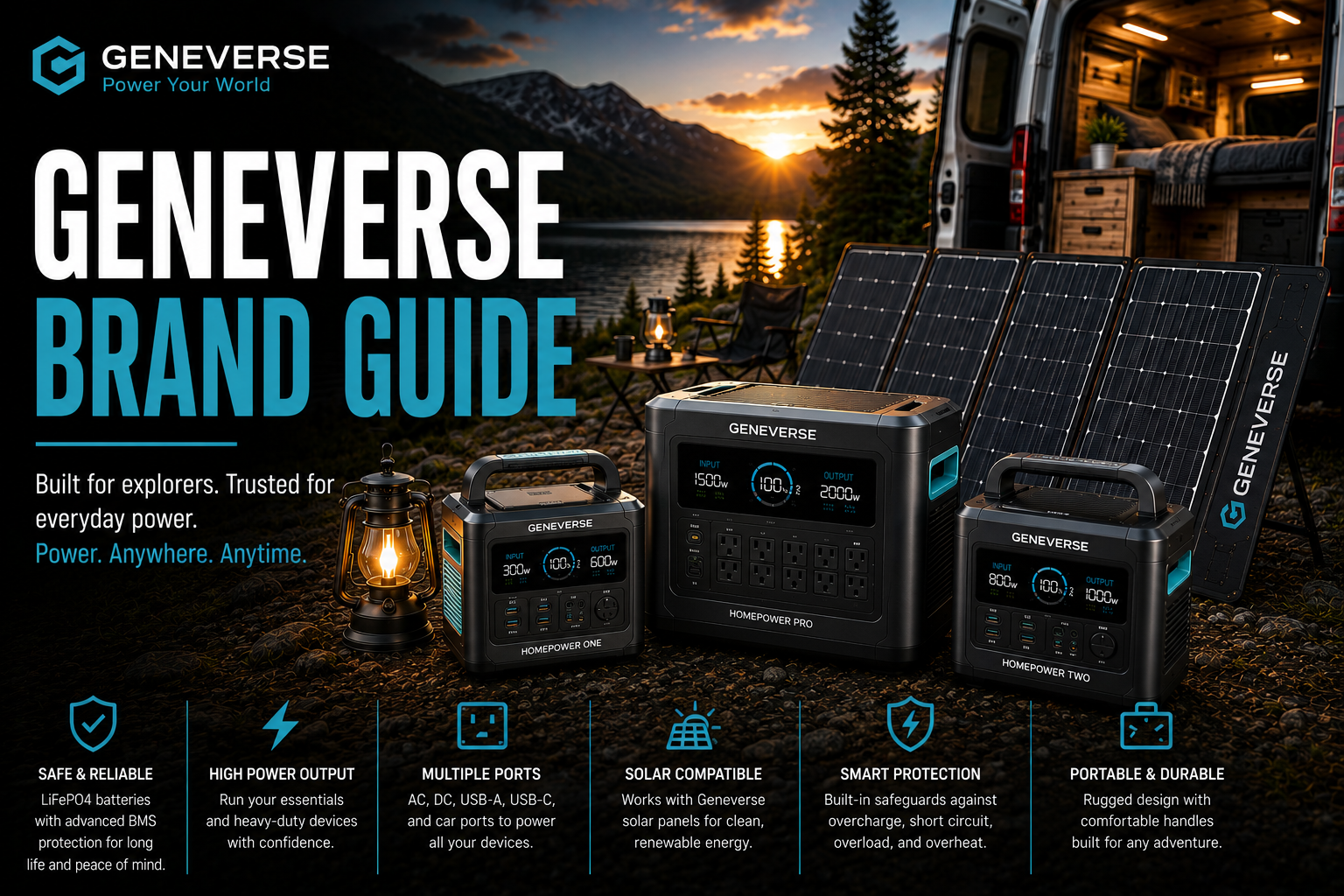
Geneverse prioritizes simple appliance backup; BLUETTI offers higher output, faster app-connected operation and a much broader current lineup.
Geneverse prioritizes simple appliance backup; BLUETTI offers higher output, faster app-connected operation and a much broader current lineup.
This comparison focuses on usable capacity, continuous output, charging, solar input, portability, expansion and present-day ownership.
Main Difference
Geneverse prioritizes simple appliance backup; BLUETTI offers higher output, faster app-connected operation and a much broader current lineup.
Comparison Verdict
Geneverse prioritizes simple appliance backup; BLUETTI offers higher output, faster app-connected operation and a much broader current lineup.
Quick Comparison
| Factor | Geneverse | Competitor |
|---|---|---|
| 1kWh example | ONE PRO: 1,210Wh / 1,200W | Elite 100 V2: 1,024Wh / 1,800W |
| 2kWh example | TWO PRO: 2,419Wh / 2,200W | Elite 200 V2: 2,073.6Wh / 2,600W |
| Solar input | 800W PRO models | Up to 1,000W Elite examples |
| Expansion | Fixed capacity | Selected modular ecosystems |
| Best for | Simple backup | Features and model choice |
Output
BLUETTI provides substantially more rated output in both compared classes.
Battery Capacity
Geneverse provides more nominal energy in both examples.
Software
BLUETTI offers Wi-Fi, Bluetooth and more detailed app controls.
Ownership
BLUETTI is better for buyers who want current accessories and future model flexibility.
Who Should Buy Each?
Choose Geneverse
When simple indoor backup and straightforward controls matter.
Choose the Competitor
When higher output, app depth, expansion or faster charging matters.
Skip Both
When native 240V or whole-home scale is required.
Compare Current Stock
Geneverse availability can vary.
Check Solar Limits
Input ceilings differ sharply.
Use Continuous Watts
Do not size from surge alone.
What Matters in Real-World Use
The best way to read geneverse vs bluetti portable power stations is as a system-sizing decision, not a scoreboard. The meaningful differences are the ones that affect which appliances can run, how long they can run, how quickly the battery can be replenished and how difficult the hardware is to move or expand.
Calculate the electrical load first. Add the continuous watts of equipment that may operate at the same time, then account separately for startup surges from refrigerators, pumps, compressors and tools. After that, estimate required watt-hours from actual hours of use. This keeps output and runtime from being confused.
If both choices meet the electrical requirement, shift attention to ownership: physical size, weight, AC and solar charging, port layout, expansion support, fan behavior, app dependence and warranty service. Those differences can matter more day to day than a small advantage in capacity or maximum output.
Compare current complete-system cost rather than list price. Sales can substantially change the value equation, and accessories can erase an apparent bargain. Include any expansion battery, solar panel, adapter or cable that the planned setup actually needs before deciding which option is cheaper.
A Better Way to Decide
1. Define simultaneous loads
List the devices that must run together, their continuous wattage and any motor or compressor startup surge.
2. Set the runtime requirement
Estimate watt-hours from the actual operating hours you need, then leave reserve for inverter losses and changing loads.
3. Compare the complete system
Include panels, expansion batteries, adapters, proprietary cables and other hardware required for the intended setup.
4. Weight long-term ownership
Portability, recharge time, noise, accessory availability and warranty support can outweigh modest specification differences.
Common Buying Mistakes to Avoid
Frequently Asked Questions
Who should buy Geneverse vs BLUETTI?
Buy it when straightforward indoor backup, simple controls and Geneverse solar compatibility matter more than deep expansion.
Who should skip Geneverse vs BLUETTI?
Skip it when expandable capacity, native 240V, advanced app automation or the highest output per pound matters most.
How should Geneverse runtime be estimated?
Multiply rated watt-hours by about 0.85 for a practical estimate, then divide by the appliance’s average watts.
Can Geneverse run a refrigerator?
Most HomePower models can run common refrigerators when startup surge and continuous draw stay within the inverter limits.
Can third-party solar panels be used?
Potentially, but voltage, current, polarity and connector requirements must match the exact HomePower model.
Does Geneverse support pass-through or UPS operation?
Behavior varies by generation and charging method. Verify the exact model manual before using sensitive equipment.
How long do Geneverse batteries last?
PRO models use LiFePO4 chemistry and are positioned for longer cycle life than the original HomePower ONE generation.
Can Geneverse batteries be expanded?
The mainstream HomePower stations do not use the broad plug-in expansion-battery ecosystems common to some competitors.
How should a Geneverse station be stored?
Store it cool and dry, recharge periodically, and follow Geneverse guidance for long-term battery care.
What is the biggest Geneverse buying mistake?
Choosing by capacity alone without checking the relatively modest inverter output and current accessory availability.
Which has more output?
BLUETTI.
Which offers more nominal capacity in the compared models?
Geneverse.