
DJI Power 1000 vs Power 2000: Which Should You Buy?
Compare the original DJI Power 1000 and DJI Power 2000 by capacity, rated output, weight, charging and real-world use case—without confusing watts with watt-hours.
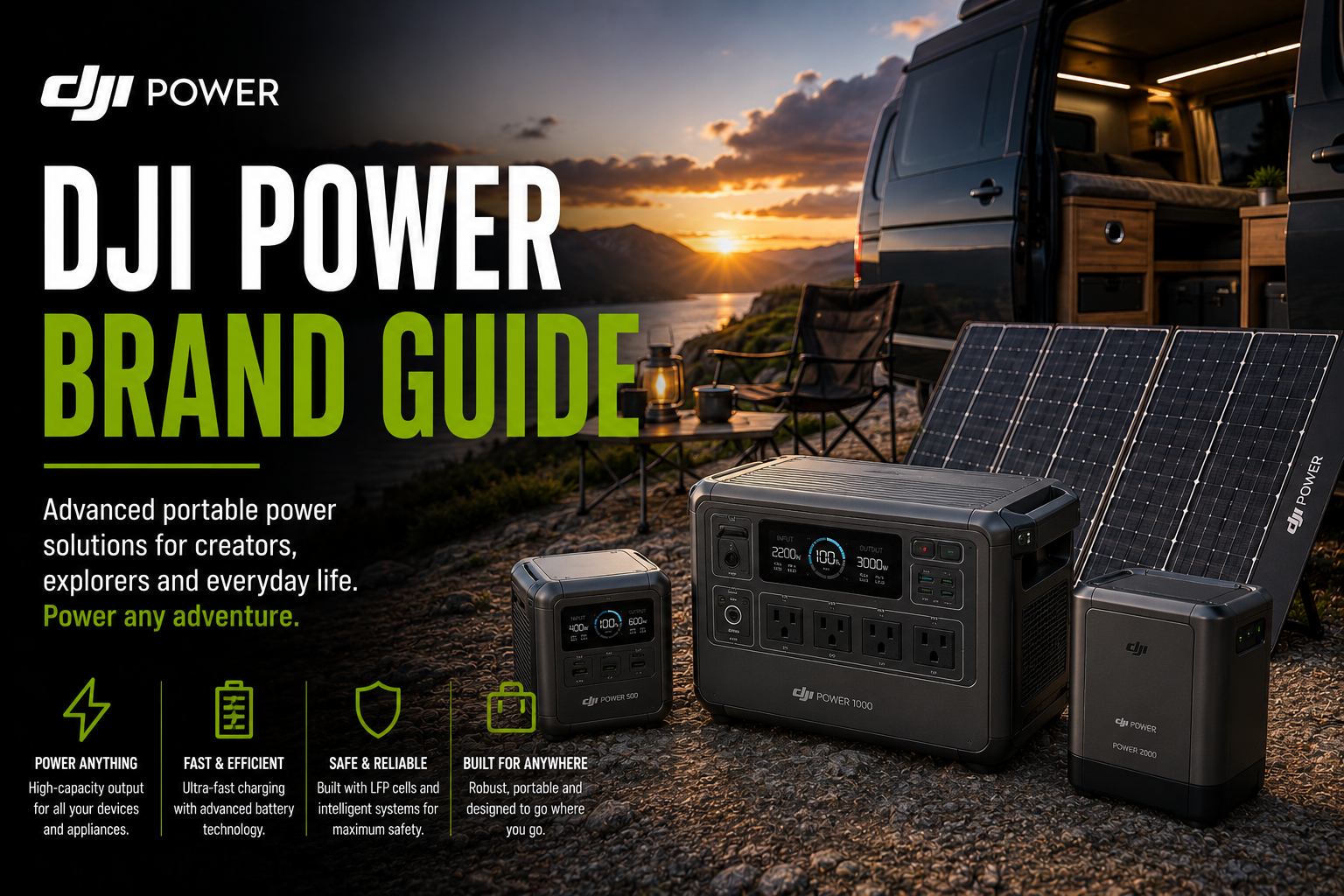
How We Compared These Models
This comparison uses published DJI specifications, not independent hands-on testing. Values refer to the original Power 1000 and Power 2000; do not confuse the Power 1000 with later 1000 V2 or 1000 Mini models. Confirm your regional SKU and firmware before purchase.
Quick Answer
Choose the Power 1000 when you want lower weight and enough energy for brief portable use. Choose the Power 2000 when you need about twice the stored energy and higher rated AC output. Runtime still depends on conversion losses and actual device consumption.
DJI Power 1000 vs Power 2000: Quick Picks
DJI Power 1000
The original Power 1000 balances a 1,024Wh LFP battery with 2,200W AC output. Its smaller capacity makes it more manageable for portable work, short outages and charging elect
DJI Power 2000
The Power 2000 doubles nominal stored energy to 2,048Wh and increases rated AC output to 3,000W. It is the more capable pick when runtime or heavier simultaneous AC loads matt
Specifications Compared
| Specification | DJI Power 1000 | DJI Power 2000 |
|---|---|---|
| Nominal capacity | 1,024Wh | 2,048Wh |
| Rated AC output | 2,200W | 3,000W |
| Approximate weight | 13 kg | 22 kg |
| Battery chemistry | LFP | LFP |
| Best use | Portable short-duration power | Longer backup and heavier loads |
Detailed Model Reviews
DJI Power 1000
Manufacturer-published specifications; not hands-on tested.
The original Power 1000 balances a 1,024Wh LFP battery with 2,200W AC output. Its smaller capacity makes it more manageable for portable work, short outages and charging electronics than a two-kilowatt-hour station.
DJI lists an approximately 70-minute 0-100% recharge in its fast charging mode under specified conditions. Check charging mode, temperature, input limits and exact regional model before relying on advertised recharge figures.
Advantages
- Lower weight and footprint than Power 2000.
- 2,200W rated AC output covers many portable appliance loads.
- LFP chemistry and DJI ecosystem compatibility.
Limitations
- Half the nominal energy capacity of Power 2000.
- High-draw appliances drain a 1,024Wh pack quickly.
- Expansion and accessory support depend on exact version and firmware.
Best for: camping, portable creative work and shorter backup sessions. Not ideal for: extended high-draw home backup.
DJI Power 2000
Manufacturer-published specifications; not hands-on tested.
The Power 2000 doubles nominal stored energy to 2,048Wh and increases rated AC output to 3,000W. It is the more capable pick when runtime or heavier simultaneous AC loads matter more than lifting weight.
DJI advertises rapid recharging and expansion-battery support for the Power 2000, but achievable charge time depends on the selected input and conditions. Check the regional product manual for exact output-port and charging configurations.
Advantages
- Approximately twice the energy capacity of Power 1000.
- 3,000W rated AC output offers more appliance headroom.
- Designed for expanded backup scenarios.
Limitations
- Noticeably heavier than Power 1000.
- Higher capacity usually costs more.
- Not a substitute for hardwired whole-home backup or a transfer switch.
Best for: longer outages, power-hungry devices and basecamp use. Not ideal for: frequent one-person carrying.
What the Capacity Difference Means
For a constant 100W AC load, dividing nominal capacity by draw gives a theoretical 10.2 hours for Power 1000 and 20.5 hours for Power 2000. Real runtime is shorter because inverter losses, standby consumption, temperature and battery-management reserves consume energy. These are illustrative calculations, not guaranteed field results.
For a 1,500W appliance, the larger Power 2000 has greater energy headroom, but both units still need adequate instantaneous output and a compatible outlet. A device with high startup surge can exceed a station rating even when its steady-state draw is modest.
Charging, Expansion and Ownership Considerations
Compare the specific AC charging mode, available solar input, DJI accessory compatibility and warranty for your region. Never infer compatibility from the Power-series name alone: later Power 1000 variants may have different specifications. If you plan to expand capacity, confirm supported expansion batteries and cable requirements directly in the current DJI manual.
Safety and Practical Limitations
Use only rated cables and properly grounded outlets. Keep the power station dry, unobstructed and within its operating temperature range. Portable power stations are not a direct replacement for a code-compliant home transfer switch; consult a qualified electrician for home-circuit connections.
Final Verdict: Power 1000 or Power 2000?
The original DJI Power 1000 is the better portable option for lighter loads and shorter use. The Power 2000 is the stronger choice for longer backup time and higher continuous AC demand, provided you can accommodate its additional weight and cost. Buy for your measured wattage and required runtime, not peak marketing figures.
Frequently Asked Questions
Does DJI Power 2000 have twice the battery capacity of Power 1000?
Yes. The original Power 1000 is rated at 1,024Wh and Power 2000 at 2,048Wh. Usable AC energy is lower than nominal capacity because of conversion losses.
Which DJI power station is easier to carry?
The original Power 1000 is lighter, at approximately 13kg versus about 22kg for Power 2000. Check the exact model and regional specifications.
Can DJI Power 1000 run a refrigerator?
Potentially, if the refrigerator running watts and compressor-start surge are within the station output rating. Runtime varies by refrigerator cycling, ambient temperature and losses.
Can Power 2000 run appliances that Power 1000 cannot?
Some appliances require more than 2,200W but less than 3,000W continuous output, making Power 2000 a better match. Check startup surge and the individual outlet limits.
How long will a 100W device run on each model?
Theoretical nominal-energy calculations give about 10.2 hours on 1,024Wh and 20.5 hours on 2,048Wh. Actual AC runtime will be lower.
Is DJI Power 1000 V2 the same as Power 1000?
No. Power 1000 V2 is a distinct generation with different published specifications. This article compares the original Power 1000 with Power 2000.
Can either DJI station power home circuits during an outage?
They can supply compatible appliances directly. Connecting to fixed home wiring requires appropriate listed equipment and qualified electrical installation; never backfeed an outlet.
Related reading: budget portable power stations and UPS versus portable power station.
Sources and Editorial Methodology
Manufacturer specifications were used for the original DJI Power 1000 and DJI Power 2000. No hands-on performance testing or live price verification is claimed. Confirm current specifications on DJI official product pages.