
Best BLUETTI Portable Power Stations: 5 Models Worth Comparing
BLUETTI's Elite and AC-series power stations can look surprisingly similar on a specification sheet. The important differences are weight, solar charging, battery expansion, outlet configuration and how you actually plan to use the power.
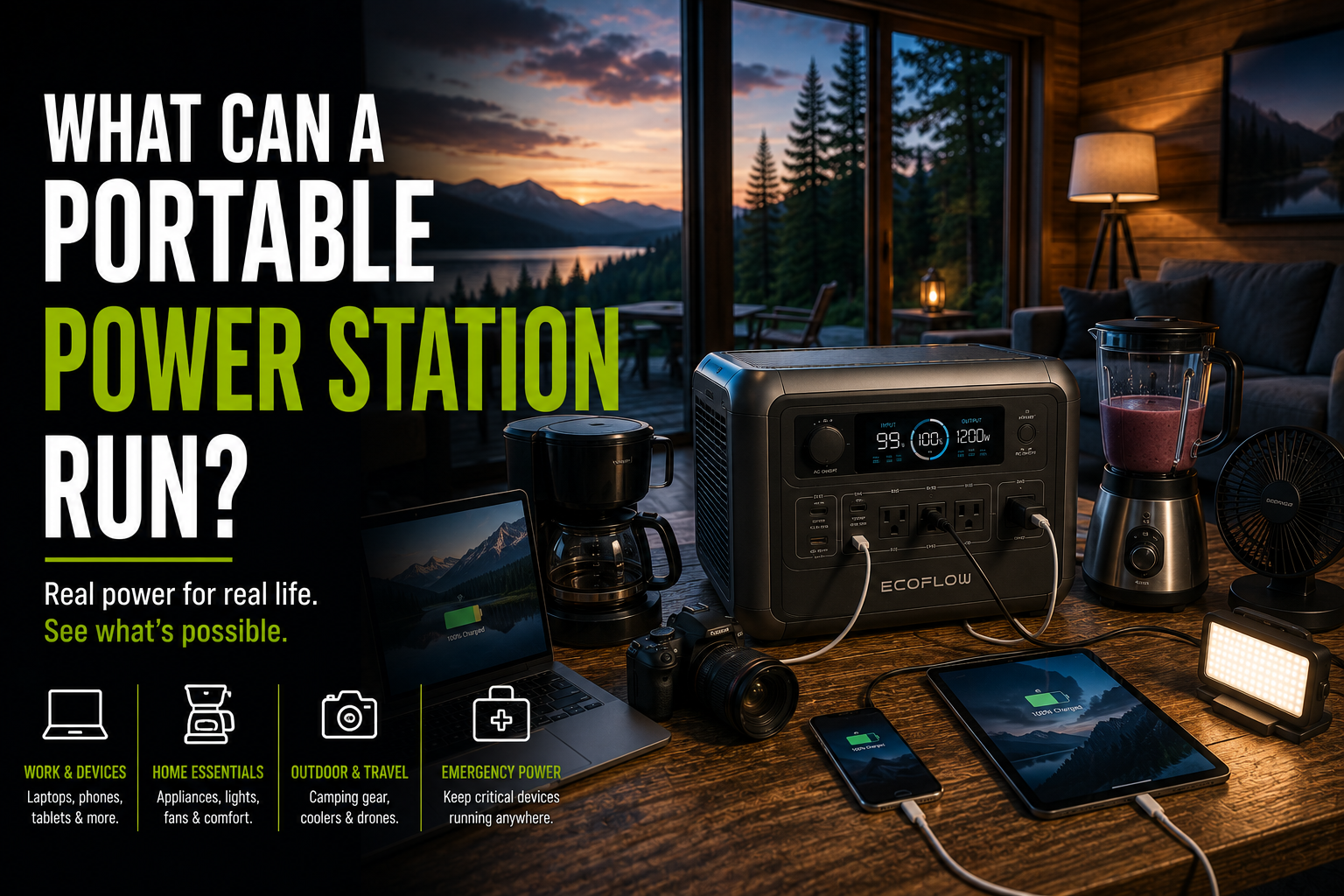
Our overall recommendation is the BLUETTI Elite 200 V2 for buyers who want around 2kWh of portable storage without committing to a modular system. The Elite 100 V2 is the more practical choice when portability matters most. If you intend to add substantial battery capacity, the AC200L or AC300 with compatible battery modules deserves closer attention.
These recommendations are based on manufacturer specifications and practical buying trade-offs, not claimed hands-on testing. They are also not a claim that these five products are the only BLUETTI models worth considering. The company's lineup continues to evolve, so compare newer alternatives and the complete system cost before purchasing.
Quick Answer: Which BLUETTI Should You Buy?
Best overall portable 2kWh option: Elite 200 V2. Its 2,073.6Wh battery, 2,600W rated AC output and approximately 53.4 lb weight make it an appealing all-in-one choice.
Best for easy carrying: Elite 100 V2. It provides 1,024Wh, 1,800W output and weighs approximately 25 lb.
Best older-generation value candidate: AC180. It offers 1,152Wh and 1,800W output, but its greater weight and lower solar-input ceiling mean it needs a meaningful price advantage over the Elite 100 V2.
Best expandable 2kWh station: AC200L. Choose it for its compatible expansion-battery system, 2,400W output and useful RV-oriented outlet configuration.
Best modular home-backup option among these five: AC300 + B300. It starts with 3,072Wh using one B300 battery and can expand further. It is not a simple grab-and-go power station.
BLUETTI Elite 200 V2
2,073.6Wh · 2,600W
The strongest all-in-one balance for serious portable backup, RV trips and higher-demand 120V appliances when external expansion is not essential.
Check PriceBLUETTI Elite 100 V2
1,024Wh · 1,800W
Our first choice for camping, home-office backup and people who regularly lift their station into a vehicle.
Check PriceBLUETTI AC180
1,152Wh · 1,800W
An older but capable station with more rated battery capacity than the Elite 100 V2. Worth considering when the total purchase price is favorable.
Check PriceBLUETTI AC200L
2,048Wh · 2,400W
A better fit than the Elite 200 V2 when compatible expansion batteries and a 120V TT-30 RV-style outlet are central to the setup.
Check PriceBLUETTI AC300 + B300
3,072Wh starting system · 3,000W
Designed for stationary or semi-stationary battery backup. Requires at least one compatible battery module and appropriate installation planning.
Check PriceBLUETTI Model Comparison: Specifications That Matter
The following specifications refer to the named U.S. model configurations. AC output is continuous rated output, not a temporary Power Lifting mode rating.
| Model | Battery Capacity | Rated AC Output | Max Solar Input | Weight | Main Advantage |
|---|---|---|---|---|---|
| Elite 100 V2 | 1,024Wh | 1,800W | 1,000W | Approx. 25 lb | Lightweight 1kWh-class design |
| Elite 200 V2 | 2,073.6Wh | 2,600W | 1,000W | Approx. 53.4 lb | Strong all-in-one 2kWh output |
| AC180 | 1,152Wh | 1,800W | 500W | Approx. 35.3 lb | Extra capacity if discounted |
| AC200L | 2,048Wh | 2,400W | 1,200W | Approx. 62.4 lb | Expansion and RV-style AC outlet |
| AC300 + B300 | 3,072Wh with one B300 | 3,000W | 2,400W | Multi-component system | Modular home backup |
All five configurations use LiFePO4 battery technology. But battery chemistry alone does not establish which model is best: weight, cycle-life definitions, charging inputs, system complexity and accessory compatibility matter just as much.
Detailed Reviews: Where Each BLUETTI Makes Sense
1. BLUETTI Elite 100 V2
The Elite 100 V2 is the model we would start with for someone who wants a capable portable station without the weight of a 2kWh unit. Its 1,024Wh battery is suitable for many electronics and modest backup loads, while its 1,800W inverter offers more flexibility than its compact dimensions might suggest.
The most meaningful upgrade over the AC180 is not raw AC output—both are rated at 1,800W. It is the combination of substantially lower weight, higher solar-input ceiling and newer connectivity features.
BLUETTI specifies Wi-Fi and Bluetooth app connectivity, a manufacturer-rated transfer time of no more than 10 milliseconds for its UPS function, and more than 4,000 battery cycles to 80% original capacity.
Those claims are useful specifications, but they do not guarantee uninterrupted operation of every connected device. Sensitive electronics should be checked against their own power-continuity requirements.
- About 25 lb—much easier to move than larger stations.
- 1,800W continuous AC output.
- 1,000W published maximum solar input.
- Wi-Fi and Bluetooth connectivity.
- Less stored energy than the AC180.
- Not a conventional high-capacity expandable AC-series system.
- 120V output is not a solution for standard 240V appliances.
- Solar-input maximum requires compatible panel wiring.
Who should buy it: Campers, mobile workers, home-office users and households seeking portable backup for carefully selected essentials.
Who should skip it: Buyers who already know they need multiple kilowatt-hours of battery storage or extensive external battery expansion.
Check Price2. BLUETTI Elite 200 V2
The Elite 200 V2 is our preferred all-in-one choice in this group because it balances a useful 2,073.6Wh battery with 2,600W continuous AC output and a more manageable footprint than many modular systems.
Its rated output is 200W higher than the AC200L's 2,400W. That may be valuable for appliances with substantial running loads, although startup surge and individual receptacle limits still need to be checked.
BLUETTI's U.S. manual specifies 1,800W maximum AC input, 1,000W maximum DC/solar input, and a combined AC-plus-DC charging ceiling of 2,400W. These are distinct charging modes, not interchangeable input ratings.
The Elite 200 V2 also has a manufacturer-published UPS switchover rating of no more than 15 milliseconds. This is a transfer specification, not proof of universal compatibility with servers, medical devices or every sensitive electronic load.
- Strong 2,600W continuous inverter.
- More than 2kWh of rated storage.
- Approximately 9 lb lighter than the AC200L.
- Substantial AC and solar charging capability.
- Still heavy at approximately 53.4 lb.
- Not the right choice for extensive AC-series battery expansion.
- 120V output does not directly serve standard 240V loads.
- Accessory and panel costs can change total value.
Who should buy it: RV travelers, homeowners seeking substantial portable backup and users who want one capable 2kWh-class station.
Who should skip it: Buyers whose main objective is to build a much larger modular battery bank over time.
Check Price3. BLUETTI AC180
The AC180 remains relevant because it offers 1,152Wh of rated storage and 1,800W continuous AC output. It can make sense when an older-generation model is available at a substantially lower complete purchase price.
Compared with the Elite 100 V2, the AC180 provides 128Wh more rated battery capacity. But it weighs about 10 lb more and has half the published maximum solar-input wattage.
That makes this a value decision rather than an automatic performance upgrade. If the prices are close, the Elite 100 V2 is usually more compelling for people who move their station frequently or depend on higher solar-input capability.
The AC180 has a manufacturer-rated 1,440W maximum AC charging input and supports Bluetooth app control. BLUETTI also specifies a 20-millisecond UPS transfer time for this model.
- More base capacity than Elite 100 V2.
- Same 1,800W continuous AC rating.
- Fast AC charging.
- Potentially attractive when heavily discounted.
- Noticeably heavier than Elite 100 V2.
- 500W maximum solar input.
- Older connectivity and design.
- Not intended as a large modular expansion platform.
Who should buy it: Buyers who need a reliable 1kWh-class station and find a meaningful price advantage over newer models.
Who should skip it: People prioritizing weight, compactness or the fastest possible compatible solar charging.
Check Price4. BLUETTI AC200L
The AC200L is the most interesting choice in this group for buyers who want a 2kWh base station now and significantly more storage later. It combines a 2,048Wh battery with a 2,400W inverter and compatibility with specified BLUETTI expansion batteries.
The most important distinction from the Elite 200 V2 is the expansion architecture. BLUETTI documents configurations with compatible B230, B210 and B300 battery modules, subject to the exact cables and supported combinations.
For example, the manufacturer describes expansion to 4,096Wh using one B230, or to 8,192Wh using two B300 batteries. The B210 configuration has a different total capacity. These batteries are not interchangeable simply because they carry the BLUETTI name.
The AC200L also includes a 120V/30A NEMA TT-30 RV-style outlet in the U.S. configuration. That outlet can be useful in compatible RV setups, but the station's total rated AC output remains 2,400W. A 30A receptacle does not mean the station can continuously supply 3,600W.
- Substantial compatible battery expansion.
- 2,400W rated continuous AC output.
- 1,200W maximum solar input.
- RV-oriented 120V TT-30 receptacle.
- Heavier than Elite 200 V2.
- Lower rated AC output than Elite 200 V2.
- Expansion modules add cost, weight and storage needs.
- Battery and cable compatibility require careful checking.
Who should buy it: RV owners and home-backup buyers who intend to expand capacity and have confirmed the correct accessories.
Who should skip it: People who want a lighter, self-contained 2kWh station and have no plans to add batteries.
Check Price5. BLUETTI AC300 + B300
The AC300 is different from the other four choices. It is a modular inverter and control platform that requires compatible external battery storage to operate as a complete power system.
Its appeal is the ability to build a larger battery reserve for extended outages or an off-grid installation. BLUETTI publishes support for up to four B300 batteries per AC300, creating a maximum rated storage capacity of 12,288Wh.
The AC300's 3,000W continuous AC output is a separate specification from its expandable energy capacity. Adding batteries extends potential runtime; it does not automatically increase the inverter's output rating.
BLUETTI also documents 240V split-phase configurations using paired compatible equipment and the appropriate accessories. A single AC300 system should not be treated as a general-purpose 240V power source.
Because the system uses multiple components and may involve home electrical integration, it requires more planning than a portable station that plugs directly into individual appliances.
- Expandable to 12,288Wh with four B300 modules.
- 3,000W rated inverter output.
- 2,400W maximum solar-input capability.
- Designed for larger modular backup configurations.
- Requires external battery storage.
- Bulky multi-component setup.
- Home integration and 240V configurations require specialized equipment.
- Older battery modules may have changing availability.
Who should buy it: Buyers deliberately planning a larger modular backup system and able to confirm compatible batteries and installation requirements.
Who should skip it: Campers, frequent travelers and anyone who simply needs an easy-to-carry backup battery.
How Much BLUETTI Battery Capacity Do You Actually Need?
The most common buying mistake is choosing a power station by inverter wattage alone. A 2,600W inverter tells you how much power the station can deliver at one time; it does not tell you how many hours the battery will last.
Estimated Runtime at a Constant 100W Load
| Model | Rated Battery | Estimated Runtime at 100W | Interpretation |
|---|---|---|---|
| Elite 100 V2 | 1,024Wh | About 8.7 hours | Good starting point for modest overnight loads |
| Elite 200 V2 | 2,073.6Wh | About 17.6 hours | Roughly twice the storage of Elite 100 V2 |
| AC180 | 1,152Wh | About 9.8 hours | Slightly more stored energy than Elite 100 V2 |
| AC200L | 2,048Wh | About 17.4 hours | Similar base energy to Elite 200 V2 |
| AC300 + 1 × B300 | 3,072Wh | About 26.1 hours | Greater reserve, with a larger multi-part system |
Actual runtime can differ considerably. Inverter overhead is proportionally more important with small loads, and refrigerators cycle rather than drawing a constant wattage. Battery temperature, age and operating mode also matter.
Example: A 10-Hour Internet and Lighting Backup
Suppose your modem, router, lights and other essential equipment average 70W for 10 hours.
Under those assumptions, either the Elite 100 V2 or AC180 could provide sufficient rated energy. The Elite 200 V2 would add a larger reserve, but that extra capacity may be unnecessary if you can recharge regularly.
Example: A Refrigerator During an Outage
For a refrigerator, start with its actual energy consumption or measured average watts over a representative period. Then check its compressor startup requirements against the station's inverter and surge specifications.
Do not size the system using the refrigerator's running watts alone. Also avoid assuming that a manufacturer-advertised Power Lifting mode is equivalent to unrestricted continuous inverter power.
Solar Charging: Why the Input Limit Matters
BLUETTI's published solar-input limits vary considerably across these models. This matters if you want to recharge while camping or use solar panels to support longer outages.
| Model | Maximum Solar Input | Buying Implication |
|---|---|---|
| Elite 100 V2 | 1,000W | High solar-input ceiling for a 1kWh-class battery |
| Elite 200 V2 | 1,000W | Useful for larger portable panel arrays |
| AC180 | 500W | More limited maximum solar intake |
| AC200L | 1,200W | Good potential for a larger off-grid charging setup |
| AC300 | 2,400W | Designed for substantial solar input with compatible battery storage |
The Elite 100 V2's 1,000W rating is particularly notable because it is twice the AC180's published maximum. However, that does not mean a 1,000W panel array will always deliver 1,000W in real conditions.
Panel orientation, clouds, temperature, wiring losses, charging state and the station's internal controls all affect the energy actually received.
Is Fast AC Charging More Important Than Solar?
For emergency backup, fast AC charging may be more useful if you typically recharge from the grid between outages. For multi-day camping or off-grid use, solar compatibility becomes more important.
The best approach is to estimate how much energy you consume each day and whether your expected solar production can replenish it. A high maximum solar-input rating alone does not guarantee energy independence.
Elite vs AC Series: The Expansion Decision
One of the most important differences in this comparison is the system architecture.
Elite 100 V2 & Elite 200 V2
These models are most compelling when their built-in batteries already meet your needs. Their value lies in compact integration, portability and useful inverter capability.
Do not assume that a newer accessory bundle creates the same expansion functionality as an AC-series direct battery connection. Verify the exact architecture before buying.
AC200L & AC300
These systems are better suited to buyers who want to add compatible battery modules and increase total stored energy.
The AC200L begins as a complete power station. The AC300 requires an external battery module from the outset. That difference affects portability, cost and installation.
Do Expansion Batteries Increase AC Output?
Not necessarily. Expansion batteries primarily increase stored energy and potential runtime. The continuous AC output remains governed by the inverter and the manufacturer's supported configuration.
A 2,400W AC200L does not become a 4,800W inverter simply because you double its battery capacity. Likewise, a single AC300's 3,000W inverter rating should not be confused with its maximum 12,288Wh energy storage.
Compare the Complete System Before Buying
Calculate the total cost of the base station, battery modules, required connection cables, solar panels and any home-integration equipment.
A smaller station with expansion batteries can be a good long-term system, but it is not automatically cheaper or more convenient than purchasing a larger self-contained station from the start.
Which BLUETTI Fits Your Situation?
Camping & Road Trips
Start with Elite 100 V2. Its lower weight and 1kWh-class capacity make it practical for portable electronics and moderate loads.
RV & Larger Portable Loads
Start with Elite 200 V2. Consider AC200L instead if compatible expansion batteries or its TT-30 outlet are important.
Extended Home Backup
Start with AC200L or a modular system. AC300 + B300 makes more sense when you are deliberately building a larger battery reserve.
For an Apartment
The Elite 100 V2 or Elite 200 V2 may be easier to store and move than a modular system. Choose based on essential loads, available floor space and how much weight you can safely handle.
For a Home Office
Start by calculating the combined energy needs of your computer, displays and networking equipment. If uninterrupted operation is critical, a dedicated UPS may still be appropriate even when a portable station advertises a fast transfer mode.
For an RV
Check the RV's actual electrical loads and connector requirements. The AC200L's 120V TT-30 outlet is useful in some setups, but its 2,400W total AC output remains the limiting rating. It cannot be assumed to power every RV appliance simultaneously.
For Whole-Home Backup
Do not select a station solely by its total battery watt-hours. Whole-home applications require evaluation of simultaneous loads, 120V/240V requirements, starting surges, transfer equipment and applicable electrical codes.
What to Check Before Ordering
- Exact model generation: Elite 100 V2, Elite 200 V2, AC180 and AC200L are distinct products with different capabilities.
- Continuous AC output: Confirm the total wattage and individual outlet limits. Do not use Power Lifting mode as the normal continuous rating.
- Battery capacity: Compare Wh, not simply the number in the product name.
- Weight and dimensions: Make sure you can carry, store and ventilate the station where you plan to use it.
- Solar compatibility: Check maximum open-circuit voltage, current, connector and required adapters.
- Expansion compatibility: Confirm exact battery module models, connection cables and supported configurations.
- Warranty and availability: Verify current terms, seller eligibility and access to replacement accessories.
Frequently Asked Questions
Which BLUETTI power station is best overall?
Among the five models evaluated here, we recommend the Elite 200 V2 for buyers seeking a powerful all-in-one 2kWh-class station. Its 2,073.6Wh capacity and 2,600W continuous AC output provide a strong combination without requiring external battery modules.
Is the Elite 100 V2 better than the AC180?
For portability and solar-input capability, generally yes. The Elite 100 V2 weighs about 25 lb and supports up to 1,000W solar input. The AC180 provides more battery capacity—1,152Wh versus 1,024Wh—but weighs approximately 35.3 lb and supports up to 500W solar input. A substantial price difference can change the value decision.
What is the difference between Elite 200 V2 and AC200L?
The Elite 200 V2 has slightly more base capacity, higher rated AC output and lower weight. The AC200L is heavier but supports compatible external battery expansion and includes an RV-oriented 120V TT-30 outlet. Choose based on whether you prioritize an all-in-one station or a larger expandable system.
Can the BLUETTI AC300 work without a battery?
No. The AC300 is a modular inverter/control unit and requires a compatible external battery module. An AC300 with one B300 provides 3,072Wh of rated storage.
Can BLUETTI power stations run a refrigerator?
Some models can run compatible refrigerators, but you must check the appliance's actual running power, startup surge and energy use. Battery runtime depends on the refrigerator's duty cycle and the station's usable AC energy. No specific refrigerator is guaranteed to work based only on an advertised inverter wattage.
Are BLUETTI portable power stations safe to use indoors?
Battery-powered stations do not produce gasoline-engine exhaust while operating on their batteries. However, they still require dry conditions, suitable ventilation, unobstructed cooling vents and compliance with the manufacturer's safety instructions. They are not automatically waterproof or appropriate for every indoor location.
Can a BLUETTI power station replace a UPS?
Not universally. Some models advertise UPS or EPS transfer behavior, but transfer times and compatibility vary. For equipment that cannot tolerate interruptions, check the exact transfer specification and the connected equipment's requirements. A dedicated UPS may be preferable for critical electronics.
Do all BLUETTI expansion batteries work with all stations?
No. Expansion support is model-specific. The AC200L and AC300 have different supported configurations and cable requirements. Verify the exact module and current manufacturer compatibility instructions before buying.
Sources and Editorial Methodology
This article evaluates manufacturer-published specifications and practical buying trade-offs. We prioritized rated battery capacity, continuous inverter output, weight, charging capability, compatible expansion options and the electrical requirements of common use cases.
We did not perform or claim firsthand laboratory testing. Runtime examples are calculated estimates using explicitly stated assumptions. Manufacturer charging, UPS and battery-cycle claims are not presented as independently verified performance results.
Manufacturer Documentation
- BLUETTI Elite 100 V2 — Official Specifications
- BLUETTI Elite 200 V2 — Official Specifications
- BLUETTI AC180 — Official Specifications
- BLUETTI AC200L — Official Specifications and Expansion
- BLUETTI AC300 + B300 — Official Modular System Specifications
- BLUETTI Elite 200 V2 — U.S. User Manual
Specification interpretation: Solar-input limits are maximum permitted charging specifications, not guaranteed real-world solar harvest. Continuous AC output is different from temporary surge or Power Lifting operation. Battery-cycle claims use manufacturer-defined test conditions.
Availability: Some older models and expansion batteries may be intermittently available or replaced by newer generations. Confirm the current product, compatible accessories, warranty terms and seller before purchasing.
Final Recommendation: Buy for Your Actual Power Needs
Choose the Elite 100 V2 when portability matters most and approximately 1kWh of storage is sufficient.
Choose the Elite 200 V2 for the best all-in-one balance among these five models: more than 2kWh of battery capacity, 2,600W continuous AC output and manageable portability for its size.
Choose the AC180 when its price offers a meaningful advantage and you do not mind the extra weight. Choose the AC200L when you need compatible expansion batteries or its RV-oriented outlet. Choose AC300 + B300 only when you are deliberately building a modular backup system.
Before ordering, confirm the wattage and runtime your appliances actually require, then compare the full system price—including batteries, panels, cables and installation needs.
Compare Current Options