
Best ALLPOWERS Portable Power Stations: Which Model Should You Buy?
ALLPOWERS offers everything from compact camping batteries to large solar-capable backup systems. The right choice depends on how much energy you need, what appliances you plan to run and whether portability or expansion matters more.
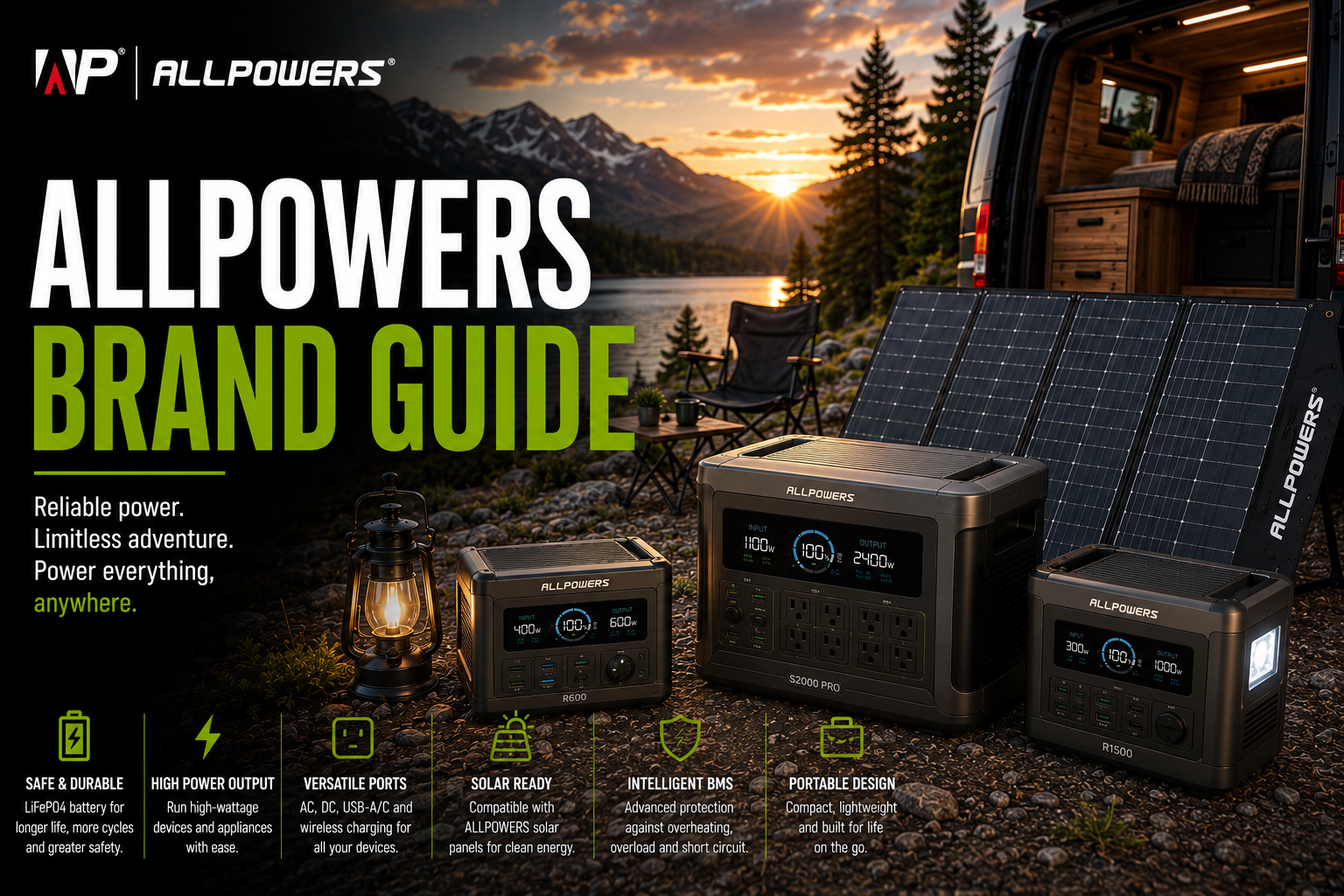
Our recommendation: Start with the ALLPOWERS R1500 if you need a versatile mid-size power station, the R600 if you prioritize portability, or the R2500 if you need substantially more stored energy and output. The larger R3500 and R4000 platforms deserve consideration only when your backup requirements justify their size.
The Best ALLPOWERS Model Depends on Your Power Needs
The R1500 is a sensible starting point for shoppers seeking a balance between usable battery capacity and manageable size. Its 1,500W-class inverter is more versatile than a compact electronics station.
The R600 is the better direction for lighter camping and electronics use. It avoids paying for capacity and output that may sit unused.
The R2500 is a stronger candidate for longer outages or larger simultaneous loads, provided its additional weight and cost are justified.
Do not buy by model number alone. The R-series and older S-series use different battery technologies and have different charging, expansion and output characteristics.
ALLPOWERS R600
A practical entry point for small electronics, campsite lighting and short-duration AC loads.
Choose it for: lower carrying burden and modest energy needs.
ALLPOWERS R1500
A useful middle ground for camping, portable appliances and selected emergency backup loads.
Choose it for: stronger inverter capability without moving to the largest units.
ALLPOWERS R2500
A larger-capacity alternative for users whose calculated runtime needs exceed the mid-size class.
Choose it for: longer backup duration and higher-power applications.
ALLPOWERS Portable Power Stations Compared
The table below separates the most important product families by intended use. Power figures for the R-series correspond to the manufacturer's published output classes. Exact regional specifications and package contents should be confirmed before ordering.
| Model | Battery Chemistry | AC Output Class | Best Use | Main Trade-Off |
|---|---|---|---|---|
| R600 | LiFePO4 | 600W | Light camping and electronics | Limited runtime and appliance headroom |
| R1500 | LiFePO4 | 1,500W | General-purpose portable power | Less stored energy than larger models |
| R2500 | LiFePO4 | 2,500W | Longer backup and larger AC loads | More weight and higher total cost |
| R3500 | LiFePO4 | 3,500W | High-demand backup setups | Substantial size and storage requirements |
| R4000 | LiFePO4 | 4,000W | Large backup configurations | Complexity, weight and installation planning |
| S2000 Pro | NCM lithium-ion | 2,400W | Buyers comparing older high-output models | Different battery chemistry and generation |
Detailed ALLPOWERS Model Reviews
These recommendations are based on the roles each model is designed to fill, rather than a claim that every model has been independently tested.
ALLPOWERS R600
The more sensible purchase when you want portable electricity without carrying a large backup battery.
The R600 is the ALLPOWERS model we would consider first for short camping trips, small devices and portable lighting. Its 600W-class output is useful for many low-demand AC applications without requiring a much larger inverter.
The limitation is not just maximum wattage. Compact stations also store less energy, so even a modest continuous load can exhaust the battery sooner than buyers expect.
- More manageable for travel
- LFP battery chemistry
- Appropriate for small electronics
- Avoids oversizing basic needs
- 600W continuous output class
- Limited energy for long outages
- Not a whole-home backup solution
- Motor startup loads need checking
Who should buy: Campers, travelers and households needing occasional electronics backup.
Who should avoid: Anyone planning to run a high-power cooking appliance, heater or multiple substantial AC loads.
Check PriceALLPOWERS R1500
A middle-ground choice for buyers who need more AC capability than a compact station provides.
The R1500 is our starting recommendation for shoppers who need a genuinely versatile portable power station. The 1,500W-class inverter opens up more appliance possibilities than the R600, while remaining below the size of the largest home-backup models.
This makes it relevant for RV accessories, camping equipment, communications gear and selected household backup loads.
It is not automatically the right choice for long outages. A larger inverter does not compensate for insufficient battery capacity.
- More versatile AC output
- LFP battery technology
- Good middle-ground category
- Suitable for varied portable uses
- Heavier than compact stations
- Runtime still depends on battery Wh
- Not suitable for every high-surge load
- Expansion must be verified by version
Who should buy: Buyers seeking a flexible station for occasional outages, camping or general off-grid use.
Who should avoid: Users who need extended backup for multiple high-consumption appliances without recharging.
Check PriceALLPOWERS R2500
A step toward larger appliance loads and longer-duration emergency power.
The R2500 makes more sense when your equipment requirements exceed the R1500's output class or when you need the additional energy storage associated with a larger model.
The most important buying question is whether the higher capacity translates into enough additional hours for your specific loads. That requires calculating average consumption, not simply comparing peak watt ratings.
- Higher AC output class
- Better suited to larger backup loads
- LFP battery chemistry
- More room for simultaneous devices
- Less convenient to transport
- Greater purchase commitment
- High loads drain batteries quickly
- Compatibility must be checked
Who should buy: Households and RV owners with a documented need for higher inverter output and more stored energy.
Who should avoid: Buyers who primarily charge phones, tablets and laptops.
Check PriceALLPOWERS R3500
A higher-output LFP platform for more demanding power requirements.
The R3500 belongs on the shortlist when a smaller station cannot satisfy your running-load requirements.
Its 3,500W output class may offer more appliance flexibility, but buyers should verify voltage, startup capability, battery capacity and compatible accessories.
Best for: Larger planned backup loads where portability is secondary.
Avoid if: You need something that one person can carry easily.
Check PriceALLPOWERS R4000
A high-output option for users building a more substantial power setup.
The R4000 is a more specialized purchase. Its 4,000W-class output is relevant only when the electrical requirements justify it.
Consider battery capacity, charging, weight, storage and any compatible expansion components before comparing prices.
Best for: Planned backup systems with significant energy needs.
Avoid if: You only need portable 120V electronics power.
Check PriceWhat About the Older ALLPOWERS S-Series?
The older S-series deserves attention because it can appear in product searches alongside the newer R-series.
ALLPOWERS' own product catalog identifies models such as the S2000 Pro as using NCM lithium-ion chemistry, while its R-series models are identified as LFP.
R-Series
Generally more appealing when frequent cycling and battery longevity are major priorities, assuming comparable specifications and a reasonable purchase price.
S2000 Pro
Still worth comparing when high inverter output matters and the specific unit, warranty and pricing make sense.
Do not confuse its NCM battery chemistry with the LFP batteries in the R-series.
Check PriceHow Much ALLPOWERS Battery Capacity Do You Need?
The biggest buying mistake is choosing a station by its maximum AC wattage while overlooking the amount of energy stored in the battery.
The 85% factor is a simplified planning assumption for usable AC energy, not an independently measured efficiency figure for ALLPOWERS equipment.
Example: A 1,000Wh Battery
| Average AC Load | Estimated Runtime | Typical Context |
|---|---|---|
| 25W | 34 hours | Low-power electronics |
| 50W | 17 hours | Small continuous load |
| 100W | 8.5 hours | Moderate electronics load |
| 200W | 4.25 hours | Multiple small devices |
| 500W | 1.7 hours | Higher continuous demand |
| 1,000W | 0.85 hours | High-power continuous load |
This is an illustrative 1,000Wh battery, not a claim that any particular ALLPOWERS model has exactly 1,000Wh capacity. Actual runtime varies with inverter overhead, temperature, battery condition, load fluctuations and shutdown limits.
Three Questions That Determine the Right Size
1. Running Watts
Add the power draw of devices you will use simultaneously. The total must stay within the station's continuous output rating.
2. Startup Watts
Compressors and motors may draw substantially more power at startup. Check actual surge requirements and the station's limits.
3. Daily Watt-Hours
Multiply each device's average watts by its daily operating hours. Add the results to estimate daily energy consumption.
Which ALLPOWERS Stations Are Best for Solar Charging?
Solar capability can be more important than inverter output when you are away from the grid for multiple days. But maximum advertised solar input is only one part of the decision.
For Weekend Camping
A smaller R-series station paired with appropriately sized portable panels can be easier to transport and position.
The best setup is the one you can actually deploy in direct sunlight, not necessarily the one with the largest theoretical input.
For Extended Off-Grid Use
Larger stations become more attractive when they support sufficient solar input to replace meaningful daily consumption.
Compare your daily watt-hour demand against realistic solar production and expected weather conditions.
Estimate Solar Energy Production
For example, a 400W solar array receiving four equivalent peak-sun hours could produce approximately:
This is a planning estimate. Actual output depends on shading, temperature, panel orientation, weather, charge-controller behavior and battery acceptance. A station's solar input ceiling can also limit production from a larger array.
How to Choose the Best ALLPOWERS Station for Your Situation
| Your Situation | Start With | Reason |
|---|---|---|
| Phones, laptops and lighting | R600 | Compact size and sufficient output for many small loads |
| General camping and RV accessories | R1500 | More versatile AC output |
| Longer outages and higher-power devices | R2500 | Greater output class and larger-system potential |
| High-demand backup | R3500 | Higher inverter output for a defined load plan |
| Large planned backup configuration | R4000 | Specialized high-output platform |
| Comparing older discounted models | S2000 Pro | Compare generation, battery chemistry and warranty carefully |
Check These Details Before Ordering
Battery Capacity
Compare rated watt-hours and expected usable energy. Don't infer capacity from the model name.
Continuous AC Output
Make sure the inverter supports all simultaneously connected devices and their startup requirements.
Charging Performance
Compare wall charging, solar input and any limitations when using multiple charging sources.
Battery Expansion
Confirm that the exact model supports the specific expansion battery you intend to buy. Do not assume R-series batteries are interchangeable.
Warranty and Support
Verify the written warranty, seller eligibility, service location and replacement-part availability.
Weight and Storage
Large backup stations may be impractical for frequent carrying, even when marketed as portable.
Are ALLPOWERS Power Stations Good for Home Backup?
They can be useful for selected backup loads, particularly electronics, lighting and compatible appliances. But there is a major difference between powering devices directly from a station and connecting a system to household electrical circuits.
Direct Appliance Backup
Plug compatible equipment directly into the station, staying within the outlet, inverter and battery limits.
This is often the simplest approach for temporary backup.
Household Circuit Backup
Requires compatible equipment, correct voltage and appropriately installed transfer or interlock hardware.
Installation should be performed by a qualified electrician in accordance with applicable codes.
For critical computers, networking equipment and medical devices, check transfer behavior and device compatibility. A manufacturer describing a station as having UPS or EPS functionality does not guarantee uninterrupted operation for every load.
ALLPOWERS vs Other Portable Power Station Brands
ALLPOWERS can be worth considering when the model's specifications meet your needs at a competitive total cost. However, brand-level comparisons can be misleading because products differ considerably within each lineup.
| Buying Priority | What to Compare | Why It Matters |
|---|---|---|
| Best value | Complete system price per usable Wh | Captures expansion and accessory costs |
| Long-term use | Battery chemistry, cycle claims and warranty | Helps assess ownership expectations |
| Fast charging | Actual AC input rating and charging conditions | Determines how quickly energy can be restored |
| Solar camping | PV voltage range, current limits and input wattage | Determines panel compatibility |
| Home backup | Output voltage, continuous power and transfer equipment | Determines electrical suitability |
| Portability | Weight, dimensions and handling | Determines practical usability |
Frequently Asked Questions
Which ALLPOWERS power station is best overall?
The R1500 is a useful starting point for buyers seeking a versatile mid-size station. However, the R600 is more appropriate for lightweight needs, while the R2500 and larger models make sense for higher-demand backup.
Is the ALLPOWERS R600 enough for camping?
It can be suitable for small electronics, lighting and modest AC loads. Check your total watt-hours per day and the continuous power requirements of any appliance you plan to use.
Should I buy the R1500 or R2500?
Choose based on required inverter output, battery capacity, portability and budget. The R2500 is more appropriate when your power requirements exceed the R1500's capabilities. The R1500 may be better value for moderate loads.
Do ALLPOWERS stations use LiFePO4 batteries?
Many R-series models use LFP batteries, but not every ALLPOWERS product does. The manufacturer's catalog identifies older S-series models such as the S2000 Pro as using NCM lithium-ion. Verify the exact model.
Can ALLPOWERS stations charge from solar panels?
Supported models can accept solar input, but panel compatibility depends on voltage, current, polarity and connectors. Check the exact station manual before connecting a solar array.
Can I use an ALLPOWERS station as a UPS?
Some models offer backup switching features. Transfer times and operating modes vary. Do not assume they can replace a dedicated UPS for sensitive equipment without verifying the exact device requirements.
Can an ALLPOWERS station power a refrigerator?
A suitably sized station may support a compatible refrigerator, but compressor startup demand and actual energy use must be checked. Refrigerator runtime varies with temperature, door openings and compressor duty cycle.
Are ALLPOWERS expansion batteries universal?
No. Expansion support and compatibility are model-specific. Check the manufacturer's exact approved battery and cable list.
Is a bigger ALLPOWERS station always better?
No. Larger systems cost more, weigh more and can be less convenient for travel. Buy enough battery capacity and output for your calculated needs, rather than choosing the highest watt rating.
Final Verdict: The Best ALLPOWERS Power Station to Buy
For general-purpose portable power, start with the ALLPOWERS R1500. Its 1,500W output class makes it a more versatile choice than a compact electronics station.
Choose the R600 when portability and smaller loads are the priority. Move to the R2500 when you genuinely need more stored energy or higher output.
The R3500 and R4000 belong in more specialized backup plans, where their additional capability justifies the weight, cost and electrical considerations.
Before purchasing, verify the exact model's capacity, continuous AC output, solar limits, warranty and accessory compatibility. Those details matter more than the model number alone.
Sources and Editorial Methodology
This guide uses manufacturer documentation and practical power-system sizing principles. Product recommendations are editorial judgments based on intended use, not claims of hands-on testing.
- ALLPOWERS Official Product Catalog — Model families, output classes and battery chemistry.
- ALLPOWERS R1500 Official Product Information — Manufacturer model identification.
- ALLPOWERS Official Download Center — User manuals and technical documentation.
- ALLPOWERS Application and Backup Power Information — Intended usage categories.
Related Power Gear Guide Articles
For a direct comparison of two popular ALLPOWERS models, see ALLPOWERS R1500 vs R2500 .
To compare other brands and capacities, visit Best Portable Power Stations .
Editorial transparency: Manufacturer specifications and model classifications are distinguished from buying recommendations and calculated estimates. No prices, stock levels, independent performance measurements or firsthand experiences have been fabricated. Confirm the exact regional model and current manufacturer documentation before purchasing.