
ALLPOWERS Portable Power Stations & Backup Power Guide
Compare ALLPOWERS R-series and S-series stations by battery chemistry, inverter output, solar compatibility and realistic backup use - not just the biggest number in the model name.
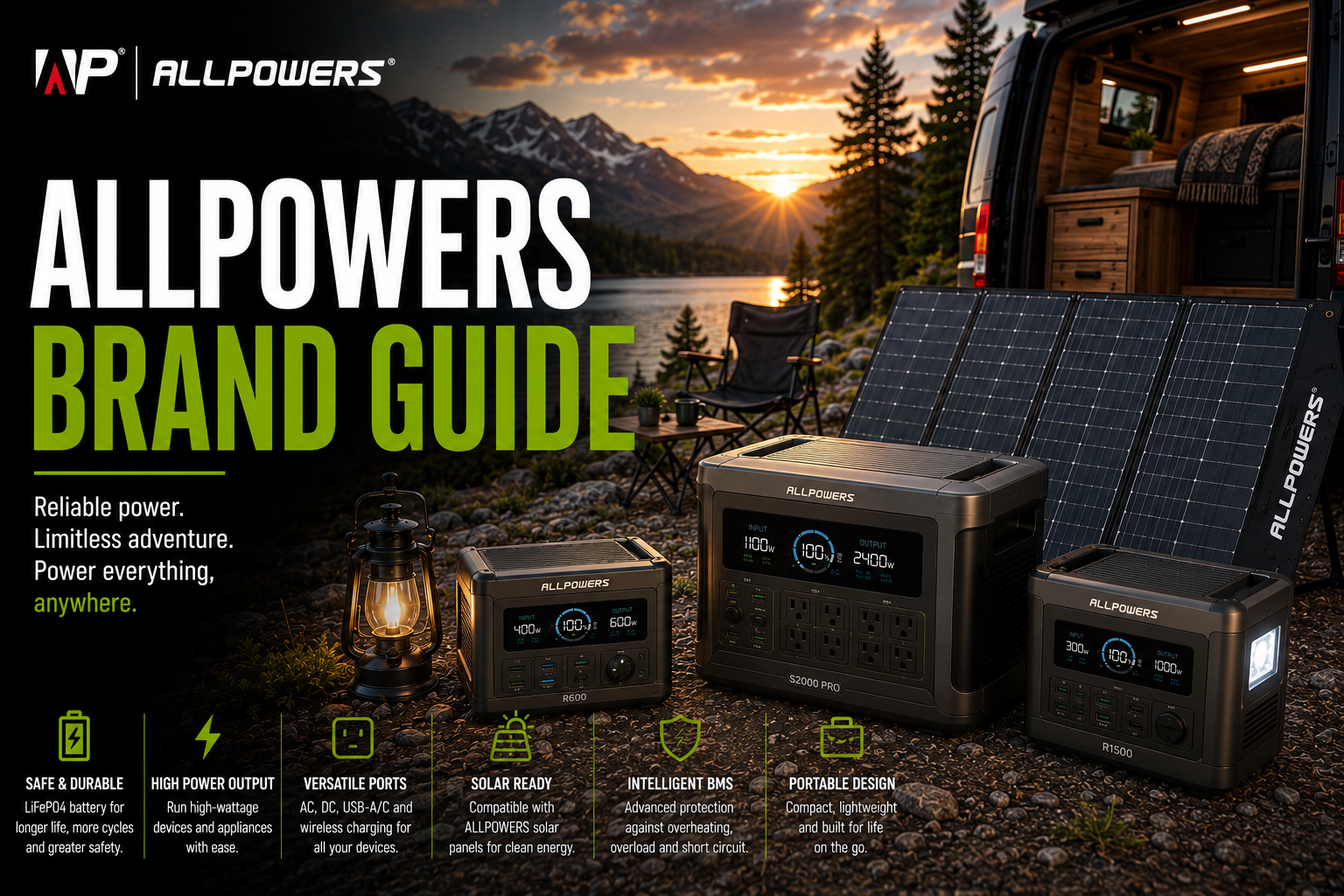
ALLPOWERS sells portable battery stations spanning compact camping units and larger backup equipment. Its own catalog distinguishes LFP-based R models from NMC-based S models. These are different battery platforms, not simply different sizes of one interchangeable system.
This is a documentation-based comparison, not a hands-on test. Product availability, regional variants, solar limits and expansion accessories should be checked against the exact listing and manual before purchase.
Choose the R Series First for Most New Purchases
R600: compact 600W-class LFP station for smaller loads.
R1500: 1,500W-class LFP option for moderate loads.
R2500: 2,500W-class LFP alternative when higher continuous output is necessary.
R3500: 3,500W-class LFP system for larger backup plans.
S2000 Pro: older 2,400W-class NMC alternative worth comparing only after checking battery condition, age and support.
Important: These watt figures describe output class, not battery capacity or runtime.
ALLPOWERS Quick Picks by Use Case
ALLPOWERS R600
Start here for charging electronics and modest AC loads, provided the device stays within the station's limits.
ALLPOWERS R1500
A mid-range choice when 600W is insufficient but the largest system would be unnecessary.
ALLPOWERS R2500
Consider for loads requiring more continuous AC output, with careful attention to usable energy.
ALLPOWERS R3500
For higher-demand essentials when bulk, cost and transport are less important than output.
ALLPOWERS Model Comparison
| Model | Battery chemistry | Manufacturer-listed output class | Primary consideration |
|---|---|---|---|
| R600 | LFP | 600W | Compact, modest loads |
| R1500 | LFP | 1,500W | Mid-range inverter headroom |
| R2500 | LFP | 2,500W | Higher-output applications |
| R3500 | LFP | 3,500W | Larger essential-load backup |
| S2000 Pro | NMC | 2,400W | Older chemistry and generation |
Individual ALLPOWERS Models Compared
ALLPOWERS R600
Short camping trips, laptop charging and modest backup loads
A portable entry point for buyers whose appliances stay within a 600W continuous output class. It is not a substitute for a larger station when powering heating equipment or multiple appliances.
- Distinct use case within the ALLPOWERS lineup.
- Documented LiFePO4 chemistry classification.
- Compare output class against your measured running watts.
- Verify exact watt-hour capacity and charging limits for your variant.
- Confirm warranty, stock status and compatible accessories.
- Less suitable for: large cooking appliances or high-surge tools.
Best for: Light-use buyers who value portability. Not ideal for: Large cooking appliances or high-surge tools.
Check PriceALLPOWERS R1500
Moderate appliance loads and longer camping stays
A useful step up in inverter output from the R600. Confirm the exact regional variant and battery capacity before buying: wattage in the model family does not tell you runtime.
- Distinct use case within the ALLPOWERS lineup.
- Documented LiFePO4 chemistry classification.
- Compare output class against your measured running watts.
- Verify exact watt-hour capacity and charging limits for your variant.
- Confirm warranty, stock status and compatible accessories.
- Less suitable for: whole-home or heavy-duty appliance backup.
Best for: Buyers balancing portability and household essentials. Not ideal for: Whole-home or heavy-duty appliance backup.
Check PriceALLPOWERS R2500
More demanding appliances and emergency backup
A higher-output LFP platform. The additional inverter headroom matters for some appliances, but large loads also drain stored energy quickly. Confirm physical weight and solar limits for the exact unit.
- Distinct use case within the ALLPOWERS lineup.
- Documented LiFePO4 chemistry classification.
- Compare output class against your measured running watts.
- Verify exact watt-hour capacity and charging limits for your variant.
- Confirm warranty, stock status and compatible accessories.
- Less suitable for: lightweight backpack or minimalist camping use.
Best for: Users who need higher AC output. Not ideal for: Lightweight backpack or minimalist camping use.
Check PriceALLPOWERS R3500
Higher-demand backup where portability is secondary
A large-station option for essential-load planning. It requires a realistic daily energy budget; high inverter output does not guarantee long refrigerator, heater or air-conditioner runtime.
- Distinct use case within the ALLPOWERS lineup.
- Documented LiFePO4 chemistry classification.
- Compare output class against your measured running watts.
- Verify exact watt-hour capacity and charging limits for your variant.
- Confirm warranty, stock status and compatible accessories.
- Less suitable for: frequent carrying or very small spaces.
Best for: Buyers prioritizing inverter output and stationary use. Not ideal for: Frequent carrying or very small spaces.
Check PriceALLPOWERS S2000 Pro
Comparing older high-output models against LFP alternatives
The manufacturer lists S2000 Pro under NMC chemistry, unlike its LFP R-series. Compare condition, age, cycle-life terms and support if considering older stock or a used unit.
- Distinct use case within the ALLPOWERS lineup.
- Documented NMC chemistry classification.
- Compare output class against your measured running watts.
- Verify exact watt-hour capacity and charging limits for your variant.
- Confirm warranty, stock status and compatible accessories.
- Less suitable for: those prioritizing maximum long-term cycling.
Best for: Price-sensitive buyers comparing documented older equipment. Not ideal for: Those prioritizing maximum long-term cycling.
Check PriceR-Series vs S-Series: The Battery Difference
R600, R1500, R2500, R3500
ALLPOWERS identifies these models as lithium iron phosphate (LFP). This chemistry generally favors long cycle life and thermal stability. Individual battery life claims still depend on the test endpoint and actual use.
S2000 Pro and Other S Models
ALLPOWERS identifies S2000 Pro, S2000, S1500 and smaller S models as NMC in its official catalog. NMC can offer higher energy density, but chemistry alone cannot establish the weight or reliability of a complete station.
Solar Charging: Match the Panel to the Station
ALLPOWERS sells separate portable solar panels, including 100W, 200W and 400W-class products. A solar panel is compatible only when its open-circuit voltage, operating voltage, current, connector and polarity meet the station's input requirements. Matching brand names is not enough.
Cold weather can raise a panel's open-circuit voltage; never exceed the station's limit.
Confirm the supported solar-input range and connection method.
Panel nameplate wattage is not a guarantee of delivered charging watts.
How Long Will an ALLPOWERS Station Run an Appliance?
Use the battery's actual watt-hour capacity, not its model number or inverter output rating. A useful planning approximation for steady AC loads is:
| Hypothetical battery | 50W load | 100W load | 500W load |
|---|---|---|---|
| 500Wh | 8.5 h | 4.25 h | 0.85 h |
| 1,000Wh | 17 h | 8.5 h | 1.7 h |
| 2,000Wh | 34 h | 17 h | 3.4 h |
These are hypothetical capacities, not specifications assigned to R600, R1500 or R2500. A cycling refrigerator needs an average measured consumption rather than its compressor's peak running wattage. Startup surge must also remain within the station's supported limits.
Can ALLPOWERS Replace a Home Backup System?
Portable stations can be useful for powering selected essentials through their built-in outlets, but they do not automatically become whole-home backup systems. Start with a list of essential appliances, running wattages, surge needs and total daily watt-hours.
- Directly power compatible devices from the station's outlets.
- Use a correctly sized station for critical electronics and selected appliances.
- Recharge using an approved AC or solar input method.
- A high AC watt rating means all-day runtime.
- EPS/UPS transfer is fast enough for every computer or medical device.
- Any expansion battery works with any ALLPOWERS station.
- A portable unit can be plugged into a household outlet to energize the home.
Expansion Batteries, EPS and UPS Claims
ALLPOWERS lists the B3000 as a 3,168Wh LFP battery pack and includes larger R-series products in its energy-storage range. That does not mean the B3000 connects to every R-series unit. Confirm exact expansion support, cables, firmware and supported battery count for the particular model.
Likewise, EPS or UPS terminology can hide important differences. Check the model manual for supported pass-through operation, transfer time, supported output ports and charging restrictions. A portable power station is not automatically a zero-interruption UPS.
Buying Checklist Before You Order
- Identify your loads: Record continuous watts, startup surge and daily watt-hours.
- Confirm capacity: Read the actual battery Wh rating, not the model's marketing number.
- Verify generation: Check the exact model code, chemistry and regional voltage version.
- Check solar: Match voltage, current, wattage and connector to the manual.
- Review ownership: Confirm seller, return policy, support, warranty and current availability.
- Confirm features: Do not assume expansion, EPS, app control or charging speed from another model.
Final Verdict: Match the ALLPOWERS Model to the Job
Start with the LFP R600 for modest portable loads, R1500 for a middle ground, R2500 when more continuous output is needed, and R3500 when backup power is the priority. Compare older NMC S-series models with care, particularly when assessing battery age and support. In every case, verify actual Wh capacity and solar compatibility before purchasing.
Frequently Asked Questions
Which ALLPOWERS model is best for camping?
R600 is a sensible starting point for lighter loads. Choose a larger station only after estimating your actual daily watt-hours and checking what you can carry comfortably.
Are ALLPOWERS R-series batteries LiFePO4?
The manufacturer's product catalog identifies R600, R1500, R2500 and R3500 as LFP models. Always confirm the exact listing and generation.
Is the S2000 Pro also LiFePO4?
No. ALLPOWERS lists S2000 Pro under NMC chemistry, so do not apply R-series battery claims to it.
Does R2500 mean 2,500Wh of battery storage?
No. ALLPOWERS identifies it as a 2,500W high-power station. Wattage is power output; watt-hours are energy storage. Check the model's actual battery-capacity specification separately.
Can an ALLPOWERS station run a refrigerator?
Possibly, if its continuous and surge output meet the refrigerator's requirements. Runtime depends on average measured consumption and usable battery energy.
Can I use a third-party solar panel?
Only if its electrical specifications, connector and polarity meet the station's documented PV input limits.
Are ALLPOWERS expansion batteries universal?
No. Verify exact battery compatibility and cable requirements before purchasing an add-on pack.
Can I use an ALLPOWERS station as a UPS?
Only for applications supported by that model's documented EPS/UPS transfer behavior. Some sensitive equipment requires a dedicated UPS.
Sources and Editorial Methodology
Specifications and chemistry classifications in this guide are drawn from ALLPOWERS' official product catalog, download center and support materials. We have not performed hands-on testing. Current retail prices, regional stock, and unverified per-model solar, capacity and expansion specifications are intentionally not asserted.