
Backup Power Glossary
Watts describe instantaneous power, watt-hours describe stored energy, surge watts cover motor startup, voltage determines compatibility and transfer equipment determines safe household connection.
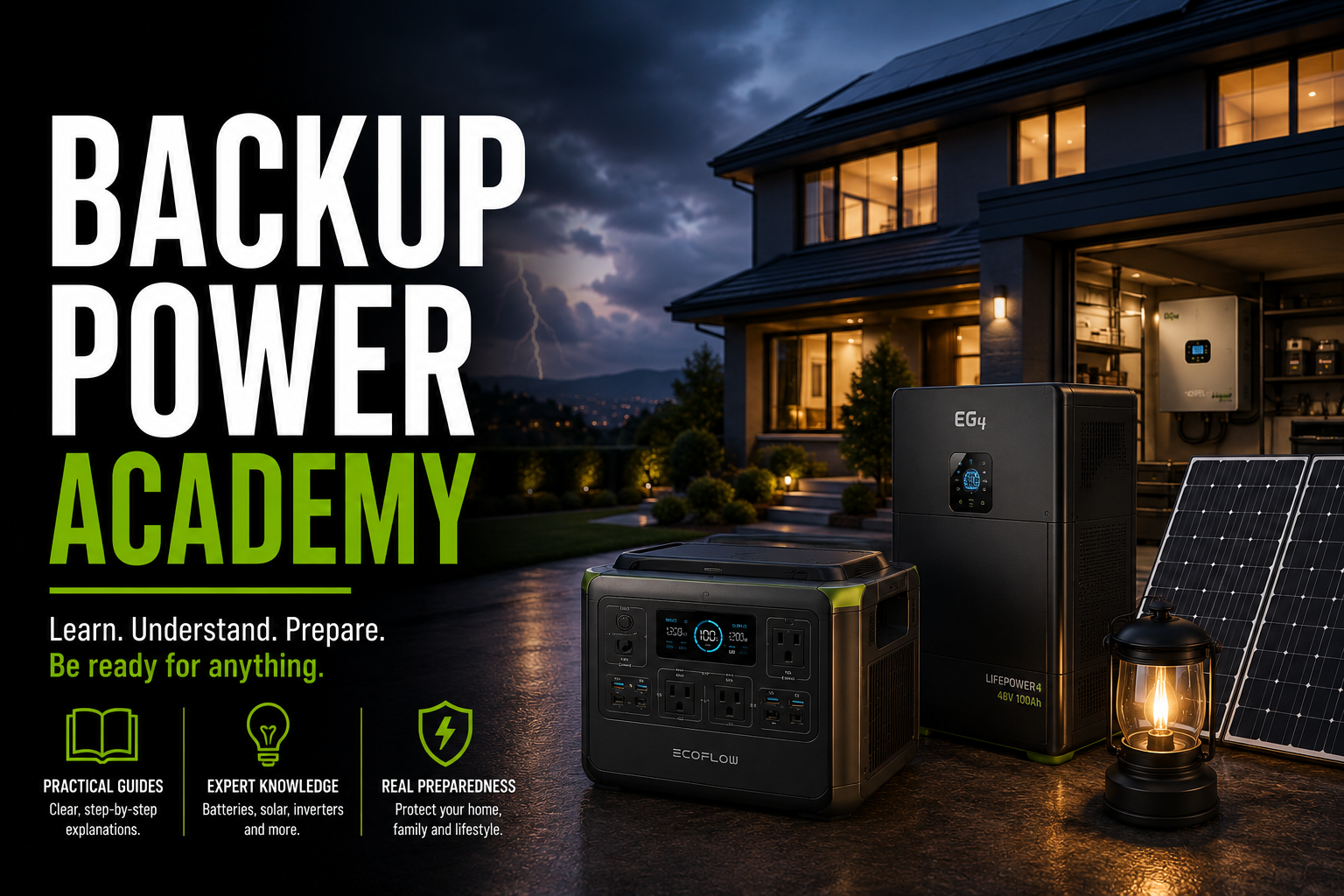
Watts describe instantaneous power, watt-hours describe stored energy, surge watts cover motor startup, voltage determines compatibility and transfer equipment determines safe household connection.
Complete guide covering backup power glossary, including features, real-world uses, sizing, safety considerations, and buying advice.
What Matters Most
Watts describe instantaneous power, watt-hours describe stored energy, surge watts cover motor startup, voltage determines compatibility and transfer equipment determines safe household connection.
Editor's Verdict
Watts describe instantaneous power, watt-hours describe stored energy, surge watts cover motor startup, voltage determines compatibility and transfer equipment determines safe household connection.
Watts and Watt-Hours
A watt measures power at a moment. A watt-hour measures energy used or stored over time. A 100W load running for five hours uses 500Wh.
Battery Terms
State of charge is the estimated remaining percentage. Depth of discharge is the portion used. Cycle life is the number of equivalent full cycles before capacity falls to a stated level.
Inverter Terms
Pure sine wave describes smooth AC power. Continuous output is sustained wattage. Surge output is short-duration peak power.
Generator Terms
Running watts describe continuous output. Starting watts cover brief motor-start demand. Dual-fuel and tri-fuel describe supported fuel types.
Solar Terms
MC4 is a common locking PV connector format. MPPT optimizes solar harvesting. Open-circuit voltage is panel voltage with no load.
Installation Terms
A transfer switch safely selects utility or backup power. Backfeeding is a dangerous improper connection that can energize utility lines.
Buying and Safety Checklist
Confirm Compatibility
Use the exact model, voltage, connector, dimensions and rating.
Check Electrical Limits
Do not exceed source, outlet, cable or accessory ratings.
Review Installation
Follow current manufacturer instructions and applicable electrical requirements.
Inspect Before Use
Do not use damaged, wet, overheated or poorly fitting equipment.
How to Use This Resource
Use backup power glossary as a starting point rather than reading every page in isolation. Backup-power decisions are connected: load size determines inverter requirements, runtime determines battery capacity, and recharge strategy determines how much solar or generator support makes sense.
Start with the scenario you are solving—short outage, multi-day emergency, camping, RV use or home backup. Then identify critical loads and separate must-run equipment from convenience loads. That keeps the system from becoming oversized and expensive simply because every possible appliance was included.
Move from fundamentals to sizing and only then to product comparisons. Understanding watts, watt-hours, surge demand and battery chemistry makes commercial comparisons much easier to interpret and reduces the chance of buying from marketing claims alone.
A Simple Safety Margin
When sizing backup power, avoid planning around 100% of any rating. Continuous inverter output, battery capacity and solar input all benefit from headroom. The margin helps absorb startup events, conversion losses, temperature effects and loads that draw more than expected.
For outage preparation, decide in advance which loads are essential and which can be rotated. Running a refrigerator, freezer or medical device does not necessarily mean every appliance must operate simultaneously. Load management can extend runtime dramatically without buying a much larger battery.
Frequently Asked Questions
What is the difference between watts and watt-hours?
Watts measure power; watt-hours measure energy over time.
What are surge watts?
Short-duration power available to start motors and compressors.
What is usable capacity?
Energy available after reserves and conversion losses.
What is pure sine wave?
Smooth AC output similar to utility electricity.
What is MPPT?
A charge-control method that optimizes available solar input.
What is a transfer switch?
Equipment that safely selects utility or backup power for circuits.
Related PowerGearGuide Resources
Terms That Are Easy to Confuse
Watts vs. watt-hours
Watts describe the rate of power at a moment in time. Watt-hours describe an amount of energy. Output determines whether a load can run; stored watt-hours help determine how long it can run.
Continuous vs. surge output
Continuous output is the level an inverter can sustain. Surge output is short-duration headroom intended mainly for startup events from motors and compressors.
Capacity vs. usable capacity
Nameplate battery capacity is not identical to AC energy delivered to appliances. Inverter losses, electronics and battery-management reserves reduce usable AC energy.
Solar panel watts vs. solar energy
Panel watts are a power rating under test conditions. Daily solar energy depends on sun hours, orientation, shading, temperature and the charge controller's input limits.