
Appliance Wattage Guide
Use this guide to compare typical running watts, startup surge and battery difficulty before sizing a portable power station or generator.
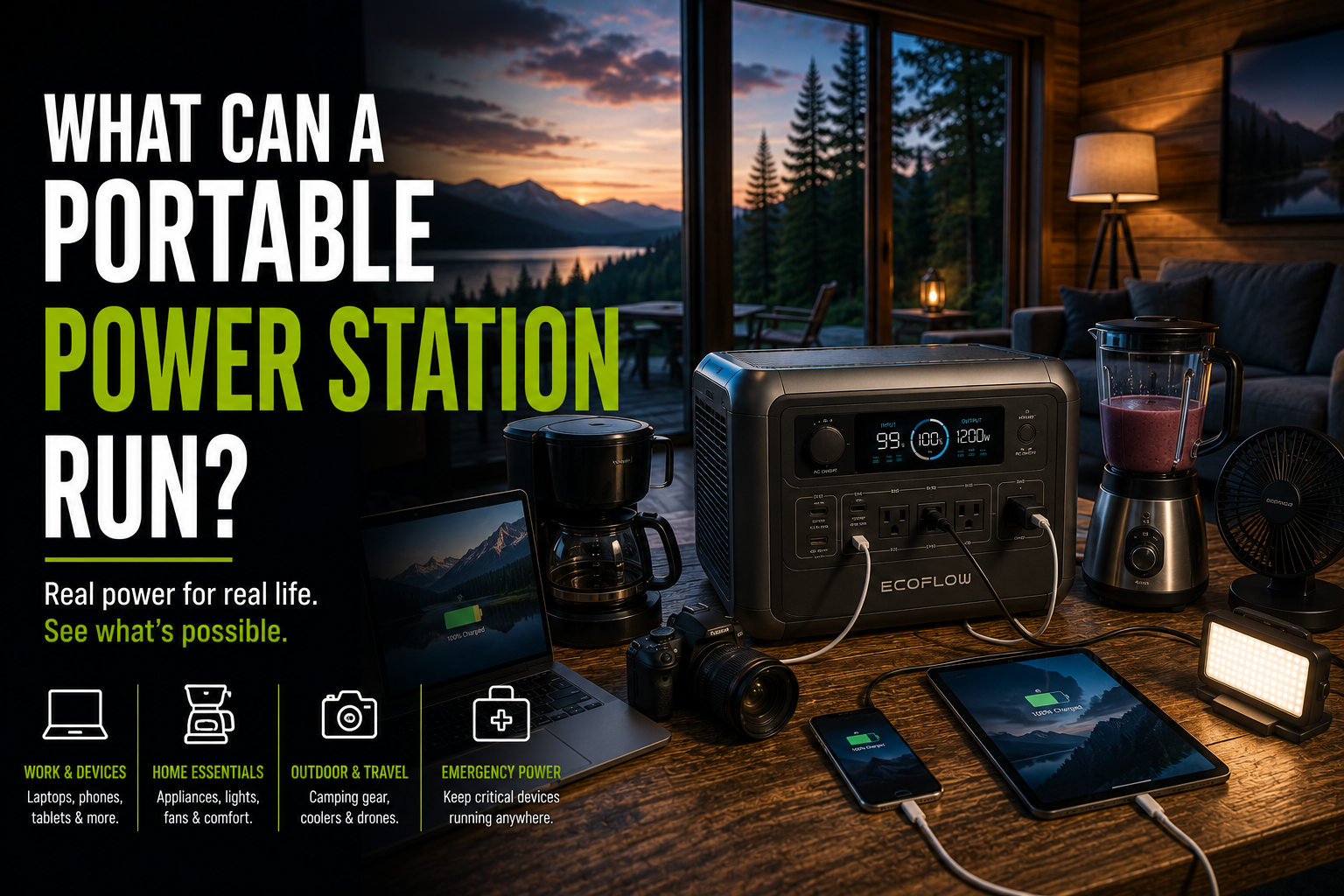
Use this guide to compare typical running watts, startup surge and battery difficulty before sizing a portable power station or generator.
Appliance wattage is the starting point for backup-power sizing, but runtime also depends on battery energy, cycling and efficiency.
This reference covers common household electronics, refrigeration, cooking, heating, laundry, pumps, air conditioning and tools.
Separate Running Watts, Starting Watts and Watt-Hours
Running watts determine continuous inverter size, starting watts determine surge capability and watt-hours determine runtime. Always verify the exact appliance label before purchase.
Bottom Line
Use generic wattage tables for planning, then confirm the exact appliance with manufacturer data or a power meter before choosing equipment.
Appliance Wattage Reference Table
| Appliance | Typical Running Power | Typical Startup | Power-Station Difficulty |
|---|---|---|---|
| Phone charger | 5–20W | Minimal | Very easy |
| Laptop | 30–140W | Minimal | Easy |
| TV | 40–250W | Minimal | Easy |
| Router + modem | 10–40W | Minimal | Very easy |
| Mini fridge | 50–150W cycling | 300–800W | Easy-moderate |
| Refrigerator | 100–800W cycling | 1,000–2,200W | Moderate |
| Freezer | 100–700W cycling | 800–2,000W | Moderate |
| CPAP | 20–120W | Low | Easy |
| Coffee maker | 600–1,500W | Minimal | Moderate |
| Microwave | 1,000–1,700W input | Model dependent | Moderate-high |
| Hair dryer | 1,000–1,875W | Minimal | High draw |
| Electric grill | 1,000–1,800W | Minimal | High draw |
| Space heater | 750–1,500W | Minimal | Poor battery match |
| Washing machine | 300–1,200W | 1,000–2,500W | Moderate-high |
| Sump pump | 400–1,200W | 800–2,500W+ | High surge |
| Well pump | 1,000–2,000W | 3,000–6,000W+ | Often 240V |
| Electric dryer | 4,000–6,000W | Varies | Usually impractical |
| Window AC | 500–1,500W | 1,200–3,000W | High draw |
| Power tools | 300–2,000W | 900–3,000W+ | Tool dependent |
Running Watts vs Starting Watts
Running watts describe sustained demand. Starting watts are short peaks required by compressors, pumps and motors. The inverter must support both the peak magnitude and its duration.
Watts vs Watt-Hours
Watts determine whether an appliance can run. Watt-hours determine runtime. A 1,500W appliance may fit a 2,000W inverter but still drain a 1,000Wh battery in well under an hour.
Portable Power Station Size Classes
| Capacity Class | Typical Inverter | Best Uses | Main Limitation |
|---|---|---|---|
| 250–500Wh | 300–700W | Phones, laptops, routers, TVs | Limited appliances |
| 700–1,500Wh | 1,000–2,000W | Refrigeration, CPAP, short cooking loads | Finite overnight energy |
| 2–4kWh | 2,000–4,000W | Multiple essentials, tools, selected AC | Heavy and expensive |
| 4kWh+ expandable | 4,000W+ and possible 240V | Home circuits, pumps, managed appliances | Installation and budget |
How to Calculate Appliance Backup Needs
Read the Nameplate
Record volts, amps and watts.
Measure Real Use
Use a plug-in energy meter when practical.
Identify Startup Loads
Motors may need several times running power.
Choose Simultaneous Loads
Do not assume everything runs together.
Add Runtime Hours
Convert each load into watt-hours.
Include Margin
Allow for losses, reserve, temperature and aging.
Common Wattage Mistakes
Using Output Watts as Runtime
A 2,000W inverter says nothing about battery duration.
Ignoring Input Watts
Cooking wattage can be lower than actual electrical input.
Adding Every Surge
Only add simultaneous startup events that can realistically occur.
Using Generic Tables Alone
Real appliances can vary widely.
Ignoring Voltage
A 240V appliance cannot run from a 120V-only station.
Forgetting Cycle Behavior
Refrigerators and pumps do not draw full power continuously.
How to Use Appliance Wattage Correctly
Wattage tables are best used for initial screening. They help identify which appliances are light loads, which require substantial continuous output and which may have startup surges. They should not be treated as exact measurements for every model.
For battery sizing, runtime matters as much as watts. A high-wattage appliance used for five minutes can consume less energy than a modest load that runs all night. Convert the operating pattern into watt-hours before deciding how much battery capacity is required.
Motor-driven equipment deserves extra attention because startup demand can exceed normal running watts. Refrigerators, freezers, pumps, air conditioners and many tools should be checked against both continuous and surge capability.
Frequently Asked Questions
What is the difference between running and starting watts?
Running watts are sustained power; starting watts are brief motor or compressor peaks.
How do I calculate watt-hours?
Multiply appliance watts by operating hours.
Why is actual runtime lower than the simple calculation?
Inverter losses, reserve settings, temperature and battery aging reduce delivered energy.
Can a 2,000W station run every 2,000W appliance?
Not necessarily. Surge, outlet rating, voltage and duty cycle also matter.
How accurate are generic wattage charts?
They are planning tools only; exact models can differ substantially.
What appliances are hardest to run?
Electric heating, central air, well pumps, dryers and large motor loads are among the most demanding.