
Renogy vs BLUETTI: Which Is Better for Solar and Backup Power?
Renogy and BLUETTI both sell equipment for battery-powered electricity, but they approach the problem differently. Renogy is particularly strong in customizable RV and off-grid solar components, while BLUETTI offers a broad lineup of integrated portable power stations.
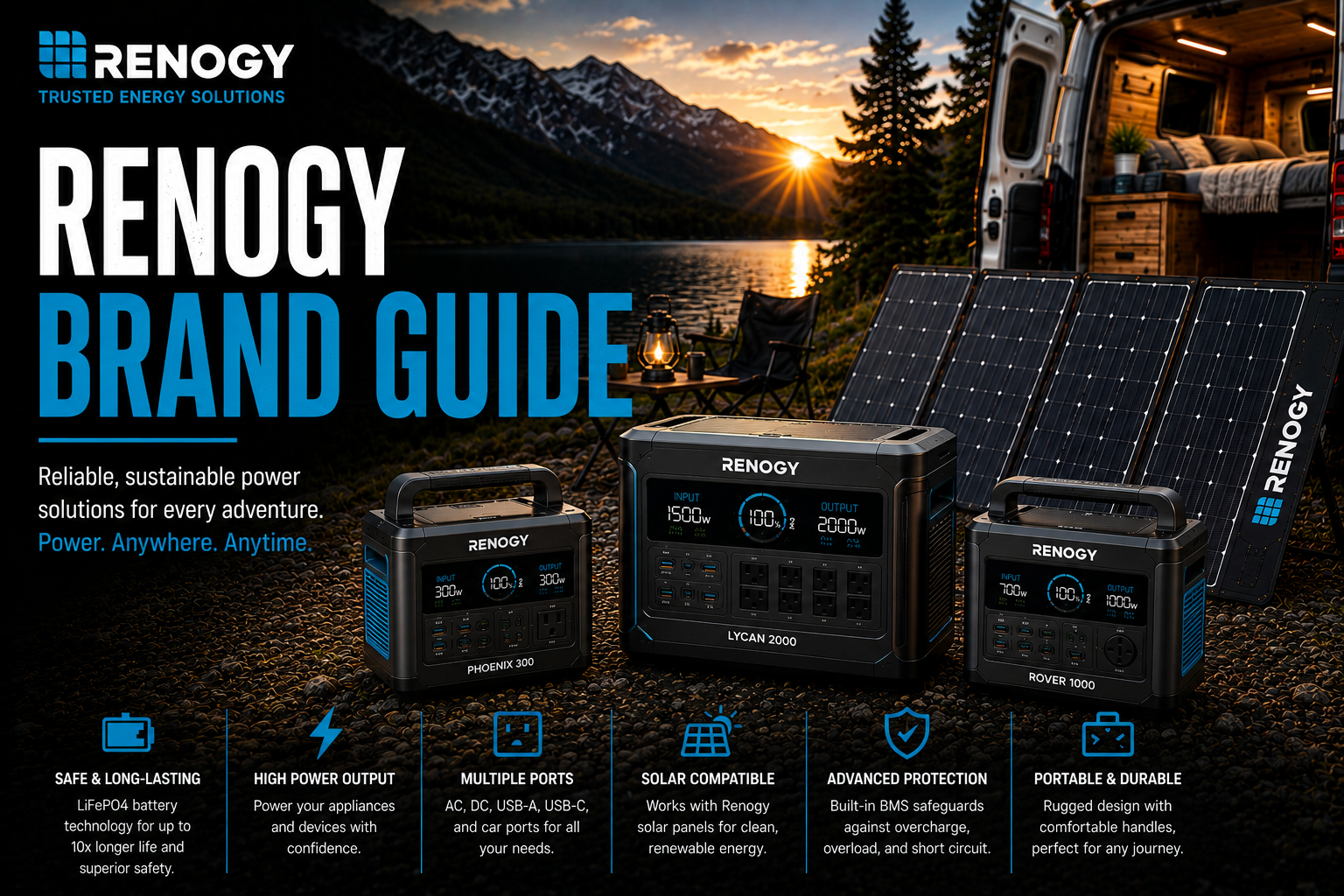
Quick verdict: Choose BLUETTI when you want a ready-to-use portable power station with an integrated battery, inverter and charging system. Choose Renogy when you want to design a permanent RV, campervan or off-grid solar installation using separate batteries, inverters and charging components.
The important distinction is that Renogy and BLUETTI are not simply competing on battery capacity. A complete portable power station and a custom-installed solar electrical system have different installation requirements, capabilities and ownership costs.
Renogy vs BLUETTI: The Short Answer
For a portable 1kWh battery: The BLUETTI Elite 100 V2 offers 1,024Wh of rated battery capacity and 1,800W continuous AC output. The older Renogy PHOENIX 1000 offers 998.4Wh and 1,500W continuous AC output. BLUETTI has the higher inverter rating.
For larger portable backup: The BLUETTI Elite 200 V2 provides 2,073.6Wh of rated storage and 2,600W continuous AC output. This makes it more appropriate for buyers who need longer runtime or higher simultaneous loads.
For permanent RV or off-grid installations: Renogy offers a component-based approach that can integrate lithium batteries, DC-DC chargers, charge controllers, inverters and solar panels.
Our editorial conclusion: BLUETTI is the stronger starting point for most portable-power buyers. Renogy becomes more compelling when a custom electrical installation is the goal.
You Want a Custom Solar System
Renogy's ecosystem lets you select separate batteries, inverters and charging equipment around the electrical requirements of your vehicle or off-grid setup.
Best fit: Permanently installed RV systems, campervan conversions and custom off-grid electrical projects.
Compare Current OptionsYou Want Convenient Portable Power
BLUETTI integrates battery storage, inverter output, charging electronics and outlets into a self-contained station that can move between locations.
Best fit: Camping, temporary backup, mobile work and households that do not want to install a custom electrical system.
Compare Current OptionsRenogy vs BLUETTI: Side-by-Side Specifications
These examples compare specific portable power stations and explain why a component-based Renogy installation belongs in a separate category. Ratings are manufacturer-published specifications rather than independent test measurements.
| Product or System | Rated Capacity | Continuous AC Output | Battery Type | Best Application |
|---|---|---|---|---|
| Renogy PHOENIX 1000 | 998.4Wh | 1,500W | LiFePO4 | Older portable power station option |
| BLUETTI Elite 100 V2 | 1,024Wh | 1,800W | LiFePO4 | Modern portable 1kWh-class power |
| BLUETTI Elite 200 V2 | 2,073.6Wh | 2,600W | LiFePO4 | Higher-capacity portable backup |
| Renogy Custom RV System | Depends on battery bank | Depends on inverter | Depends on selected battery | Permanent RV and off-grid installation |
Three Portable Power Station Options Worth Comparing
BLUETTI Elite 100 V2
The BLUETTI Elite 100 V2 is a strong starting point for someone who wants a self-contained portable battery rather than a permanently installed system. Its 1,024Wh rated capacity and 1,800W continuous AC output make it suitable for many moderate camping and emergency loads.
The station combines the battery, inverter, outlets and charging electronics in one enclosure. This reduces the number of components a buyer must select and install.
Its 1,800W continuous inverter rating is higher than the Renogy PHOENIX 1000's 1,500W rating. That may matter for appliances with higher running loads, although the appliance's startup surge and individual outlet limits still need verification.
BLUETTI also publishes a maximum solar-input rating of 1,000W for this model. Reaching that input requires an electrically compatible panel configuration and suitable sunlight.
- Integrated portable design.
- 1,800W continuous inverter output.
- LiFePO4 battery chemistry.
- Useful capacity for camping and short outages.
- About 1kWh may be insufficient for extended outages.
- It is not a permanent RV electrical system.
- Higher-wattage appliances can drain the battery quickly.
- Solar-input voltage and current limits still apply.
Our pick: The Elite 100 V2 is the more straightforward choice for buyers who want modern portable power without designing a custom installation.
Check PriceRenogy PHOENIX 1000
The PHOENIX 1000 demonstrates that Renogy has also offered integrated portable power stations. Its published specifications include a 998.4Wh LiFePO4 battery and a 1,500W continuous pure-sine-wave inverter.
Compared with the Elite 100 V2, the PHOENIX 1000 has slightly less rated stored energy and 300W less continuous inverter output. Their battery capacities are close enough that runtime differences under small constant loads may be modest.
Renogy documented a compatible two-unit parallel configuration for this product family. This is a model-specific capability and does not mean arbitrary portable stations can be connected together.
The more significant concern is purchasing an older-generation product. Verify the condition of the unit, seller authorization, warranty eligibility and availability of compatible accessories before buying.
- Approximately 1kWh of battery capacity.
- 1,500W continuous pure-sine-wave inverter.
- LiFePO4 chemistry.
- Could offer value at a meaningful discount.
- Older product generation.
- Lower continuous AC rating than Elite 100 V2.
- Current inventory may be limited.
- Warranty and accessory support require confirmation.
Our pick: Consider the PHOENIX 1000 only when its actual price, condition and support make it a compelling alternative to newer portable stations.
Check PriceBLUETTI Elite 200 V2
The Elite 200 V2 is a different size class from the approximately 1kWh options. Its 2,073.6Wh rated battery provides more than twice the stored energy of the Renogy PHOENIX 1000.
The 2,600W continuous inverter can support larger combined AC loads, subject to the station's operating limits. The larger battery can also provide substantially longer runtime when powering the same appliance.
However, the larger battery makes the unit heavier. At approximately 53.4 lb, it is less convenient for frequent carrying than a compact 1kWh station.
This makes the Elite 200 V2 better suited to buyers who expect longer outages or higher energy use and are willing to accept the additional size and weight.
- More than 2kWh of rated storage.
- 2,600W continuous AC output.
- Integrated battery and charging equipment.
- Useful for larger portable backup loads.
- Significantly heavier than 1kWh models.
- Higher total purchase cost.
- Not automatically suitable for whole-home backup.
- Solar-panel compatibility must be checked.
Our pick: The Elite 200 V2 is the better choice when your load calculations show that approximately 1kWh of battery storage is not enough.
Check PriceRenogy vs BLUETTI for RV and Off-Grid Solar
This is where the brands differ most meaningfully. A portable power station and a custom RV electrical system may both store solar energy, but their architectures are different.
Permanent RV Electrical Systems
Renogy sells components for systems built around separate batteries, charge controllers, inverters and vehicle charging equipment.
This can be useful when the electrical system must support permanent 12V circuits, solar charging and charging from the vehicle's alternator.
Trade-off: You must choose compatible components and install them correctly.
Portable Solar Generators
BLUETTI power stations combine storage, charging electronics and AC outlets in one unit. Compatible solar panels can recharge the station without a separately installed charge controller.
This can be easier for occasional camping or backup power that moves between locations.
Trade-off: You are limited by the station's built-in charging and output architecture.
What a Custom Renogy System Requires
For a typical RV or van conversion, the equipment list may include:
- Lithium battery bank: Sized for daily energy use and desired reserve capacity.
- Inverter: Matched to AC appliance requirements and startup surge.
- Solar charge controller: Compatible with the panel array and battery charging profile.
- DC-DC charger: Selected for the vehicle's alternator and electrical architecture.
- Circuit protection: Correctly rated fuses, breakers, disconnects and cables.
- Monitoring: Appropriate battery-state and system monitoring.
The benefit is customization. You can select each major component around the installation instead of accepting the fixed configuration of a portable power station.
The disadvantage is complexity. A component system requires more design work, proper cable sizing, protective devices and installation planning.
Can Renogy Solar Panels Charge a BLUETTI Power Station?
Potentially, yes. Solar compatibility depends on electrical specifications rather than the panel manufacturer's name.
1. Verify Voltage
Check the panel array's open-circuit voltage, including cold-weather increases, against the station's maximum allowable solar-input voltage.
2. Verify Current
Confirm that the proposed panel configuration meets the power station's input-current and charging specifications.
3. Verify Connections
Check polarity, connector type, adapter requirements and manufacturer-approved wiring configurations.
A published 1,000W solar-input limit does not mean that any combination of panels totaling 1,000W is compatible. Input voltage and current limits must also be respected.
Battery Runtime: Renogy vs BLUETTI
Battery capacity is measured in watt-hours (Wh). Continuous inverter output is measured in watts (W). They answer different questions.
Watt-hours help estimate how long equipment can run. Watts describe how much electrical power the station can deliver at a given time.
Example: Running a Continuous 100W Load
| Power Station | Rated Capacity | Estimated Runtime at 100W |
|---|---|---|
| Renogy PHOENIX 1000 | 998.4Wh | About 8.5 hours |
| BLUETTI Elite 100 V2 | 1,024Wh | About 8.7 hours |
| BLUETTI Elite 200 V2 | 2,073.6Wh | About 17.6 hours |
These figures are calculations, not measured runtimes. They assume a constant 100W load and that 85% of the rated battery capacity is available as usable AC energy.
The Renogy PHOENIX 1000 and BLUETTI Elite 100 V2 have very similar rated battery capacities. Under an identical modest load, their estimated runtimes are therefore close despite the difference in inverter output.
The Elite 200 V2 has approximately twice the stored energy, so it can potentially run the same load for about twice as long under the same assumptions.
Example: Overnight Internet and Lighting
Suppose a router, modem and LED lights draw an average of 60W for 12 hours:
Either 1kWh-class station could theoretically cover that requirement under the stated assumptions. However, extending the same load to 24 hours raises the required rated capacity to approximately 1,694Wh.
This is why sizing a backup system by expected energy consumption is more useful than choosing the highest advertised inverter wattage.
Which Brand Is Better for Home Backup?
Both brands can be part of a home-backup strategy, but the right equipment depends on what you want to power and whether you need a portable or permanently installed solution.
1. List Essential Loads
Identify the running power, startup surge and voltage requirements of refrigerators, lights, communications equipment and other essentials.
2. Calculate Required Energy
Multiply average power consumption by the desired operating hours, then account for conversion losses and reserve capacity.
3. Choose the System Type
Decide whether you need portable outlets for selected appliances or a professionally integrated backup system serving fixed circuits.
Small Essential Loads
For routers, communications devices, LED lights and other moderate loads, a 1kWh-class BLUETTI power station may be sufficient for short outages.
Longer Portable Backup
The Elite 200 V2 is more appropriate when the calculated energy requirement exceeds the practical capacity of a 1kWh station.
Permanent Home Backup
A permanently installed system requires additional design considerations, including circuit selection, transfer equipment, voltage compatibility, inverter sizing and electrical code compliance.
Renogy components may be relevant to a custom project, but purchasing a battery and inverter separately does not automatically create a safe or complete whole-home backup system.
Warranty, Battery Life and Long-Term Ownership
Battery Chemistry and Cycle Life
The three portable models discussed here use LiFePO4 batteries. This chemistry is commonly selected for repeated charging and long service life, but published cycle-life claims depend on test conditions and the remaining-capacity threshold.
Do not assume two batteries with different cycle-life figures were tested under identical conditions.
Warranty Coverage
Warranty terms vary by product, generation, seller and region. BLUETTI publishes multi-year limited warranty coverage for certain Elite-series products. Renogy warranty terms vary across its batteries, charging equipment, solar panels and portable stations.
Check the exact model's current warranty documentation, authorized-seller requirements and exclusions before buying.
Replacement Parts and Accessories
Accessory availability is particularly important for older portable stations such as the Renogy PHOENIX 1000.
For a custom Renogy system, long-term serviceability also depends on how accessible the individual components are and whether compatible replacements can be sourced.
Five Mistakes to Avoid When Comparing Renogy and BLUETTI
- Comparing a standalone battery with a complete power station. The battery alone does not provide the same functions as an integrated inverter and charging system.
- Confusing watts with watt-hours. High inverter output does not necessarily mean longer runtime.
- Ignoring solar-input voltage. A panel array must meet the station's voltage, current and connector requirements.
- Buying older equipment without checking support. Verify warranty eligibility, seller authorization and accessory availability.
- Underestimating installation requirements. Permanent RV and home electrical systems need proper circuit protection, wiring and compatible components.
Frequently Asked Questions
Is Renogy better than BLUETTI?
Renogy is especially relevant for customized RV and off-grid solar installations. BLUETTI is generally more straightforward for buyers who want a complete portable power station. The better choice depends on your application.
Which brand is better for camping?
BLUETTI is often more convenient for portable camping power because its stations integrate the battery, inverter, charging electronics and outlets. Renogy components may be preferable for a permanently installed campervan electrical system.
Does Renogy make portable power stations?
Yes. Renogy has offered PHOENIX portable power stations, including the PHOENIX 1000. Verify current availability, exact model specifications and support before purchasing an older-generation unit.
Can Renogy solar panels charge a BLUETTI power station?
Potentially. The panel configuration must meet the BLUETTI station's permitted solar-input voltage, current, connector and polarity requirements. Brand names alone do not determine compatibility.
Which is better for RV solar?
Renogy is particularly suitable when you want to design a permanent system with separate batteries, charging equipment and an inverter. BLUETTI may be more convenient when you want a portable station without permanent electrical installation.
Can either brand run a refrigerator?
Potentially, depending on the refrigerator's running watts, compressor startup surge and daily energy consumption. Verify the exact appliance requirements against the station's specifications.
Does a bigger inverter mean longer battery runtime?
No. Inverter wattage determines the supported load. Battery capacity in watt-hours is the primary starting point for estimating runtime.
Are Renogy and BLUETTI expansion batteries interchangeable?
No. Do not assume that expansion batteries, cables or charging accessories from different brands or product generations are interchangeable. Use only equipment approved for the exact system.
Which brand is better for whole-home backup?
Neither a basic portable station nor a standalone battery should automatically be treated as a whole-home solution. Whole-home backup requires appropriate load calculations, inverter capacity, transfer equipment and electrical installation planning.
Are BLUETTI power stations safe to use indoors?
Battery power stations do not produce combustion exhaust while operating from their batteries. However, they still require appropriate ventilation, dry conditions, unobstructed cooling vents and compliance with the manufacturer's operating instructions.
Manufacturer Sources and Editorial Methodology
This comparison uses published manufacturer specifications and evaluates battery capacity, continuous AC output, charging architecture, portability and practical installation requirements. We did not perform or claim firsthand testing.
Primary manufacturer resources:
- Renogy — Official Products, Documentation and Support
- BLUETTI — Official Portable Power Station Catalog
- BLUETTI Elite 100 V2 — Product Specifications
- BLUETTI Elite 200 V2 — Product Specifications
How to interpret this comparison: Manufacturer ratings describe specified operating limits rather than guaranteed performance with every appliance. Runtime estimates are illustrative calculations using stated assumptions.
Availability and pricing: Inventory, product generations, warranty terms and promotions change. This comparison does not assume that every historical product remains available or that one brand is always less expensive.
Final Verdict: Renogy or BLUETTI?
BLUETTI is our preferred starting point for portable power stations. The Elite 100 V2 is a useful option for approximately 1kWh of portable storage, while the Elite 200 V2 provides more energy and higher continuous inverter output for larger backup needs.
Renogy is especially compelling for permanent RV and off-grid solar installations. Its component ecosystem allows buyers to design a system around the battery capacity, inverter size and charging sources they actually need.
The Renogy PHOENIX 1000 is a possible portable alternative, but its older product generation means availability, warranty coverage and accessory support should be confirmed before purchase.
The right buying decision comes from matching your electrical loads, required runtime, charging options and installation needs—then comparing the full system cost.
Compare Current Options