
OUPES Mega 1 vs Mega 2: Which Power Station Is Better?
The Mega 1 is lighter and easier to move. The Mega 2 doubles the base battery capacity, adds 500W of continuous AC output and supports substantially more solar input. Here's how those differences affect camping, RV use and home backup.
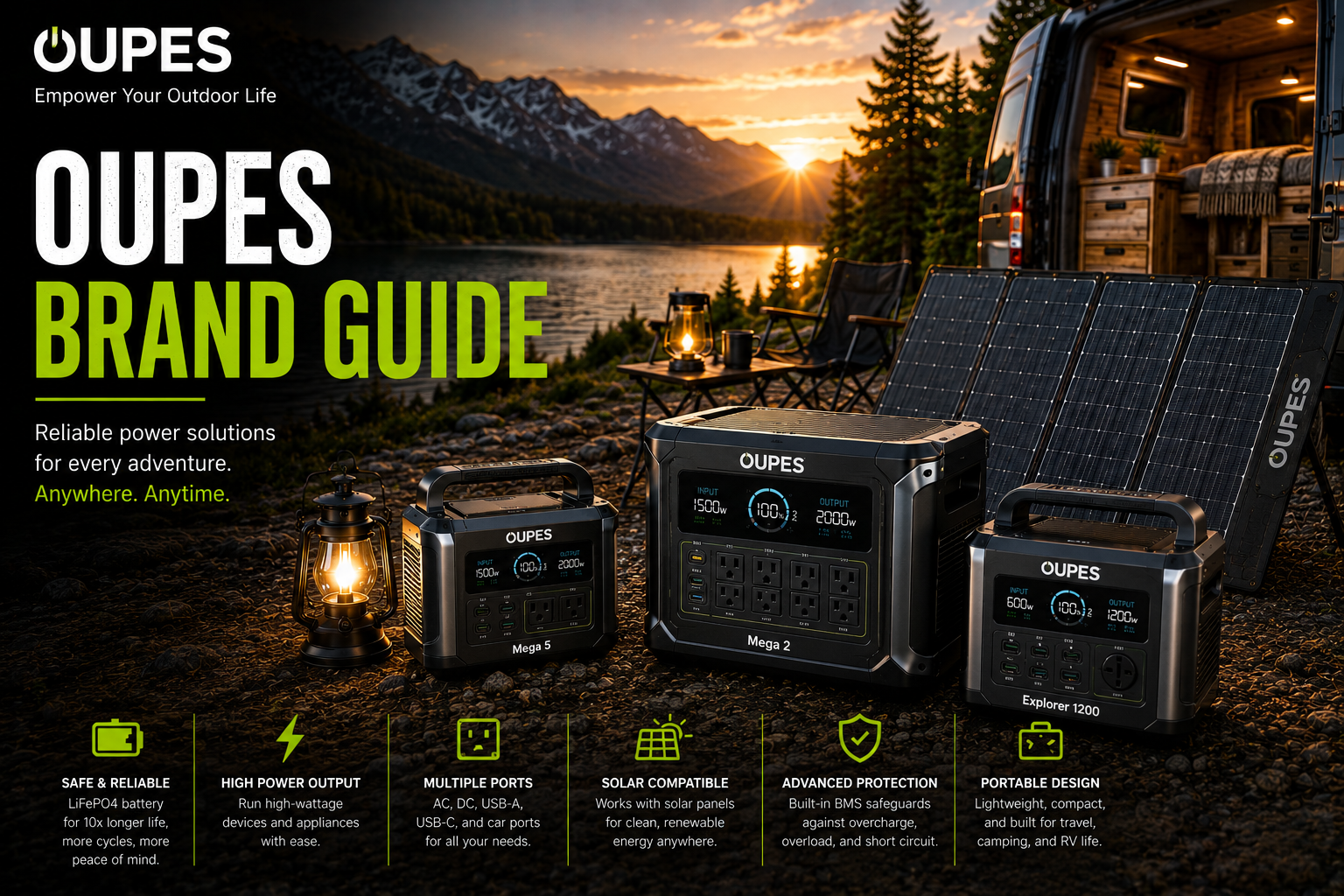
The most important difference between the OUPES Mega 1 and Mega 2 is not their inverter rating. It is how much energy they store. The Mega 2 has exactly twice the nominal battery capacity, which can matter more than its additional 500W of output during an overnight outage.
But that extra capacity comes with a significant weight penalty. If you regularly carry a power station from your house to your vehicle, campsite or jobsite, the Mega 1 may be the better purchase even though the Mega 2 is more capable on paper.
Quick Verdict: Mega 1 for Portability, Mega 2 for Longer Backup
Buy the OUPES Mega 1 when a 1,024Wh battery is sufficient, you value its 27.8 lb weight and you need up to 2,000W of rated AC output.
Choose the OUPES Mega 2 when you need approximately twice the base stored energy, 2,500W rated AC output, a larger expansion ceiling or substantially greater maximum solar input.
One current buying complication: OUPES's official comparison catalog labels the standard Mega 2 as sold out. Its successor-style alternative, the Mega 2 Pro, has different solar and DC specifications. Do not treat those two models as interchangeable.
OUPES Mega 1 vs Mega 2: Full Specification Comparison
These are the standard Mega 1 and standard Mega 2, based on OUPES's published comparison and product information. Maximum charging inputs are equipment limits, not guaranteed charging rates in all conditions.
| Specification | OUPES Mega 1 | OUPES Mega 2 |
|---|---|---|
| Nominal battery capacity | 1,024Wh | 2,048Wh |
| Battery chemistry | LiFePO4 | LiFePO4 |
| Rated AC output | 2,000W | 2,500W |
| Published surge rating | 4,500W | 5,400W |
| Maximum solar input | 800W | 2,100W |
| Maximum AC + solar input | 2,200W | 3,700W |
| Expandable capacity | Up to 5,120Wh with two compatible B2 batteries | Up to 10,240Wh with four compatible B2 batteries |
| Published cycle-life claim | More than 3,500 cycles to 80% capacity | More than 3,500 cycles to 80% capacity |
| Weight | 27.8 lb | 48.5 lb |
| Standard AC voltage | 120V | 120V |
| Best fit | Portable power, shorter backup periods | RV use, longer backup periods, larger solar setups |
What the numbers reveal: The Mega 2 has 100% more base capacity but only 25% more rated AC output. That is why its advantage is most noticeable when powering equipment for hours rather than when running a single short-duration appliance.
Which Model Should You Actually Buy?
OUPES Mega 1
2,000W rated output · 27.8 lb
The Mega 1 is the more practical choice for people who move their battery often. It offers unusually substantial inverter output for a station in the 1kWh class, but its energy reserve remains relatively modest.
Best for: camping, mobile work, electronics and shorter emergency backup.
Not ideal for: extended overnight loads without recharging or expansion.
Check PriceOUPES Mega 2
2,500W rated output · 48.5 lb
The Mega 2 offers more energy before you need an expansion battery. Its higher solar input limit and larger expansion ceiling also make it more flexible for substantial backup configurations.
Best for: RV essentials, refrigerators with compatible starting requirements and longer outage preparation.
Not ideal for: frequent carrying, very small loads or buyers who cannot locate the exact standard model.
Check Price- About 20.7 lb lighter.
- 2,000W rated AC output from a compact station.
- Supports compatible B2 expansion.
- Easier to carry and store.
- Less initial capacity to pay for if your loads are small.
- Twice the nominal base battery capacity.
- 500W more continuous AC output.
- Higher published surge rating.
- 2,100W maximum solar input versus 800W.
- Higher total expansion ceiling.
Runtime Comparison: How Much Longer Does Mega 2 Last?
Battery capacity is measured in watt-hours (Wh). Appliance demand is measured in watts (W). A 2,048Wh station has twice the nominal energy of a 1,024Wh station, but real AC runtime depends on inverter losses, standby consumption and the load.
| Average AC Load | Mega 1 Estimate | Mega 2 Estimate | Practical Interpretation |
|---|---|---|---|
| 50W | 17.4 hours | 34.8 hours | Light electronics; inverter overhead can materially affect results |
| 100W | 8.7 hours | 17.4 hours | Small continuous-load backup |
| 200W | 4.4 hours | 8.7 hours | Multiple electronics or modest equipment |
| 500W | 1.7 hours | 3.5 hours | Moderate sustained load |
| 1,000W | 0.9 hours | 1.7 hours | Higher draw; check continuous-load and outlet ratings |
These estimates show the core difference: at similar operating efficiency, Mega 2 should provide roughly twice the runtime at the same load.
Example: Refrigerator Backup
A refrigerator does not draw its running wattage continuously. Its compressor cycles on and off, and starting demand can be much higher than its steady running draw.
Suppose a refrigerator averages 60W over time, based on measured energy consumption:
- Mega 1: 1,024 × 0.85 ÷ 60 ≈ 14.5 hours.
- Mega 2: 2,048 × 0.85 ÷ 60 ≈ 29 hours.
This is an illustrative scenario only. Actual performance requires checking the refrigerator's compressor startup requirement and measuring its energy use.
Charging Comparison: The Mega 2 Has a Much Higher Solar Input Ceiling
Solar charging is one of the largest differences between these two stations.
Up to 800W
OUPES lists an 800W maximum solar input for the standard Mega 1. That is a substantial input relative to its 1,024Wh battery, but the panels must meet the exact DC voltage, current and connector requirements.
Up to 2,100W
OUPES lists a 2,100W maximum solar input for the standard Mega 2. That gives it more potential charging capacity in a sufficiently large, correctly configured solar installation.
Maximum input does not equal the power a solar array will produce all day. Actual charging depends on sunlight, shading, temperature, panel orientation, battery state of charge and charging-system limits.
Example: Charging With a 400W Solar Array
Assume a 400W array averages 280W of useful charging power during a favorable period. Ignoring tapering and additional charging losses for a simplified comparison:
- Replenishing 1,024Wh would take approximately 3.7 hours at 280W.
- Replenishing 2,048Wh would take approximately 7.3 hours at 280W.
These are theoretical energy calculations, not guaranteed full-charge times. Real-world charging will vary.
Why the Mega 2's Higher Limit Matters
With a small portable panel, the Mega 2's 2,100W maximum may provide little advantage. With a larger compatible solar array, however, it can accept substantially more solar power than the Mega 1.
For help estimating charge time, use our solar charging time calculator.
Battery Expansion: 5.12kWh vs 10.24kWh
Both stations support OUPES B2 expansion batteries in the manufacturer-specified configurations. Each B2 battery adds 2,048Wh of nominal capacity.
| Configuration | Mega 1 | Mega 2 |
|---|---|---|
| Base station only | 1,024Wh | 2,048Wh |
| With one B2 battery | 3,072Wh | 4,096Wh |
| With two B2 batteries | 5,120Wh | 6,144Wh |
| Maximum manufacturer-listed configuration | 5,120Wh | 10,240Wh with four B2 batteries |
The Mega 2 can scale much further, but that does not mean it is automatically a better value. Expansion batteries add cost, space and weight. If your needs fit within the Mega 1's base capacity, expansion potential may never matter.
Check the current B2 accessory listing and the exact connection requirements before purchasing either station with the intention of expanding it later.
Portability: Mega 1 Is the Clear Winner
OUPES lists the Mega 1 at 27.8 lb and the Mega 2 at 48.5 lb. The Mega 2 weighs approximately 74% more than the Mega 1.
That difference becomes meaningful when lifting a unit into a vehicle, carrying it through a campground or moving it between floors.
Choose Mega 1 When...
- You move the power station frequently.
- You want a smaller vehicle or camping setup.
- Your planned loads fit comfortably within 1kWh of storage.
- High output matters more than extended runtime.
Choose Mega 2 When...
- You expect longer outages.
- You plan to leave the unit in one place most of the time.
- You want more capacity before buying extra batteries.
- You intend to build a larger compatible solar system.
Which Is Better for Camping, RVs and Home Backup?
Camping: Mega 1 Usually Makes More Sense
For lighting, charging electronics, fans and occasional compatible appliances, the Mega 1's lower weight is attractive. The main limitation is its smaller energy reserve.
Choose the Mega 2 only if your trip requires considerably more stored energy and the extra carrying weight is acceptable.
RV Use: Mega 2 Offers More Flexibility
The Mega 2's larger battery and higher solar input ceiling are useful advantages for RV owners. However, it is not a universal substitute for an RV electrical system.
Verify the RV's voltage, shore-power connection requirements, charging equipment and appliance loads. A TT-30 receptacle is not equivalent to a 240V split-phase outlet. Never assume an adapter changes a station's actual output voltage or available power.
Home Outages: Mega 2 Is Better for Longer Essential-Load Backup
The Mega 2 can provide more time for compatible essentials such as communication equipment, lighting and certain refrigeration loads. For short outages, the Mega 1 may still be enough.
Neither should be treated as a whole-house solution simply because it has a high surge rating. Calculate the combined continuous load and energy needed over the intended outage duration.
Tools and High-Draw Appliances: Check the Starting Load
Both units have relatively high rated output for their battery capacities. But motor startup, outlet ratings and the duration of the load can limit compatibility.
A high-wattage tool may be within the inverter's rated output yet drain the battery quickly. If the job is continuous, battery capacity matters just as much as inverter power.
What About Mega 1 Lite and Mega 2 Pro?
OUPES has expanded its lineup, so a shopper searching for Mega 1 or Mega 2 may encounter similarly named models.
Mega 1 Lite
OUPES lists 1,024Wh and 2,000W rated output, but does not list the same B2 expansion capability as the standard Mega 1. It also has a different USB configuration.
Do not buy Mega 1 Lite expecting standard Mega 1 expansion.
Check PriceMega 2 Pro
OUPES lists the same 2,048Wh base capacity and 2,500W rated output as the standard Mega 2, but with different solar input limits, USB-C ports, high-power DC features and published battery cycle-life figures.
Do not assume Mega 2 Pro has the standard Mega 2's 2,100W solar input.
Check PriceOUPES's current official comparison catalog identifies the standard Mega 2 as sold out. If it is unavailable from a suitable seller, compare the Mega 2 Pro carefully rather than purchasing an older listing without confirming warranty and support.
Which Offers Better Value?
There is no permanent winner on price because offers change. The useful comparison is total cost relative to the energy and output you actually need.
- Compare the current purchase price. The Mega 2 should not be evaluated only against the Mega 1's original list price.
- Calculate cost per nominal Wh. Divide the price by 1,024 for Mega 1 or 2,048 for Mega 2. This is a simple capacity metric, not a complete measure of quality.
- Include required accessories. Add compatible panels, B2 batteries and connection equipment.
- Consider transportation and storage. The Mega 1's lower weight can have practical value even if its price per Wh is higher.
- Verify the seller and warranty. A low price is less appealing if the exact model is difficult to service or no longer readily available.
Important Safety and Compatibility Notes
- Home wiring: Never connect either station to household circuits through an improvised backfeed cable. Use only manufacturer-approved connection methods and qualified electrical installation where required.
- 120V vs 240V: Do not assume these standard units provide native 240V split-phase output.
- UPS/EPS: OUPES advertises backup transfer functionality, but that does not guarantee interruption-free operation for every computer, server or medical device.
- Solar: Follow the exact model's voltage, current and connector limits.
- Moisture and temperature: Keep the units within manufacturer operating conditions and protect them from rain or standing water.
- Medical equipment: Confirm electrical compatibility and maintain an appropriate backup plan rather than relying solely on a consumer power station.
Frequently Asked Questions
Is OUPES Mega 2 twice as powerful as Mega 1?
No. Mega 2 has twice the nominal battery capacity, but its rated AC output is 2,500W versus Mega 1's 2,000W. It stores twice as much energy but does not deliver twice the continuous power.
Which lasts longer, Mega 1 or Mega 2?
Mega 2 generally lasts approximately twice as long under the same load and similar efficiency because it has twice the base battery capacity. Actual runtime depends on the appliance and inverter losses.
Can both models use OUPES B2 batteries?
Yes, in their specified configurations. Mega 1 supports up to two compatible B2 batteries; Mega 2 supports up to four. Verify compatibility and accessories before ordering.
Which is better for solar charging?
The standard Mega 2 has a higher published maximum solar input: 2,100W versus Mega 1's 800W. The advantage is meaningful only with an appropriately sized and electrically compatible solar array.
Is Mega 2 better for a refrigerator?
For a refrigerator whose running and startup requirements are supported by both stations, Mega 2 offers a longer potential backup duration. Measure energy use and confirm compressor startup compatibility first.
Is Mega 2 Pro the same as Mega 2?
No. Although they share 2,048Wh nominal capacity and 2,500W rated output, their charging, solar and DC specifications differ. Compare the exact model before purchasing.
Which should I buy if I rarely move the station?
If longer backup duration matters and your budget allows, Mega 2 is generally the stronger fit. If you only need modest energy storage, Mega 1 can still be sufficient.
Sources and How This Comparison Was Prepared
This comparison uses published manufacturer specifications and clearly labeled calculations. We have not claimed to perform hands-on runtime, noise or charging tests. The product suitability judgments are based on differences in capacity, rated output, charging limits, portability and expansion.
- OUPES — Official Mega Series Buying Guide and Specifications
- OUPES — Mega 1 Product Specifications
- OUPES — Mega Series Model Comparison
- OUPES — Current Product Catalog and Availability Labels
- OUPES — Official User Manuals
Source interpretation: Manufacturer ratings are specifications, not proof of performance under every condition. Runtime tables are calculated examples. Retail stock, prices and warranty eligibility must be checked at the time of purchase.
Final Recommendation: Which OUPES Mega Should You Choose?
Choose Mega 1 if you want a more portable station with strong 2,000W output and enough stored energy for shorter backup needs.
Choose Mega 2 if your priority is longer runtime, more expansion capacity and the ability to use a larger compatible solar array.
For most buyers who plan to keep the station in an RV or at home, Mega 2's extra energy is the more meaningful upgrade. For frequent travel and carrying, Mega 1's lighter design is difficult to ignore.
Before purchasing, confirm availability of the exact standard model—especially Mega 2—and compare it with the newer Mega 2 Pro if necessary.
Compare Current Options