
Best OUPES Portable Power Stations: Which Model Is Worth Buying?
OUPES offers everything from lightweight camping batteries to expandable multi-kilowatt home backup systems. But the best choice is not necessarily the biggest model. This guide compares actual battery capacity, continuous AC output, solar charging, portability and expansion to help you choose the right OUPES power station.
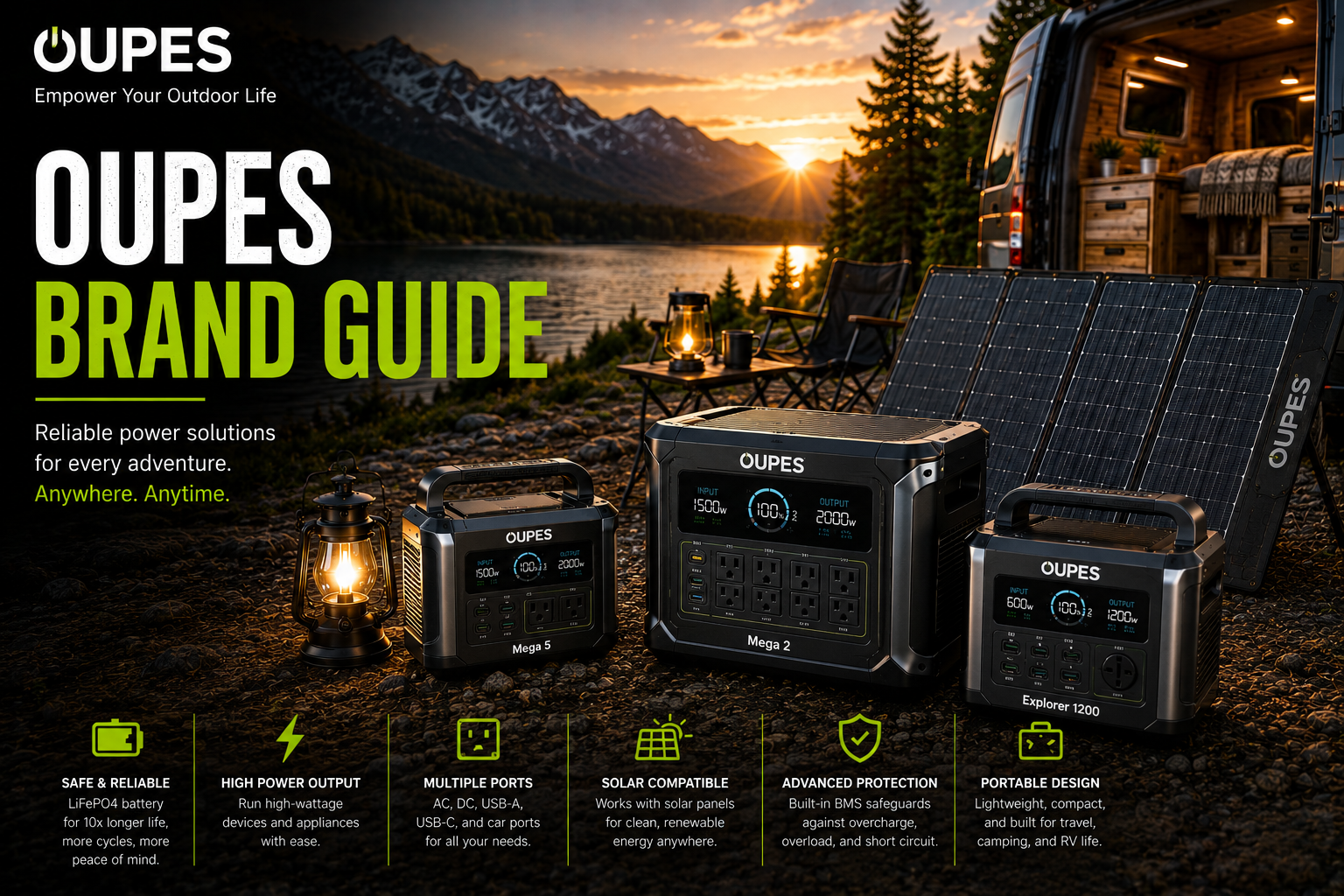
Our top recommendation is the OUPES Mega 2 Pro for buyers who need a versatile 2kWh-class station. Its 2,048Wh battery, 2,500W continuous AC output, expansion capability and 1,000W solar input make it a strong all-around option. For a smaller station, choose the Mega 1; for higher-power appliances, consider the Mega 3.
Which OUPES Power Station Is Best?
Best overall — Mega 2 Pro: The most compelling balance of battery storage, 2,500W AC output, expansion and modern charging features.
Best expandable 1kWh option — Mega 1: Ideal when you want high inverter output now and the ability to add battery storage later.
Best budget-oriented 1kWh alternative — Mega 1 Lite: Similar headline capacity and AC output, but without the Mega 1's documented B2 expansion capability.
Best for demanding loads — Mega 3: The better fit for larger appliances and longer outages, provided its substantial weight is acceptable.
Best compact travel option — Exodus 700: A lighter station for electronics, small appliances and modest camping needs.
Best stationary high-capacity option — Mega 5: Worth evaluating for serious backup needs, but availability and system requirements should be checked carefully.
Top OUPES Power Stations at a Glance
Mega 2 Pro
2,048Wh · 2,500W
Best for home essentials, RV use and buyers who want expandable 2kWh-class storage.
Read the evaluationMega 1
1,024Wh · 2,000W
A compact, high-output station with compatible B2 expansion.
Read the evaluationMega 3
3,072Wh · 3,600W
Better suited to demanding appliances and longer emergency backup.
Read the evaluationMega 1 Lite
1,024Wh · 2,000W
A simpler choice if you do not plan to expand storage.
Read the evaluationExodus 700
576Wh · 700W
Best for portable electronics and modest camping loads.
Read the evaluationMega 5
5,040Wh · 4,000W
A specialized system for stationary backup and large expansion plans.
Read the evaluationOUPES Portable Power Station Comparison Chart
Battery capacity determines how much energy a station stores. Continuous AC output determines how much power it can supply at once. Both numbers matter, and neither should be confused with a temporary surge rating.
| Model | Battery | Continuous AC | Max Solar | Approx. Weight | Best Use |
|---|---|---|---|---|---|
| Exodus 700 | 576Wh | 700W | 240W | 13.9 lb | Camping and electronics |
| Mega 1 Lite | 1,024Wh | 2,000W | 800W | 26.8 lb | Compact 1kWh backup |
| Mega 1 | 1,024Wh | 2,000W | 800W | 27.8 lb | Expandable compact backup |
| Mega 2 Pro | 2,048Wh | 2,500W | 1,000W | 48.8 lb | RV and home essentials |
| Mega 3 | 3,072Wh | 3,600W | 2,100W | 83.3 lb | Large appliances and longer backup |
| Mega 5 | 5,040Wh | 4,000W | Verify configuration | Large stationary unit | Extended backup |
Figures are manufacturer-published nominal specifications. Solar input is a maximum rating, not a guarantee of real-world solar production. The Mega 5 should be assessed using the exact unit and expansion configuration.
Detailed OUPES Power Station Reviews
OUPES Mega 2 Pro
The strongest all-around choice for buyers who want a substantial battery without moving into an 80-pound system.
The Mega 2 Pro combines 2,048Wh of LiFePO4 storage with a 2,500W pure sine wave inverter. It supports expansion with compatible OUPES B2 batteries to a published maximum of 10.24kWh.
OUPES specifies 1,000W maximum solar input, 1,800W fast AC charging and up to 2,800W combined AC and solar input. It also includes a 120V TT-30 outlet, making it worth evaluating for compatible RV applications.
The manufacturer's 3,600W Boost feature should not be treated as a universal 3,600W continuous inverter. Actual appliance compatibility depends on load characteristics.
- Useful 2kWh base battery
- 2,500W continuous AC output
- B2 battery expansion
- 1,000W maximum solar input
- 120V TT-30 RV-style outlet
- App control and monitoring
- Approximately 48.8 pounds
- Boost mode has load restrictions
- Extra batteries increase total cost
- 20ms-class transfer is not zero interruption
- 120V output does not provide native 240V split phase
Best for: RV owners, home emergency kits, refrigerators with compatible starting requirements and buyers planning future expansion.
Skip it if: You need lightweight camping power or a native 240V home backup solution.
Check PriceOUPES Mega 1
Compact battery capacity, unusually strong inverter output and room to expand.
The Mega 1 stands out because its 2,000W continuous inverter is relatively powerful for a 1,024Wh battery. It can support higher-wattage compatible appliances, although doing so will drain its battery quickly.
OUPES specifies 800W maximum solar input and compatibility with up to two B2 expansion batteries. Its published weight is approximately 27.8 pounds.
This is the more flexible choice over the Mega 1 Lite if you expect to add storage later rather than replace the whole system.
- 2,000W continuous output
- Expandable with B2 batteries
- 800W maximum solar input
- LiFePO4 battery
- More manageable weight than 2kWh models
- Only 1,024Wh in the base unit
- High-power loads shorten runtime
- Expansion batteries add bulk
- No native 240V output
Best for: Home emergency essentials, short RV trips and buyers who value future expansion.
Skip it if: You need several days of backup from the base unit alone.
Check PriceOUPES Mega 3
A larger 3kWh-class system for demanding backup needs.
The Mega 3 delivers 3,600W continuous AC output from a 3,072Wh LiFePO4 battery. OUPES advertises a 7,000W surge rating, 2,100W maximum solar input and expansion with up to six compatible B2 batteries.
Its high inverter rating makes it worth considering for appliances that exceed the output limits of smaller power stations. But a high output rating does not guarantee compatibility with every motor, heater or electrical appliance.
At approximately 83.3 pounds, this is better viewed as movable home equipment than something most people will carry around a campsite.
- 3,072Wh base battery
- 3,600W continuous AC output
- Large expansion potential
- 2,100W maximum solar input
- Suitable for demanding compatible loads
- Approximately 83.3 pounds
- Substantial floor space
- Expansion requires planning
- No native split-phase 240V from one unit
- Surge rating is not continuous output
Best for: Larger home essentials, workshops and users who want a scalable battery system.
Skip it if: You prioritize portability or only need to charge phones and laptops.
Check PriceOUPES Mega 1 Lite
Similar core power specifications to the Mega 1 without its documented expansion path.
The Mega 1 Lite offers 1,024Wh of LiFePO4 storage, 2,000W continuous AC output and 800W maximum solar input.
Its principal advantage is straightforward: if you do not need expansion batteries, you can compare the Lite against the standard Mega 1 based on their actual selling prices.
OUPES does not list B2 expansion for the Mega 1 Lite in its official comparison. Do not assume accessories for the standard Mega 1 are compatible.
- 2,000W rated output
- 1,024Wh battery
- 800W solar input
- Relatively manageable weight
- Potential value when priced below Mega 1
- No documented B2 expansion support
- Only 1kWh-class storage
- Less flexible for long-term upgrades
- UPS transfer is model-specific
Best for: Buyers who want a self-contained 1kWh station and do not plan to add batteries.
Skip it if: Expansion is an important part of your future backup plan.
Check PriceOUPES Exodus 700
A compact battery station designed for smaller loads and easier transport.
The Exodus 700 is a much more portable choice than the Mega series. OUPES specifies a 576Wh LiFePO4 battery, 700W continuous AC output and 240W maximum solar charging.
Its 140W USB-C output is especially useful for compatible laptops and other USB-C devices. The manufacturer also specifies seven output ports and app connectivity.
The limitation is inverter power. Appliances requiring more than 700W continuously are outside its normal AC output rating.
- Lightweight 13.9-pound design
- 576Wh battery
- 140W USB-C port
- 240W maximum solar input
- Good fit for travel electronics
- 700W continuous AC limit
- Limited runtime for larger loads
- Not suitable for high-power appliances
- Not a large home backup solution
Best for: Camping, laptops, small fans, lights and modest emergency loads.
Skip it if: You need to power high-wattage kitchen appliances or large household loads.
Check PriceOUPES Mega 5
A specialized high-capacity battery platform rather than an everyday portable station.
OUPES lists the Mega 5 with a 5,040Wh LiFePO4 battery, 4,000W continuous AC inverter and expansion capability using compatible B5 batteries.
Its advertised 45.36kWh maximum expansion makes it a different type of purchase from a 1kWh camping station. Buyers need to consider space, transport, charging arrangements, battery compatibility and the cost of the complete system.
The manufacturer has listed this model as sold out in parts of its current catalog. Verify availability before planning an expansion system around it.
- Large 5,040Wh base battery
- 4,000W continuous AC output
- Extensive expansion potential
- LiFePO4 battery chemistry
- Designed for substantial backup needs
- Large and heavy system
- Not practical for frequent carrying
- B5 batteries are model-specific
- Availability may be limited
- Requires careful system planning
Best for: Buyers planning substantial stationary backup with compatible expansion batteries.
Skip it if: You need a lightweight power station or simple occasional emergency charging.
Check PriceOUPES Expansion Batteries: What Works With What?
Expansion is one of the most important differences between OUPES models. A compatible battery increases available watt-hours, but it does not automatically increase the main unit's continuous AC output rating.
| Main Unit | Expansion Battery | Published Maximum Capacity | Buying Consideration |
|---|---|---|---|
| Mega 1 | B2 | 5,120Wh | Up to two compatible B2 batteries |
| Mega 1 Lite | Not listed as expandable | 1,024Wh base | Do not assume Mega 1 accessories fit |
| Mega 2 Pro | B2 | 10,240Wh | Up to four compatible B2 batteries |
| Mega 3 | B2 | 15,360Wh | Up to six compatible B2 batteries |
| Mega 5 | B5 | 45,360Wh | Separate expansion ecosystem |
How Long Will an OUPES Power Station Last?
Runtime depends more on battery capacity and actual device consumption than on the maximum inverter wattage.
The 85% assumption is a simplified allowance for inverter losses and usable energy. It is not a measured efficiency result for any specific OUPES model.
| Model | 50W Load | 100W Load | 200W Load |
|---|---|---|---|
| Exodus 700 | 9.8 hours | 4.9 hours | 2.4 hours |
| Mega 1 / Mega 1 Lite | 17.4 hours | 8.7 hours | 4.4 hours |
| Mega 2 Pro | 34.8 hours | 17.4 hours | 8.7 hours |
| Mega 3 | 52.2 hours | 26.1 hours | 13.1 hours |
| Mega 5 | 85.7 hours | 42.8 hours | 21.4 hours |
Illustrative calculations for constant AC loads. Actual runtime varies with inverter idle consumption, battery age, temperature, power settings and load behavior. Low-wattage AC loads can be especially affected by inverter overhead.
What to Check Before Buying an OUPES Power Station
Choose Storage Before Output
A 2,000W inverter does not mean a station can supply 2,000W for several hours. Match battery watt-hours to your actual energy requirements.
Verify Solar Compatibility
Solar input ratings vary significantly. Check open-circuit voltage, MPPT range, current limit, connectors and panel configuration.
Consider Total System Cost
Include compatible expansion batteries, solar panels, charging cables and any approved transfer equipment in your comparison.
UPS and Pass-Through Power
Several OUPES models advertise UPS or EPS-like operation. However, transfer times and pass-through power limits differ by model.
For example, OUPES specifies less than 20ms transfer for the Mega 2 Pro. That does not guarantee uninterrupted operation for every computer, server or medical device.
120V Versus 240V
Do not assume a high-wattage 120V portable station can operate 240V household appliances. Confirm the actual outlet voltage and approved system configuration.
Warranty and Battery Life
OUPES publishes multi-thousand-cycle LiFePO4 battery claims for many models. A cycle-life claim is not the same thing as a warranty.
Review the warranty applicable to the exact model and seller, including any registration requirements for an additional coverage period.
OUPES Mega 1 vs Mega 1 Lite vs Mega 2 Pro
These three models are likely to be the most relevant choices for many ordinary buyers.
You Want a Self-Contained 1kWh Station
It offers the same headline 1,024Wh capacity and 2,000W continuous output as the standard Mega 1.
The trade-off is its lack of documented expansion support.
You Want to Add Battery Storage Later
Its compatible B2 expansion provides a clear upgrade path without immediately purchasing a larger main unit.
You Need More Runtime Now
It doubles the base capacity to 2,048Wh and increases continuous AC output to 2,500W.
Your Appliances Demand More Power
Its 3,600W continuous inverter and 3,072Wh battery offer greater capability, but at a significant weight penalty.
Frequently Asked Questions
Are OUPES portable power stations worth buying?
They are worth comparing when high inverter output, LiFePO4 batteries, rapid charging and expansion fit your needs. Value depends on the exact model, warranty, current price and competing alternatives.
What is the best OUPES power station for home backup?
The Mega 2 Pro offers a useful balance for selected home essentials. The Mega 3 is better suited to larger loads, while the Mega 5 is a more specialized high-capacity option.
What is the difference between Mega 1 and Mega 1 Lite?
Both have 1,024Wh batteries and 2,000W continuous AC output. The standard Mega 1 supports documented B2 expansion, while the Mega 1 Lite is not listed as expandable in OUPES's model comparison.
Can an OUPES station run a refrigerator?
Some models may power compatible refrigerators, but suitability depends on running wattage, compressor startup requirements and daily energy use. Verify the appliance specifications rather than relying on a general compatibility claim.
Can OUPES power stations use third-party solar panels?
Potentially, when the panel configuration matches the station's permitted voltage, current, connector and polarity requirements. Follow the exact model's manual.
Do OUPES power stations work as a UPS?
Selected models provide UPS or EPS functions. Transfer times, bypass limits and supported loads vary. Sensitive equipment may require a dedicated UPS.
Are OUPES B2 batteries compatible with Mega 5?
No. The Mega 5 uses a separate B5 expansion ecosystem. Always check battery compatibility before purchasing.
Which OUPES model is easiest to carry?
Among the models compared here, the Exodus 700 is the lightest at approximately 13.9 pounds.
Final Verdict: The Best OUPES Power Station for Your Needs
Choose the Mega 2 Pro if you want a strong balance of 2kWh-class storage, 2,500W continuous output, solar charging and battery expansion.
Choose the Mega 1 when portability and future expansion matter more than having 2kWh immediately.
Choose the Mega 3 for demanding compatible appliances and larger backup requirements. The Exodus 700 is the more practical choice for lighter travel loads.
Compare exact configurations and current offers, not just the biggest advertised wattage or promotional discount.
Compare Current OptionsSources and Editorial Methodology
Model specifications were evaluated against OUPES's official product information and comparison materials. Recommendations are based on intended use and published capabilities, not claimed hands-on testing.
- OUPES Mega Series 2026 Comparison — Capacity, output, solar input, expansion and weight.
- OUPES Mega 2 Pro Specifications — Battery, inverter, charging, expansion and outlet details.
- OUPES Mega 1 Lite Specifications — Capacity, output, solar input and weight.
- OUPES Mega 3 Specifications — Battery, output, solar charging and expansion.
- OUPES Exodus 700 Specifications — Compact model battery, ports, charging and weight.
- OUPES Mega 5 Product Information — Base storage, inverter and B5 expansion.
- Official OUPES User Manuals — Model-specific operating and safety instructions.
- OUPES Current Product Catalog — Product lineup and model availability.
Editorial note: Specifications are manufacturer-published. Runtime calculations are illustrative. Prices, stock, warranty terms, firmware and accessories can change. Verify the exact model before purchasing.