
OUPES Portable Power Station Buying Guide
Choose OUPES by runtime, continuous output, charging speed, B2 or B5 battery compatibility, solar input and carrying weight.
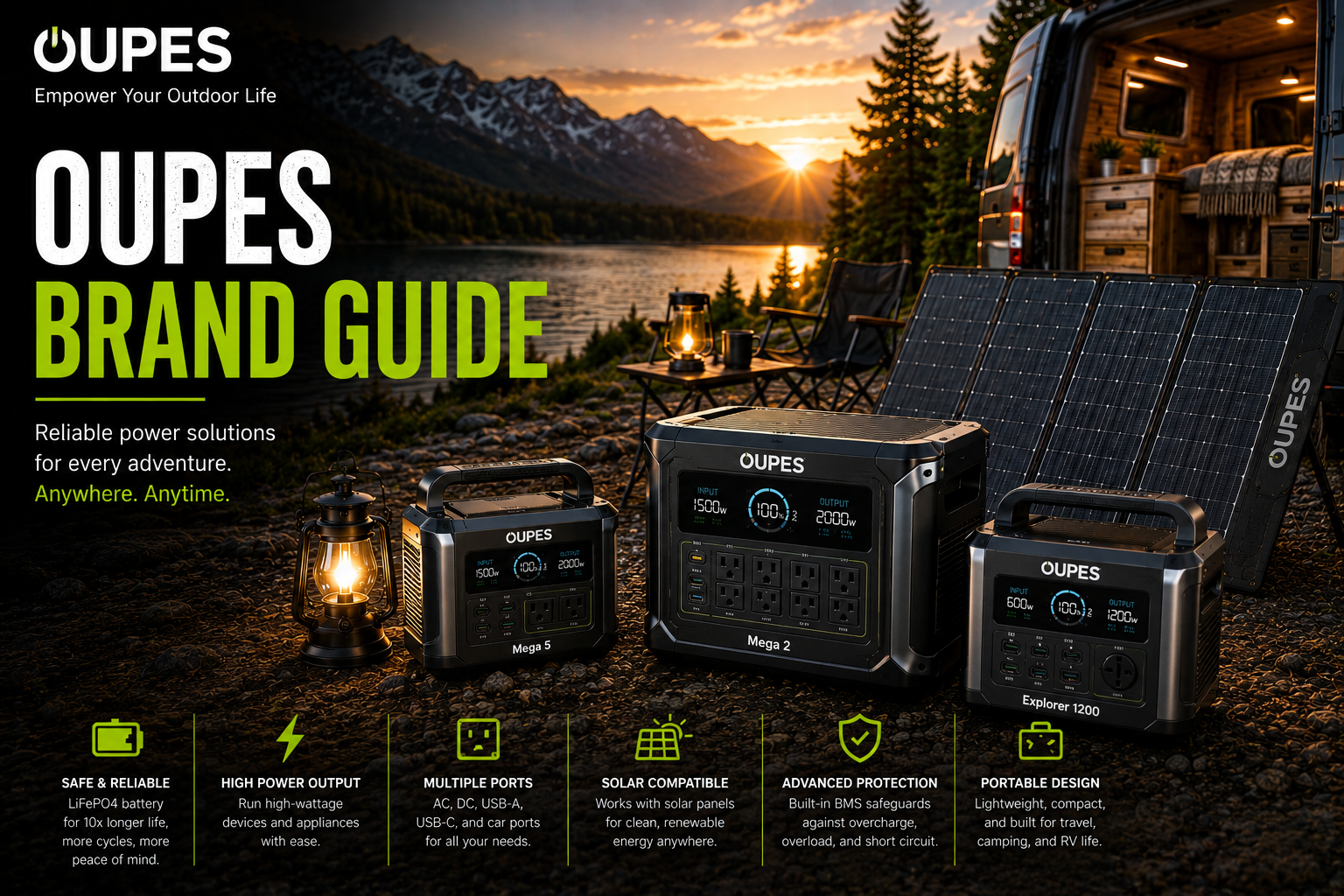
Choose OUPES by runtime, continuous output, charging speed, B2 or B5 battery compatibility, solar input and carrying weight.
OUPES makes high-spec stations, but buyers must distinguish base capacity from inverter power and B2 from B5 expansion.
This guide focuses on selecting the correct system before adding batteries and solar.
Mega 1 for Portability; Mega 2 for Balance; Mega 3 for Large Loads
Mega 2 is the safest general recommendation because it avoids the extremes of the 1kWh and 5kWh models.
Buying Guidance
Calculate loads first, then verify the battery family and current accessory stock before purchase.
Choose Capacity and Output Separately
| Class | Recommended Model | Best Use |
|---|---|---|
| 1kWh | Mega 1 | Portable high output |
| 2kWh | Mega 2 / Mega 2 Pro | RV and home essentials |
| 3kWh | Mega 3 | Large appliances |
| 5kWh | Mega 5 | Multi-day stationary backup |
Charging and Solar
Mega 1
Up to 2,200W combined input.
Mega 2
Strong AC plus solar charging.
Mega 2 Pro
About 0.6-hour full-charge positioning.
Mega 3
Up to 3,900W combined input.
Mega 5
High-input 5kWh platform.
Solar Panels
Match voltage and current exactly.
Expansion Batteries
B2 batteries support the Mega 1, Mega 2 and Mega 3 ecosystems in approved configurations. Mega 5 uses the separate B5 family. These packs are not interchangeable.
Common Buying Mistakes
Buying by Surge Watts
Use continuous output.
Mixing B2 and B5
They are different.
Ignoring Weight
Mega 3 and 5 are heavy.
Assuming Native 240V
Verify exact output.
Skipping UPS Details
Sensitive equipment needs checks.
Buying Base Before Battery
Confirm expansion stock first.
Frequently Asked Questions
Who should buy an OUPES station?
Buy it when OUPES’ high inverter output, rapid charging, app control and expansion pricing match your actual backup plan.
Who should skip an OUPES station?
Skip it when native 240V, lower weight or a larger retail service network matters more.
How should OUPES runtime be estimated?
Multiply rated watt-hours by roughly 0.80 to 0.90 for usable AC energy, then divide by average load watts.
Can OUPES run a refrigerator?
Mega 1 and larger models can generally run common refrigerators when compressor startup remains within surge limits.
Can third-party solar panels be used?
Yes, when voltage, current, polarity and connectors remain within the exact model’s MPPT specifications.
Does OUPES work as a UPS?
Mega models advertise UPS or EPS operation, but transfer time should be verified for sensitive servers or medical equipment.
How long do OUPES batteries last?
Current Mega LFP models generally claim more than 3,500 cycles to about 80% capacity.
Are OUPES expansion batteries universal?
No. B2 batteries serve Mega 1, Mega 2 and Mega 3 families, while B5 is for Mega 5.
How should an OUPES station be stored?
Keep it cool, dry and ventilated, and follow the manual’s periodic charging guidance.
What is the biggest OUPES buying mistake?
Assuming all Mega models use the same battery pack, charging limit or UPS rating.
Which is best for an RV?
Mega 2.
Which supports the largest solar and expansion system?
Mega 5.