
Pecron Portable Power Stations and Backup Power
Pecron spans compact camping stations, expandable mid-size systems and 3–4kWh home-backup platforms with aggressive capacity and solar-input value.
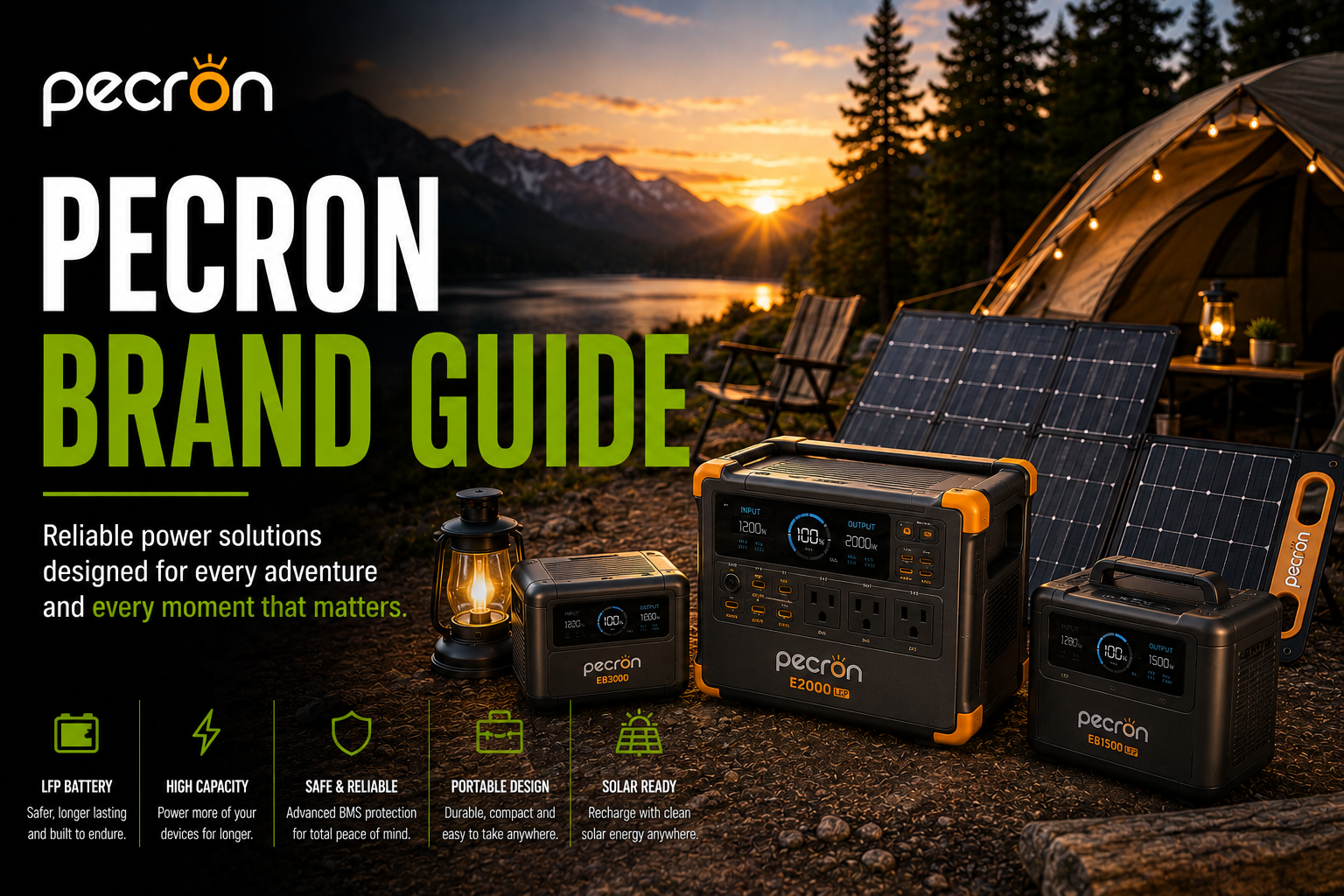
Pecron spans compact camping stations, expandable mid-size systems and 3–4kWh home-backup platforms with aggressive capacity and solar-input value.
Pecron’s lineup is broad but not perfectly unified, so choosing the correct battery family and generation matters as much as capacity.
This guide separates current value models, legacy expansion systems and newer high-output platforms so buyers can compare them accurately.
E1000LFP for 1kWh, E1500LFP for Expansion, E3600LFP for Home Backup
The E2400LFP is the cleaner current 2kWh choice, while the older E2000LFP remains attractive when deeply discounted.
Hub Verdict
Pecron is strongest for buyers who prioritize watt-hours, solar input and expansion value and are willing to verify accessory compatibility carefully.
Pecron Platform Overview
Compact E Series
E600LFP and E1000LFP serve camping and essentials.
Expandable Mid-Size
E1500LFP adds large 48V expansion.
Legacy 2kWh
E2000LFP uses dedicated 24V batteries.
Modern 2kWh
E2400LFP improves output and charging.
Large Home Backup
E3600LFP and E3800LFP support heavier loads.
F Series
Newer fast-charging alternatives sit beside the E line.
Current Pecron Model Map
| Model | Capacity | Output | Expansion | Best Use |
|---|---|---|---|---|
| E600LFP | 614Wh | 1,200W | Limited | Camping |
| E1000LFP | 1,024Wh | 1,800W | Model dependent | General backup |
| E1500LFP | 1,536Wh | 2,200W | Up to 9,216Wh | RV/scalable |
| E2000LFP | 1,920Wh | 2,000W | Up to 8,064Wh | Long runtime |
| E2400LFP | 2,048Wh | 2,400W | Platform dependent | Modern 2kWh |
| E3600LFP | 3,072Wh | 3,600W | Large + paired 240V | Home backup |
| E3800LFP | 3,840Wh | 4,200W class | Large | Maximum base |
Where Pecron Stands Out
Capacity per Dollar
Pecron often prices large batteries aggressively.
High Solar Input
Larger models accept substantial PV arrays.
Expansion Options
Selected E models scale beyond 7–15kWh.
App and UPS Features
Newer models add remote control and backup behavior.
12V High-Current Output
Useful for RV and vehicle loads.
Paired 240V Systems
E3600LFP can support 240V with two units and hardware.
How to Choose
Start With Runtime
Capacity determines hours.
Then Check Output
Inverter watts determine appliance compatibility.
Verify Battery Family
24V and 48V packs differ.
Plan Solar Voltage
Do not exceed MPPT limits.
Consider Weight
Large models exceed 60–80 lb.
Price the Whole System
Expansion and carts can dominate cost.
How to Evaluate Pecron as a Backup-Power System
Treat the Pecron lineup as a system rather than choosing by battery capacity alone. Start with the appliances you need to support, add simultaneous continuous watts, identify compressor or motor startup surges, and then estimate the watt-hours required for the desired runtime. That separates inverter sizing from battery sizing and prevents a large-capacity model from being mistaken for one that can necessarily run every high-draw load.
Recharge strategy matters almost as much as stored energy. Compare AC charging, solar-input limits and any vehicle-charging options with the way the station will actually be used. Fast wall charging is valuable for repeated cycling, while adequate solar input becomes more important when the goal is multi-day off-grid or outage use.
Also evaluate the surrounding Pecron ecosystem. Expansion batteries, proprietary cables, solar adapters, app requirements and accessory availability can materially change long-term ownership. A lower base-unit price is not necessarily lower total cost if the configuration you need requires expensive or hard-to-source extras.
For emergency use, reliability and support deserve extra weight. Check current warranty terms, service channels and the availability of replacement accessories before committing to an ecosystem. Brand and product lines change, so verify current specifications rather than assuming an older review or model generation still represents what is sold today.
Four Questions to Answer Before Choosing a Model
What must run at the same time?
Use simultaneous continuous watts plus realistic startup surge to establish the inverter requirement.
How many hours of backup do you need?
Convert the intended loads and operating time into watt-hours, then leave reserve for conversion losses and changing conditions.
How will you recharge it?
Match wall, solar and vehicle charging options to the actual outage, travel or off-grid scenario.
Will the ecosystem still work for you later?
Consider expansion batteries, cable compatibility, accessories, warranty support and the cost of growing the system.
Frequently Asked Questions
Who should buy Pecron backup power?
Buy it when Pecron’s combination of capacity, inverter output, solar input and expansion value matches your real load and runtime requirements.
Who should skip Pecron backup power?
Skip it when lower weight, a simpler nationwide retail network, native 240V from one unit or a more polished app ecosystem matters more.
How should Pecron runtime be estimated?
Multiply rated watt-hours by roughly 0.80 to 0.90 for practical AC energy, then divide by the appliance’s average running watts.
Can Pecron run a refrigerator?
E1000LFP and larger models can generally run refrigerators when compressor startup remains within the inverter’s surge rating.
Can Pecron charge from third-party solar panels?
Yes, when panel open-circuit voltage, current, polarity and connectors remain within the exact model’s input limits.
Do Pecron stations work as a UPS?
Several current E-series models advertise UPS functionality, but transfer behavior should be checked for sensitive servers or medical devices.
How long do Pecron batteries last?
Many current Pecron LiFePO4 models are rated around 3,500 cycles to 80% remaining capacity under stated conditions.
Are Pecron expansion batteries universal?
No. E2000LFP uses the 24V EB3000 system, while E1500LFP and newer 48V platforms use different compatible packs.
How should a Pecron station be stored?
Store it cool and dry, avoid extreme heat, maintain charge according to the manual and protect ports from moisture and debris.
What is the most common Pecron buying mistake?
Assuming every E-series model uses the same expansion battery, charging input and accessory cable.
Which Pecron is best overall?
E2400LFP for a modern 2kWh system; E1500LFP for mid-size expansion.
Which Pecron supports 240V?
Two E3600LFP units with the compatible 240V box.