
Zendure vs BLUETTI: Which Portable Power Station Brand Is Better?
Zendure and BLUETTI both sell battery-powered alternatives to fuel generators, but their product strategies are quite different. Zendure's SuperBase family emphasizes distinctive battery technology and large modular systems. BLUETTI offers a wider selection of portable power stations, including competitive 2kWh models and expandable home-backup platforms.
We compare the actual products, not just brand promises, to help you decide which is better for camping, RV use, emergency backup, solar charging and long-term ownership.
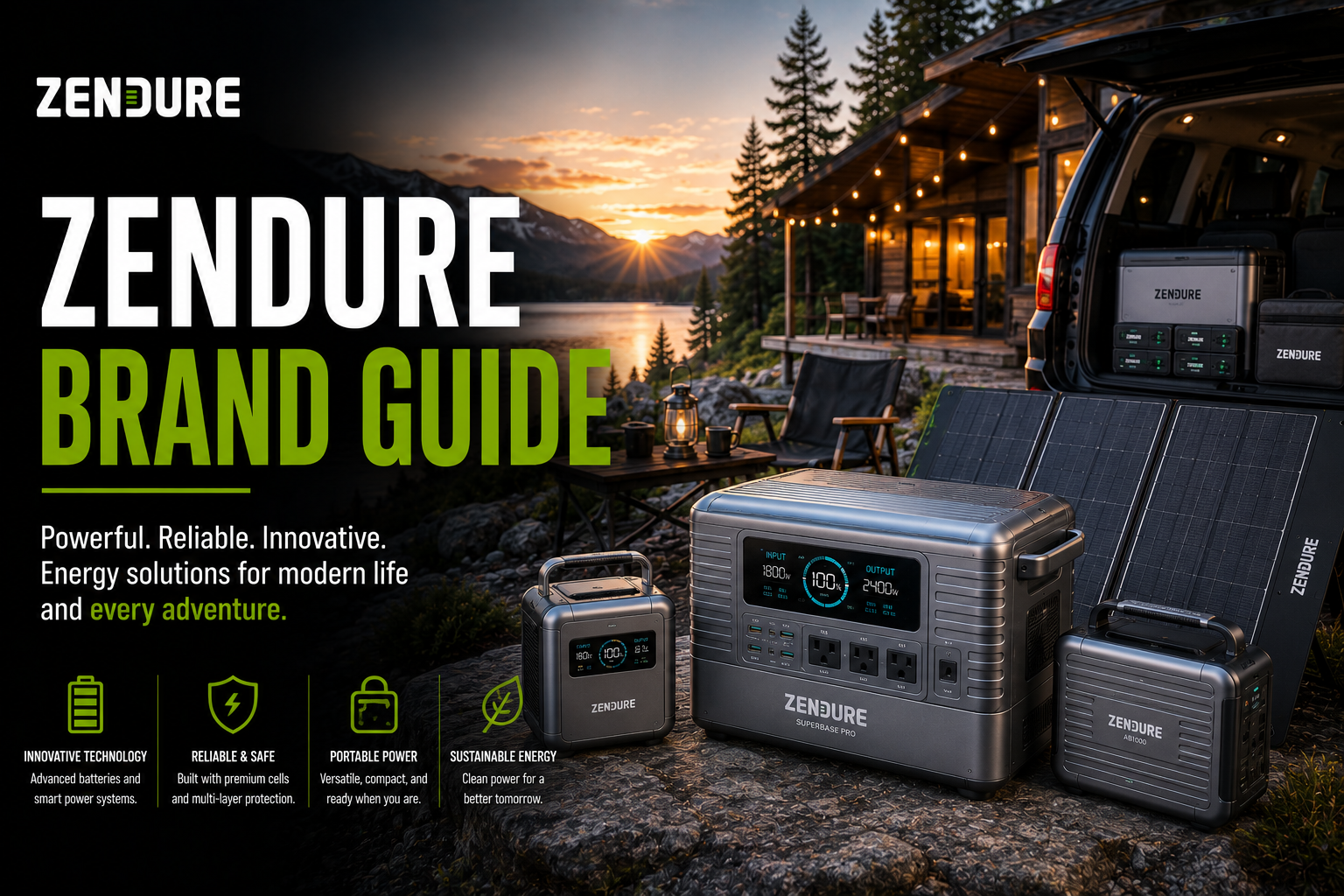
Our overall recommendation is BLUETTI for most buyers. Its broader current portable lineup, stronger 2kWh-class inverter options and clearer upgrade paths make it easier to match a product to a specific need. Zendure remains interesting for buyers considering a SuperBase V installation or who specifically value its semi-solid-state battery option.
The important qualification is that Zendure's SuperBase Pro 2000, SuperBase V4600 and SuperBase V6400 are not interchangeable product families. Likewise, BLUETTI's Elite portable stations and AC-series modular systems serve different purposes. The best choice depends on whether you need a movable battery for occasional outages or a more permanent backup system.
Quick Verdict: Zendure or BLUETTI?
Choose BLUETTI if you want a portable power station today. The Elite 200 V2 delivers 2,073.6Wh of capacity and 2,600W of continuous AC output in a 53.4-pound package. That is a compelling combination for camping, RV trips and emergency household loads.
Choose Zendure if you are specifically building around SuperBase V. The V4600 and V6400 platforms are designed around large energy capacity, battery expansion and specialized home-backup configurations. Their battery chemistries differ, so the exact model matters.
Choose BLUETTI for broader product choice. Its current range spans compact stations, roughly 1–3kWh portable units and larger systems. Zendure's US portable catalog is more limited, and availability should be confirmed before planning an ecosystem around an older model.
Zendure vs BLUETTI: Side-by-Side Comparison
| Category | Zendure | BLUETTI | Editorial Verdict |
|---|---|---|---|
| Current portable selection | Smaller US lineup centered on SuperBase products | Broad Elite and AC-series selection | BLUETTI |
| 2kWh-class example | SuperBase Pro 2000: 2,096Wh / 2,000W | Elite 200 V2: 2,073.6Wh / 2,600W | BLUETTI for AC output |
| Battery technology | NMC in SuperBase Pro 2000; LFP or semi-solid-state in SuperBase V | Primarily LFP in current portable models | Depends on chemistry priorities |
| Large backup systems | SuperBase V modular architecture | AC300, AC500, Apex and other home systems | Depends on installation |
| Portable weight at roughly 2kWh | SuperBase Pro 2000 is a wheeled design | Elite 200 V2 weighs 53.4 lb | Depends on carrying vs rolling |
| Solar flexibility | Model-specific limits; SuperBase V targets larger solar systems | Broad range of solar inputs across models | Match the actual model |
| Warranty | SuperBase Pro 2000: 2 years; SuperBase V: 3 years under published US terms | Elite 200 V2 and AC200L: 5 years under published US terms | BLUETTI on these models |
| Best overall for typical buyers | Specialized applications | Camping, RV and general home backup | BLUETTI |
Manufacturer-published specifications and warranty terms may vary by region, configuration and purchase channel. Verify the exact product before ordering.
Portable Power Station Comparison: SuperBase Pro 2000 vs Elite 200 V2
This is the most useful direct comparison for buyers considering a roughly 2kWh portable battery. Both can run ordinary 120V appliances within their inverter limits, but they take different approaches to portability and battery design.
| Specification | Zendure SuperBase Pro 2000 | BLUETTI Elite 200 V2 |
|---|---|---|
| Battery capacity | 2,096Wh | 2,073.6Wh |
| Continuous AC output | 2,000W | 2,600W |
| Battery chemistry | NMC | LiFePO₄ |
| Transport approach | Integrated wheels and handle | Compact carryable design |
| Published US warranty | 2 years | 5 years |
| Best fit | Users who prefer rolling a larger station | Users prioritizing AC output and LFP chemistry |
BLUETTI Elite 200 V2
Strong continuous AC output, LFP chemistry and a comparatively compact form factor.
The Elite 200 V2 is our preferred option for buyers who need a substantial but still transportable power station. Its 2,600W rated AC output provides more headroom than Zendure's SuperBase Pro 2000 for appliances that draw significant power continuously.
BLUETTI lists 1,000W maximum solar input, with a 12–60V input range and 20A current limit. Those limits matter when selecting third-party panels: a high-voltage panel string that works with another station may exceed the Elite 200 V2's maximum input voltage.
The LFP battery is another important distinction. BLUETTI advertises a high cycle-life rating for this model, although actual lifespan depends on temperature, cycling, storage and charging conditions. Manufacturer cycle-life figures should not be interpreted as guaranteed years of service.
- 2,600W rated continuous AC output
- Approximately 2.07kWh of energy storage
- LFP battery chemistry
- 53.4-pound weight for its capacity class
- Five-year published US warranty
- Still heavy to carry over long distances
- 1,000W solar input ceiling
- Not a native 240V split-phase home-backup system
- External batteries and accessories require exact compatibility checks
Buy it if: You want one capable portable station for camping, RV trips, refrigerator backup or a collection of household essentials.
Skip it if: You need a permanently installed whole-home system, a native 240V output or a very lightweight station for carrying on foot.
Check PriceZendure SuperBase Pro 2000
A wheeled 2kWh-class power station with a different battery chemistry and mobility approach.
The SuperBase Pro 2000 remains an interesting alternative because of its integrated wheels and telescoping handle. Rather than carrying the full weight for every move, users can roll the unit across suitable surfaces.
Zendure specifies a 2,096Wh NMC battery and 2,000W continuous AC output. Its advertised 4,000W surge capability should not be confused with its continuous rating. The company's AmpUp feature changes output behavior for certain demanding loads and is not equivalent to delivering unlimited additional continuous power.
NMC chemistry is not inherently unsuitable for portable stations, but buyers specifically prioritizing LFP cycle-life characteristics may prefer a different model. Zendure's SuperBase Pro 1500 uses LFP; the Pro 2000 does not.
- Integrated wheels and telescoping handle
- 2,096Wh battery capacity
- 2,000W continuous AC inverter
- App connectivity and configurable operating features
- Lower continuous output than Elite 200 V2
- NMC rather than LFP battery
- Shorter published US warranty
- Availability and long-term accessory support should be confirmed
Buy it if: You find a well-supported unit at an attractive total price and prefer wheeled mobility over carrying a heavy battery.
Skip it if: You prioritize LFP chemistry, the strongest continuous AC output in this comparison or the longer published warranty.
Check PriceHome Backup: Zendure SuperBase V vs BLUETTI Modular Systems
For home backup, the comparison changes substantially. A 2kWh portable station is useful for selected appliances, but multi-day backup or circuits requiring 240V may demand a different system architecture.
Zendure's SuperBase V family was designed around large modular storage, while BLUETTI offers multiple expansion platforms, including the AC300, AC500 and newer Apex-class products. The correct choice depends on the actual installation, supported batteries, output configuration and available service.
SuperBase V4600 / V6400
The SuperBase V family targets high-capacity modular power. Its defining feature is the choice between the LFP-based V4600 and the semi-solid-state V6400, with model-specific satellite batteries and expansion arrangements.
The architecture is attractive for specialized high-capacity applications, but it requires careful planning. Battery families and chemistries are not interchangeable.
AC300 / AC500 / Apex Systems
BLUETTI provides several modular paths for buyers who need more storage or higher output than a standalone portable station offers.
However, each platform has its own supported expansion batteries and configuration requirements. Do not assume a battery from one BLUETTI series can be connected to another.
Which Brand Wins for Whole-Home Backup?
There is no defensible universal winner. Zendure's SuperBase V can be compelling for a buyer specifically seeking its large modular architecture. BLUETTI offers more distinct product pathways and may be easier to compare across different home-backup budgets and power requirements.
Before selecting either brand, calculate the household circuits that must remain powered, the peak simultaneous demand, motor startup requirements, 120V/240V needs and the battery capacity required for the desired outage duration.
The most important distinction is between a portable battery used with extension cords and a system designed to supply selected household circuits. Those are different electrical projects, even when both use batteries.
Battery Technology: LFP, NMC and Semi-Solid-State
Battery chemistry is one of Zendure's most distinctive selling points, but it is also an area where vague brand comparisons become misleading.
| Product Family | Battery Chemistry | What It Means |
|---|---|---|
| Zendure SuperBase Pro 2000 | NMC | Different chemistry from the LFP Pro 1500 and SuperBase V4600 |
| Zendure SuperBase Pro 1500 | LFP | Smaller Pro model with a different battery chemistry |
| Zendure SuperBase V4600 | LFP | Large modular battery architecture |
| Zendure SuperBase V6400 | Semi-solid-state | Distinct battery design and model-specific expansion compatibility |
| BLUETTI Elite 200 V2 | LFP | Portable station with a manufacturer-advertised high cycle-life rating |
| BLUETTI AC200L | LFP | Expandable 2kWh-class station with a different system architecture |
Does Semi-Solid-State Automatically Make Zendure Better?
No. Semi-solid-state battery technology is an important product distinction, but it does not automatically make a power station superior in every practical category.
The value depends on the specific product's energy density, cycle-life rating, thermal behavior, warranty, safety documentation and complete system cost. A buyer who needs a manageable 2kWh station for occasional outages may gain more practical value from an LFP model with suitable outputs and straightforward support.
Can Zendure Batteries Be Mixed?
Do not assume so. Zendure's V4600 and V6400 configurations use different battery technologies and corresponding expansion products. SolarFlow batteries are also part of a separate product ecosystem. Follow the exact compatibility documentation rather than treating all Zendure-branded batteries as interchangeable.
Solar Charging: Which Brand Is Better?
Neither brand wins every solar-charging scenario. The decisive specifications are the particular model's maximum PV voltage, current and wattage, plus the way its charge controller handles the connected panels.
Up to 1,000W Solar Input
BLUETTI lists a 12–60V solar input range with a 20A current limit and 1,000W maximum PV input. That makes panel-string voltage an important design constraint.
Up to 1,200W Solar Input
The AC200L has a different solar-input envelope: 12–145V open-circuit voltage range, 15A current limit and 1,200W maximum solar input.
These two BLUETTI products illustrate why it is risky to choose panels based on brand alone. A series-connected array compatible with the AC200L's higher input-voltage ceiling may be unsuitable for the Elite 200 V2.
Zendure's SuperBase V is designed for larger solar configurations, but its published input limits must be checked for the exact V4600 or V6400 setup. Likewise, the SuperBase Pro series has different charging specifications from SuperBase V.
Which Brand Offers Better Portability?
Portability is not just a question of weight. The distance you need to move the station, the surfaces involved and whether you must lift it into a vehicle all affect the answer.
BLUETTI Advantage
A compact Elite-series station is generally easier to position inside a vehicle, tent setup or small storage area.
Zendure Advantage
SuperBase Pro's wheels and telescoping handle can reduce the need to carry the unit across suitable surfaces.
Depends on System
For larger modular systems, installation footprint, ventilation, cable routing and service access matter more than carry handles.
If you routinely lift a power station into a vehicle, check its actual weight and handle arrangement before buying. A model that rolls easily on pavement can still be awkward on stairs, gravel or uneven ground.
Runtime Comparison: What Can a 2kWh Station Actually Run?
Battery capacity is measured in watt-hours, while appliance demand is measured in watts. To estimate AC runtime, divide usable battery energy by the appliance's average electrical draw.
The examples below assume 85% of rated battery energy is delivered as usable AC energy. This is an illustrative planning assumption, not a measured efficiency figure for either station.
| Average AC Load | Zendure Pro 2000 Estimate | BLUETTI Elite 200 V2 Estimate |
|---|---|---|
| 50W | 35.6 hours | 35.3 hours |
| 100W | 17.8 hours | 17.6 hours |
| 200W | 8.9 hours | 8.8 hours |
| 500W | 3.6 hours | 3.5 hours |
| 1,000W | 1.8 hours | 1.8 hours |
Formula: rated Wh × 0.85 ÷ average load W. Estimates exclude unusual startup loads, standby consumption, temperature effects, battery aging and model-specific conversion behavior. Very small loads can experience proportionally greater inverter overhead.
The key insight is that the two batteries have nearly identical energy capacity. For the same moderate load, their theoretical runtimes are similar. BLUETTI's main advantage in this matchup is the higher continuous AC output, not dramatically longer runtime.
Warranty, Support and Long-Term Ownership
A power station is a significant purchase, and support can matter as much as its initial specification sheet. Batteries, inverters, charging electronics and proprietary accessories are not necessarily economical to repair independently.
Zendure's published US warranty terms list two years for the SuperBase Pro 2000 and three years for SuperBase V4600 and V6400. BLUETTI's published US warranty information lists five years for the Elite 200 V2 and AC200L.
Warranty coverage is not the same as an assurance of immediate replacement. Read the full terms for purchase-channel eligibility, exclusions, registration requirements, shipping responsibilities and available remedies.
How to Choose Between Zendure and BLUETTI
Identify the Appliances You Need to Run
List each device's continuous power requirement and any startup surge. A refrigerator, sump pump or air conditioner may demand much more power briefly at startup than during normal operation.
Calculate the Energy You Need
Multiply average watts by expected hours of operation. Add a realistic allowance for conversion losses and reserve capacity. A 2kWh station and a 6kWh system solve very different outage-duration problems.
Decide Whether Portability Is Essential
If you need to carry the station frequently, compare actual weights and dimensions. If you mainly move it across smooth surfaces, wheels may be more useful than a compact body.
Verify Solar and Charging Compatibility
Match the panel array's voltage and current to the exact station. Check charging input limits, adapters and whether your intended charging configuration is supported.
Compare the Complete System Cost
Include the base station, expansion batteries, solar panels, required cables and any approved home-backup hardware. Do not compare a bare station with a fully equipped competing system.
Confirm Availability and Warranty Support
Check that the exact product and accessories can be purchased and serviced in your region. This is especially important for older Zendure models and specialized modular battery configurations.
Which Brand Should You Choose for Each Use Case?
| Use Case | Preferred Direction | Why |
|---|---|---|
| Camping and road trips | BLUETTI | Broader range of compact and mid-size portable models |
| 2kWh-class emergency backup | BLUETTI Elite 200 V2 | Higher continuous output and LFP chemistry |
| Rolling a 2kWh station on level ground | Zendure SuperBase Pro 2000 | Integrated wheeled design |
| Large specialized modular battery system | Compare SuperBase V and BLUETTI modular systems | Configuration and installation requirements decide the outcome |
| Interest in semi-solid-state battery technology | Zendure SuperBase V6400 | Distinct battery chemistry not offered in the compared BLUETTI portable models |
| Widest range of portable capacities | BLUETTI | More choices across compact, medium and large portable stations |
Frequently Asked Questions
Is Zendure better than BLUETTI?
Not overall. BLUETTI is the stronger general recommendation for most portable power station buyers because of its broader lineup and competitive current models. Zendure is worth considering for specific SuperBase features, especially large modular systems and the V6400's semi-solid-state battery technology.
Which is better: Zendure SuperBase Pro 2000 or BLUETTI Elite 200 V2?
We prefer the BLUETTI Elite 200 V2 for most buyers. It provides 2,600W of rated continuous AC output compared with Zendure's 2,000W, while both have roughly 2kWh of battery capacity. Zendure's integrated wheels may appeal to users who prefer rolling a station.
Does Zendure use solid-state batteries?
The SuperBase V6400 uses a semi-solid-state battery design. That does not mean all Zendure products use the same chemistry. The SuperBase V4600 uses LFP, and the SuperBase Pro 2000 uses NMC.
Which brand has a better warranty?
For the specific US models compared here, BLUETTI publishes a five-year warranty for the Elite 200 V2 and AC200L, while Zendure publishes two years for the SuperBase Pro 2000 and three years for SuperBase V. Terms vary by product and region.
Can either brand power a refrigerator?
Many models can operate a compatible refrigerator if its running watts and startup surge remain within the station's limits. Runtime depends on the refrigerator's actual average energy use, ambient temperature, cycling behavior and usable battery capacity.
Can Zendure and BLUETTI batteries be connected together?
Do not connect proprietary expansion batteries across brands. Expansion batteries use model-specific electrical connections, control systems and communication protocols. Use only configurations expressly supported by the equipment manufacturers.
Which brand is better for solar panels?
It depends on the model and panel configuration. For example, BLUETTI's Elite 200 V2 supports up to 1,000W solar input with a 12–60V range, while the AC200L supports up to 1,200W with a higher published voltage ceiling. Zendure models have their own distinct limits.
Are Zendure and BLUETTI power stations safe to use indoors?
Battery power stations do not produce gasoline-generator exhaust during normal battery operation, but they still require proper ventilation, dry conditions, suitable temperatures and adherence to manufacturer instructions. Do not cover cooling vents or expose units to water unless the specific model is rated for that environment.
Can I use either brand as a UPS?
Some models offer UPS or EPS-style switching, but transfer times and operating conditions vary. A marketed UPS function does not guarantee uninterrupted operation for every computer, network device or medical appliance. Check the exact model's transfer specification and test compatibility with noncritical equipment first.
Which brand is better for whole-home backup?
Neither wins universally. Compare the exact Zendure SuperBase V configuration against a suitable BLUETTI modular system based on continuous output, 120V/240V requirements, expansion capacity, installation hardware, local support and total cost. Whole-home electrical connections require an appropriate professionally installed transfer arrangement.
Final Verdict: BLUETTI Wins for Most Buyers, Zendure for Specific Systems
BLUETTI is our overall winner because it offers a broader selection of current portable stations and a strong combination of capacity, AC output and LFP battery technology in models such as the Elite 200 V2.
Zendure remains a legitimate alternative when its particular design advantages matter. The SuperBase Pro 2000's wheels are useful for some owners, while SuperBase V offers a different approach to high-capacity modular backup and semi-solid-state technology.
The decision should begin with the appliances you need to power, how long they must run and whether the system needs to move. Once those requirements are clear, compare the exact products and their complete ownership costs rather than choosing on brand reputation alone.
Compare Current OptionsSources and Editorial Methodology
This comparison uses official manufacturer product pages, technical specifications and published US warranty information. Product-selection conclusions are editorial judgments based on verified specifications and intended use cases, not claimed firsthand testing.
- Zendure — SuperBase Pro 2000 — capacity, output, battery chemistry and product features.
- Zendure — SuperBase V — modular system and product configurations.
- Zendure — US Warranty Terms — published warranty periods and coverage conditions.
- BLUETTI — Elite 200 V2 — capacity, continuous output, solar input, weight and battery specifications.
- BLUETTI — AC200L — solar input, expansion options and technical specifications.
- BLUETTI — US Product Warranty Periods — model-specific published warranty information.
- BLUETTI — Portable Power Station Lineup — current model range and capacity classes.
Specifications are manufacturer-published and may change with model revisions. Runtime examples are calculated estimates. Availability, accessories and warranty coverage should be confirmed for the exact product and purchase region.