
Zendure vs Jackery: Which Portable Power Station Brand Is Better?
Zendure and Jackery approach backup power differently. Jackery offers a broad range of conventional portable stations and solar-generator bundles. Zendure's SuperBase products emphasize distinctive charging features and, in the SuperBase V family, ambitious modular home storage. But availability, battery chemistry and long-term support change the buying decision.
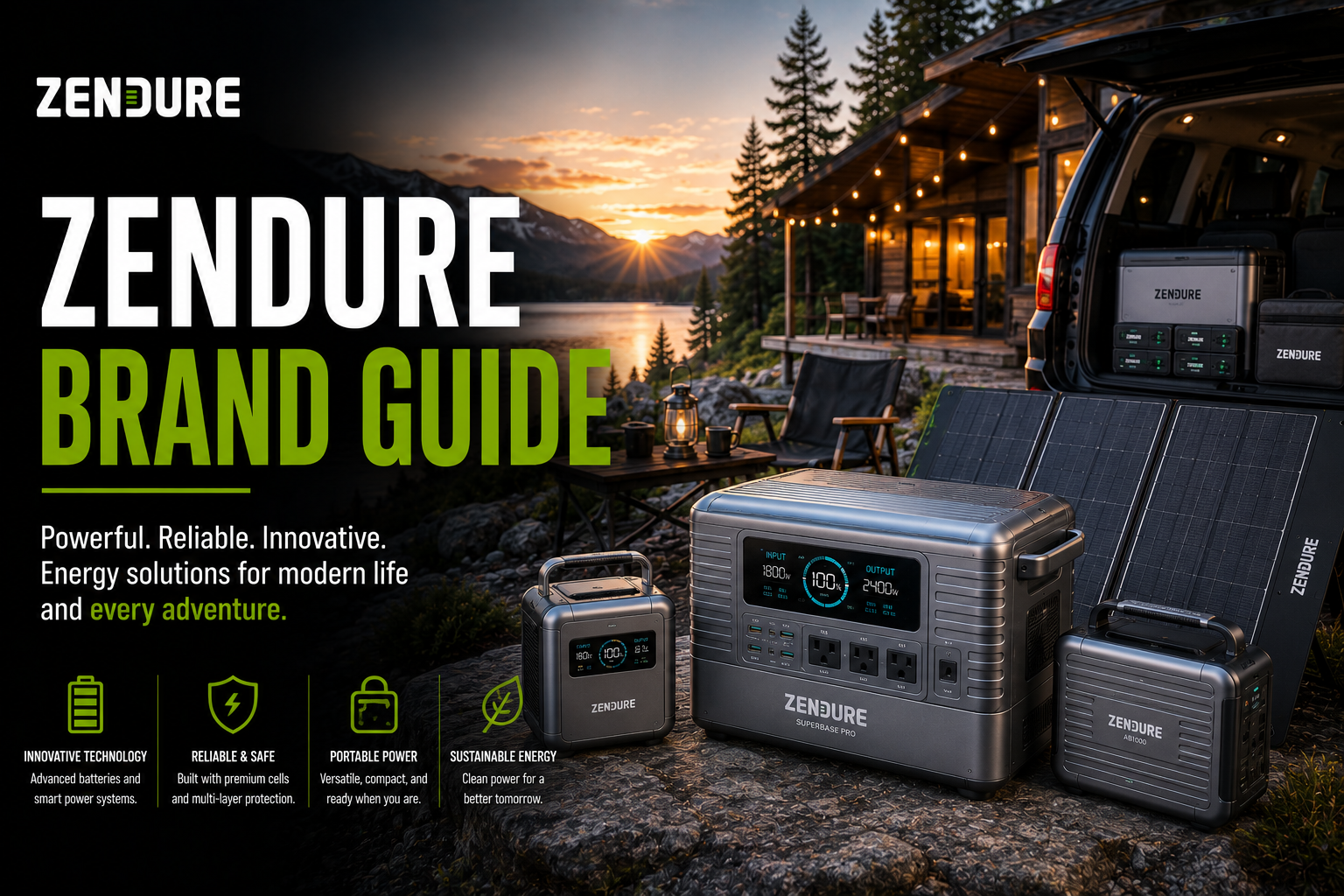
The short answer: Jackery is the more practical starting point for many US buyers seeking a portable station, because its official product lineup includes documented current-generation alternatives. Zendure's SuperBase Pro and SuperBase V remain technically interesting, but Zendure's US storefront currently marks its portable power-station range as sold out. That makes verified availability and after-sales support central to any Zendure purchase.
This is not a claim that every Jackery product is better engineered. In fact, Zendure SuperBase Pro 2000 offers some unusual charging and connectivity features, while SuperBase V can support much larger storage configurations than a conventional single portable station. The important question is whether those advantages justify the extra complexity and sourcing risk for your particular needs.
Our Verdict: Jackery for Straightforward Buying, Zendure for Specific System Requirements
Choose Jackery if you want a portable power station with clearly documented model generations, an established selection of SolarSaga bundles and a simpler path to buying a current product.
Consider Zendure if a specific SuperBase Pro feature or SuperBase V configuration solves a problem that a simpler station cannot, and you can verify the exact product, compatible accessories, warranty coverage and service arrangements before purchasing.
For home backup: Neither brand wins automatically. A modern Jackery HomePower system and a Zendure SuperBase V installation should be compared as complete electrical systems, not just batteries with different capacities.
Zendure vs Jackery: Key Differences at a Glance
Rather than comparing a brand's largest theoretical system with another brand's smallest portable unit, start with the models closest to your intended application.
| Buying Factor | Zendure | Jackery | Practical Implication |
|---|---|---|---|
| 2kWh-class example | SuperBase Pro 2000: 2,096Wh, 2,000W rated output | Explorer 2000 v2: 2,042Wh, 2,200W rated output | Similar storage; Jackery has slightly higher continuous output |
| Battery chemistry | SuperBase Pro 2000: NMC | Explorer 2000 v2: LiFePO4 | Different chemistry, longevity and operating characteristics |
| Carrying weight | SuperBase Pro 2000: approximately 46.5 lb | Explorer 2000 v2: approximately 39.5 lb | Jackery is roughly 7 lb lighter in this comparison |
| Expansion | SuperBase V supports proprietary satellite batteries | Explorer 2000 Plus supports dedicated expansion batteries | Neither ecosystem uses universal battery modules |
| Portable solar | SuperBase Pro 2000 supports distinct low-voltage and high-voltage solar paths | Explorer v2 and Plus models have model-specific DC solar limits | Panel electrical compatibility matters more than advertised panel wattage |
| US availability | Official Zendure US portable station collection currently shows sold-out listings | Jackery maintains active US listings for newer models | Confirm current sellers, stock and support before buying |
| Best fit | Specific SuperBase features or verified modular projects | Portable backup, camping and simpler essential-load systems | Choose by required functionality and complete ownership cost |
Portable Power: SuperBase Pro 2000 vs Explorer 2000 v2
These are more meaningful products to compare than an enormous expandable Zendure system against a small Jackery camping battery. Both have approximately 2kWh of storage and can operate compatible 120V equipment, but their design priorities differ.
SuperBase Pro 2000
NMC battery · approximately 46.5 lb
Its distinctive features include wheeled transport, wireless connectivity and two different solar input approaches. It is interesting for buyers with specific charging requirements.
Main concern: Zendure's official US product listing is sold out, so purchasing and support arrangements require extra diligence.
Check PriceExplorer 2000 v2
LiFePO4 battery · approximately 39.5 lb
Its appeal is a relatively compact, self-contained 2kWh battery with a 2,200W inverter, fast AC charging and a published under-20ms backup transfer specification.
Main limitation: It is not designed for the external battery expansion available on Explorer 2000 Plus.
Check Price- SuperBase Pro 2000 has slightly more nominal energy storage.
- Its integrated wheels can be convenient when moving the station across suitable surfaces.
- Its documented high-voltage solar input path may suit certain compatible panel arrangements.
- Its connectivity options include Wi-Fi and cellular/GPS functionality.
- Explorer 2000 v2 has higher rated continuous AC output.
- It weighs approximately 7 lb less.
- Its LiFePO4 chemistry differs from the SuperBase Pro 2000's NMC chemistry.
- It belongs to a more actively presented US product lineup.
Who Should Choose SuperBase Pro 2000?
It is worth considering if you specifically need its charging architecture, wheeled form factor or connectivity and can purchase a supported unit through a seller with clear return and warranty arrangements.
Who should avoid it? Buyers who want the least complicated path to a new portable station, those expecting an expandable battery system and anyone unable to verify current US support.
Who Should Choose Explorer 2000 v2?
It is a better starting point if you need a self-contained 2kWh station for camping, travel or limited home backup and prioritize carrying weight, normal AC output and a documented current-generation product.
Who should avoid it? Buyers whose primary requirement is adding several battery modules later, or those who need native 240V household output from a single station.
Home Backup: Zendure SuperBase V vs Jackery's Expandable Systems
This is where the comparison changes substantially. SuperBase V was designed as a large modular power system rather than a conventional portable camping battery. Jackery's Explorer 2000 Plus and newer HomePower products address parts of the same market, but with different electrical architectures.
SuperBase V4600 / V6400
Zendure's official comparison identifies two main SuperBase V battery variants:
- V4600: 4,608Wh, LiFePO4
- V6400: 6,438Wh, semi-solid-state battery chemistry
Zendure describes multi-unit systems with satellite batteries reaching much larger total storage capacities. Those figures apply only to specific supported combinations, not a single base station.
Best fit: A buyer evaluating a complete modular backup installation and willing to verify all required components.
Check PriceExplorer 2000 Plus
Jackery lists approximately 2,043Wh of base capacity and 3,000W rated output for Explorer 2000 Plus.
It supports compatible expansion batteries, with larger system configurations possible using Jackery's specified accessories and paired-unit arrangements.
Best fit: Buyers who want higher output and a modular system but prefer the Explorer ecosystem, provided all required batteries and connectors can be sourced.
Check PriceDoes Zendure Win Because SuperBase V Can Scale Larger?
Not necessarily. A higher maximum storage figure is only useful if you need that capacity, can afford the complete configuration and can install and maintain it appropriately.
For example, a household trying to maintain internet service, refrigeration, lights and small electronics may need far less storage than a multi-battery SuperBase V system provides. A simpler power station could meet that requirement with lower initial cost and fewer proprietary components.
On the other hand, someone planning multi-day backup for several circuits may need more energy than a single portable station can store. That is when modular systems become relevant—but the decision must include circuit compatibility, approved transfer equipment, charging capability and installation costs.
Solar Charging: Zendure Offers Interesting Options, but Compatibility Comes First
Solar input is one of the more distinctive differences between these brands, especially on SuperBase Pro 2000.
According to Zendure's US manual, SuperBase Pro 2000 supports:
- Low-voltage solar charging: 12–60V operating voltage, up to 600W through its XT60 input.
- High-voltage solar charging: 60–160V operating voltage, up to 1,800W through the specified AC-input charging path.
These are different input methods with different requirements. They should not be combined casually or interpreted as permission to connect any solar array within a headline wattage figure.
Jackery's charging systems vary by generation. Explorer 1000 v2, Explorer 2000 v2, Explorer 2000 Plus and newer HomePower products do not all have the same solar input limits or connector requirements.
Zendure Makes Sense When...
You have a carefully planned compatible solar array and need a charging feature that is specifically supported by the chosen Zendure model.
Jackery Makes Sense When...
You want a station and matched SolarSaga panel bundle with clearly identified accessories and fewer independent compatibility decisions.
Runtime Comparison: How Much Difference Does 2,096Wh vs 2,042Wh Make?
Very little in most real-world decisions. SuperBase Pro 2000 has about 2.6% more nominal energy storage than Explorer 2000 v2. Inverter efficiency, appliance behavior, ambient temperature and standby consumption can easily matter more than that difference.
| Average AC Load | Zendure SuperBase Pro 2000 | Jackery Explorer 2000 v2 |
|---|---|---|
| 100W | 17.8 hours | 17.4 hours |
| 200W | 8.9 hours | 8.7 hours |
| 500W | 3.6 hours | 3.5 hours |
| 1,000W | 1.8 hours | 1.7 hours |
The estimates show why a small difference in nominal watt-hours should not determine the purchase. If you need twice the runtime, you generally need substantially more stored energy, lower average consumption or a dependable way to recharge.
What About Refrigerators?
A refrigerator's compressor cycles on and off. The relevant energy requirement is its measured consumption over time, while the inverter must separately handle compressor starting demand.
Do not calculate refrigerator runtime using only its compressor's running wattage multiplied by 24 hours. Use an energy meter, a reliable appliance energy specification or a realistic daily consumption estimate.
Battery Chemistry, Warranty and Long-Term Ownership
Battery Chemistry Is Model-Specific
It would be inaccurate to say every Zendure uses one chemistry or every Jackery uses another.
- Zendure SuperBase Pro 2000: NMC lithium-ion battery.
- Zendure SuperBase Pro 1500: LiFePO4 battery.
- Zendure SuperBase V4600: LiFePO4 battery.
- Zendure SuperBase V6400: Zendure describes semi-solid-state chemistry.
- Jackery Explorer 2000 v2: LiFePO4 battery.
- Jackery Explorer 2000 Plus: LiFePO4 battery.
Battery chemistry influences cycle-life expectations, weight and thermal characteristics, but a chemistry label is not a substitute for reviewing the complete product design and manufacturer support.
What About Warranty?
Zendure's SuperBase Pro 2000 US manual lists a two-year warranty. Jackery advertises a longer warranty arrangement for Explorer 2000 v2 when purchased through qualifying channels, including a three-year base period plus an additional two years under its stated offer.
However, warranty eligibility may depend on country, seller, product registration, purchase date and whether a unit is new or refurbished. Check the applicable terms for the exact transaction rather than treating advertised coverage as universal.
The Hidden Cost of an Expandable System
The price of a base station is only one part of the cost. A large backup setup may require additional batteries, proprietary cables, compatible solar hardware, mounting or transfer equipment and professional electrical work.
Lower-Complexity Ownership
A standalone portable station has fewer components to source and is easier to relocate. It is often the sensible choice for camping, occasional outages and limited essential-load backup.
Higher-Capacity Ownership
A modular system can increase runtime significantly, but it introduces compatibility, space, service and installation considerations. Expansion is valuable only when it is practical to obtain and use.
Which Brand Should You Choose for Your Situation?
| Your Main Requirement | Recommended Direction | Why |
|---|---|---|
| Camping and road trips | Start with Jackery | Broad range of portable sizes and matched panel bundles |
| Portable 2kWh backup | Jackery Explorer 2000 v2 | Lower weight and higher normal AC output than SuperBase Pro 2000 |
| Specialized high-voltage solar charging | Consider Zendure SuperBase Pro 2000 | Documented alternative solar input architecture; availability must be confirmed |
| Very large modular storage | Evaluate SuperBase V and current Jackery HomePower systems | Compare complete supported configurations rather than base-unit specifications |
| Simple emergency preparation | Start with Jackery | A standalone model may provide sufficient backup without expansion complexity |
| Buying an older discounted unit | Neither brand automatically wins | Battery condition, accessories, seller support and warranty can outweigh specifications |
Three Questions to Answer Before Buying
- What is the maximum simultaneous load? Add the continuous watts of everything that may run together, then evaluate motor and compressor starting demand separately.
- How much energy do you need? Estimate average watts multiplied by hours, with allowance for conversion losses and a sensible reserve.
- Can you support the system long-term? Verify compatible batteries, solar accessories, charging equipment, service options and warranty coverage.
Once both products safely meet the first two requirements, the third question often determines which is the better purchase.
Frequently Asked Questions
Is Zendure better than Jackery?
Not universally. Zendure's SuperBase Pro and SuperBase V offer features that may suit specialized charging or modular storage projects. Jackery is generally the more straightforward starting point for US buyers seeking a portable station, especially given the sold-out status shown on Zendure's official US portable power-station collection.
Is Zendure SuperBase Pro 2000 more powerful than Jackery Explorer 2000 v2?
No, not in continuous rated AC output. SuperBase Pro 2000 is rated at 2,000W, while Explorer 2000 v2 is rated at 2,200W. Zendure has slightly more nominal battery capacity: 2,096Wh versus 2,042Wh.
Does Zendure use LiFePO4 batteries?
Some models do. SuperBase Pro 1500 and SuperBase V4600 use LiFePO4, while SuperBase Pro 2000 uses NMC. SuperBase V6400 uses a different chemistry described by Zendure as semi-solid-state. Always check the exact model.
Can Zendure SuperBase V power a house?
SuperBase V can form part of a supported home-backup system, but household compatibility depends on the exact configuration, output voltage, total load, transfer equipment and installation. It should not be connected directly to home circuits without approved equipment and appropriate professional installation.
Can I add batteries to any Jackery or Zendure?
No. Expansion depends on the specific product family. Explorer 2000 v2 is not expandable like Explorer 2000 Plus, and Zendure's SuperBase Pro does not use the SuperBase V satellite-battery system. Do not mix proprietary battery families.
Are Zendure portable power stations discontinued?
Zendure's official US portable power-station collection currently displays sold-out listings for its SuperBase products. That alone does not establish that every product has been formally discontinued worldwide. Confirm model status and regional support directly with Zendure before purchasing.
Which brand is better for a refrigerator during a blackout?
Choose a specific station based on the refrigerator's starting watts, running watts and measured energy use. A 2kWh-class station from either brand may be suitable for certain refrigerators, but compatibility and runtime cannot be guaranteed from battery capacity alone.
Sources and Editorial Methodology
This comparison uses official manufacturer documentation and US product listings. We evaluated the brands by rated output, battery capacity, chemistry, charging architecture, expansion compatibility, portability and ownership considerations. We did not conduct or claim independent hands-on testing.
- Zendure — SuperBase Pro 2000 Official Product Information
- Zendure — SuperBase Pro 2000 US User Manual
- Zendure — Official SuperBase Model Comparison
- Zendure — US Portable Power Station Collection
- Jackery — Explorer 2000 v2 Specifications
- Jackery — Official Explorer 2000 Generation Comparison
How to interpret this guide: Battery capacities, rated output and product features are manufacturer-published specifications. Runtime figures are calculated estimates, not measured test results. Availability observations reflect the official storefront when reviewed and may change. Recommendations are editorial conclusions based on the stated trade-offs.
Final Verdict: Jackery Is the Easier Starting Point, but Zendure Has Distinctive Strengths
For most US shoppers who want a portable power station for camping, travel or essential backup, Jackery is the more practical first brand to compare. Its Explorer 2000 v2 offers a compelling combination of capacity, rated output and carrying weight, while its broader lineup provides smaller and larger alternatives.
Zendure is worth a closer look when a specific SuperBase Pro charging feature or a SuperBase V modular configuration meets a genuine requirement. But buyers should not overlook the current US availability situation or the cost of maintaining an older proprietary system.
Choose the exact model that safely handles your loads, delivers the runtime you need and has the support and accessories required for years of ownership. The brand name comes second.
Compare Current Options