
Zendure Portable Power Stations & Backup Power: Models Compared
Zendure makes several very different power systems, from compact travel batteries to expandable home-backup stations. The right choice depends on whether you need mobility, inverter power, battery runtime or a dedicated home-energy setup.
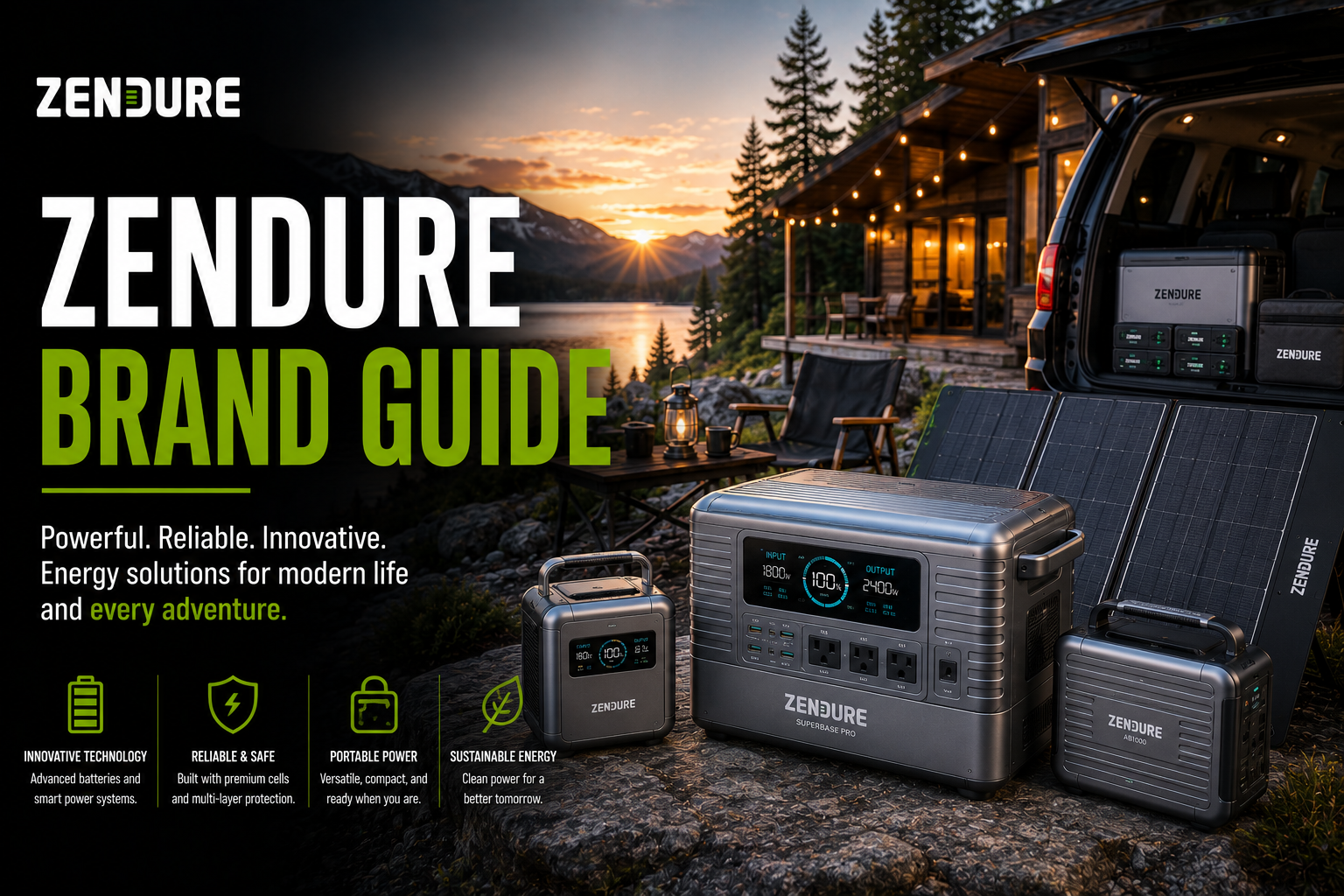
Quick answer: Choose the Zendure SuperBase Pro 2000 for wheeled, approximately 2kWh portable power. Choose the SuperBase V4600 for expandable LiFePO4 home backup, or the SuperBase V6400 if maximum starting capacity matters more than battery cycle rating. The smaller SuperBase M models make more sense for lighter loads.
Zendure's product families are not one interchangeable ecosystem. SuperBase Pro, SuperBase V and SolarFlow use different approaches to storage, charging and system expansion. Choosing the platform correctly is more important than choosing the largest battery.
Availability note: Zendure's US storefront currently lists several SuperBase configurations as sold out. Treat these as documented model comparisons, not a claim that every unit is available new. Verify the exact seller, warranty eligibility and compatible accessories before purchasing older inventory.
Which Zendure Power Station Should You Choose?
Best mobile option: SuperBase Pro 2000. Its 2,096Wh capacity, 2,000W rated AC output and integrated wheels make it a practical match for RV trips, events and temporary outage backup.
Best expandable LiFePO4 system: SuperBase V4600. It starts at 4,608Wh and supports compatible satellite batteries, with a manufacturer-published cycle rating of 6,000+ cycles.
Best for maximum starting capacity: SuperBase V6400. It offers 6,438Wh in one base unit and supports substantially larger system configurations. Its semi-solid-state battery chemistry has a different cycle-life specification.
Best compact option: SuperBase 1000M. Its 1,016Wh capacity and 1,000W rated output suit smaller appliances and recreational uses, provided the model remains available from a trustworthy seller.
Zendure Power Station Comparison Chart
| Model | Capacity | Rated AC Output | Battery Chemistry | Best Use |
|---|---|---|---|---|
| SuperBase 600M | 607Wh | 600W | Lithium-ion | Small devices and short trips |
| SuperBase 1000M | 1,016Wh | 1,000W | Lithium-ion | Compact portable backup |
| SuperBase Pro 1500 | 1,440Wh | 2,000W | LiFePO4 | Mobile power with LFP chemistry |
| SuperBase Pro 2000 | 2,096Wh | 2,000W | Lithium NMC | Longer mobile runtime |
| SuperBase V4600 | 4,608Wh | 3,800W total | LiFePO4 | Expandable home backup |
| SuperBase V6400 | 6,438Wh | 3,800W total | Semi-solid-state lithium | Higher-capacity home backup |
Ratings are from Zendure's published model comparison. Output is total inverter capability, not necessarily the limit of every individual outlet. SuperBase V specifications and supported configurations vary by region and accessory arrangement.
Zendure Models Reviewed: Strengths and Limitations
Zendure SuperBase Pro 2000
A wheeled portable station designed for substantial temporary AC power.
The SuperBase Pro 2000 is the most natural choice in Zendure's documented lineup for people who need substantial power without committing to a large home battery installation.
Its 2,096Wh battery provides considerably more energy than the SuperBase M models, while the 2,000W rated inverter can support a wider range of compatible appliances. Integrated wheels and a telescoping handle help manage its approximately 46.5-pound weight.
The Pro 2000 uses lithium NMC chemistry, unlike the LiFePO4 Pro 1500. This distinction matters for buyers comparing manufacturer cycle ratings and long-term repeated use.
Zendure documents solar charging through an XT60 input rated for up to 600W, plus a separate higher-voltage charging arrangement through the designated input. The latter must follow the manufacturer's exact connection rules.
- 2,096Wh battery capacity
- 2,000W rated AC output
- Integrated wheels and handle
- Useful for RVs, events and outages
- App connectivity
- Still heavy for lifting
- Not expandable like SuperBase V
- NMC chemistry rather than LFP
- Model availability may be limited
- No native whole-home integration platform
Best for: RV owners, mobile workspaces, outdoor events and households needing temporary power for selected appliances.
Skip it if: You want a modular multi-day home-backup system with dedicated satellite batteries.
Check PriceZendure SuperBase Pro 1500
A lower-capacity Pro model with LiFePO4 battery chemistry.
The SuperBase Pro 1500 looks similar to the Pro 2000, but the battery chemistry and storage capacity are meaningfully different.
It offers 1,440Wh of LiFePO4 storage with a 2,000W rated inverter. That means it can supply the same class of compatible AC loads as the Pro 2000, but generally for less time at the same average power draw.
Zendure publishes a higher cycle-life rating for the Pro 1500's LFP battery than for the Pro 2000's NMC battery. The trade-off is reduced capacity in the base unit.
- LiFePO4 battery chemistry
- 2,000W rated output
- Wheeled portable design
- Lighter than Pro 2000
- Only 1,440Wh storage
- Not a satellite-battery system
- Availability may be limited
- Heavy compared with compact stations
Best for: Buyers who prefer LFP chemistry and need mobile 2,000W output more than maximum runtime.
Skip it if: Your priority is the longest possible runtime from one SuperBase Pro unit.
Check PriceZendure SuperBase V4600
A modular home-backup station with 4,608Wh of LiFePO4 storage.
The SuperBase V4600 is a significant step beyond ordinary portable power stations. Its 4,608Wh battery and 3,800W total rated inverter are intended for larger backup loads and compatible home integration.
The V4600 uses LiFePO4 cells. Zendure publishes a cycle-life rating of more than 6,000 cycles to its stated remaining-capacity threshold, making it particularly relevant for buyers expecting frequent charge-discharge use.
A single V4600 can be expanded with compatible B4600 satellite batteries. Zendure documents configurations reaching 46,080Wh when two base units and the supported maximum number of expansion batteries are used.
The unit includes designated 120V and 240V AC outputs in the US configuration. However, the individual outlets have separate current and power limitations, so the total 3,800W inverter rating should not be treated as available from every socket.
- 4,608Wh starting capacity
- LiFePO4 chemistry
- 3,800W rated AC output
- Dedicated 240V outlet
- Compatible satellite battery expansion
- Approximately 121 lb
- Expansion hardware is specialized
- Home integration increases cost
- Older configurations may be hard to source
- Not suited to frequent lifting
Best for: Households wanting expandable battery storage, native 240V capability and a LiFePO4-based platform.
Skip it if: You need a lightweight recreational power station or cannot obtain the correct expansion accessories.
Check PriceZendure SuperBase V6400
A 6,438Wh expandable battery platform for larger backup systems.
The SuperBase V6400 uses a semi-solid-state lithium battery with 6,438Wh of nominal capacity. It provides approximately 40% more energy than the V4600 before any expansion batteries are added.
Its rated AC output remains 3,800W, so the larger battery primarily increases runtime, not the continuous power available from one base unit.
Zendure documents a maximum configuration of approximately 64.38kWh using two V6400 base units and eight compatible B6400 satellite batteries. This is a system maximum, not the capacity of one unit.
The V6400's published battery cycle rating is 3,000+ cycles, compared with 6,000+ for the V4600. Buyers should understand that capacity and cycle life are different trade-offs.
- 6,438Wh starting capacity
- 3,800W rated AC output
- Designated 240V output
- Large expansion potential
- Motorized-wheel assistance
- Approximately 130 lb
- Lower published cycle rating than V4600
- Large physical footprint
- Expansion system can be expensive
- Accessory availability requires verification
Best for: Homeowners who prioritize substantial stored energy and long-duration backup over portability.
Skip it if: You expect to move the station frequently or value the V4600's higher published battery cycle rating.
Check PriceZendure SuperBase M Series
Smaller portable stations for travel and limited backup loads.
The SuperBase 600M and 1000M are more appropriate for users who need to charge devices, power small electronics or run compatible low-wattage appliances away from home.
The 600M offers 607Wh with 600W rated output, while the 1000M increases that to 1,016Wh and 1,000W.
Neither should be mistaken for a home-backup equivalent to SuperBase V. Their lower inverter ratings and limited expansion capability place them in a different category.
- Smaller and lighter than Pro or V
- Useful for electronics and travel
- 1000M provides 1kWh-class storage
- Less installation complexity
- Lower continuous AC output
- Limited battery expansion
- Not a whole-home system
- Older product availability may vary
Best for: Camping, charging electronics and small emergency loads.
Skip it if: You need to run large appliances or support household circuits.
Check PriceSuperBase Pro vs SuperBase V: The Biggest Difference
SuperBase Pro
Designed around a wheeled, self-contained portable station. It is better suited to events, RV use, mobile work and temporary outages.
Capacity tops out at the selected base model, with no SuperBase V-style satellite expansion architecture.
SuperBase V
Built around larger batteries, higher inverter output, 240V capability and compatible home-backup accessories.
It can expand substantially, but requires more planning for battery matching, transfer equipment and electrical integration.
Practical rule: If the power station must regularly travel with you, start with SuperBase Pro. If it will spend most of its time supporting a house, investigate SuperBase V.
How Long Will a Zendure Power Station Run Your Devices?
Battery capacity is measured in watt-hours (Wh). Runtime depends on the average wattage of the connected equipment and the energy lost during conversion.
The 85% factor is an illustrative planning assumption, not a measured efficiency rating for these models. Actual runtime varies with load, inverter overhead, temperature and battery condition.
| Model | 100W Load | 500W Load | 1,000W Load |
|---|---|---|---|
| SuperBase 600M | 5.2 hours | 1.0 hour | Not supported at rated output |
| SuperBase 1000M | 8.6 hours | 1.7 hours | 0.9 hour |
| SuperBase Pro 1500 | 12.2 hours | 2.4 hours | 1.2 hours |
| SuperBase Pro 2000 | 17.8 hours | 3.6 hours | 1.8 hours |
| SuperBase V4600 | 39.2 hours | 7.8 hours | 3.9 hours |
| SuperBase V6400 | 54.7 hours | 10.9 hours | 5.5 hours |
Calculated estimates for constant loads, not tested results. Light-load runtime may be lower because inverter standby consumption becomes more significant. Appliances with compressors or motors also require separate startup-power checks.
Why a Larger Inverter Does Not Guarantee Longer Runtime
Watts and watt-hours answer different questions.
Watts (W) describe how much power the station can deliver at one time. Watt-hours (Wh) describe how much energy is stored.
For example, both SuperBase V4600 and V6400 have a published 3,800W total AC output rating, but the V6400 stores more energy and can therefore sustain the same average load longer.
Zendure Solar Charging: What Buyers Need to Know
Zendure supports solar charging across several platforms, but the electrical input requirements differ considerably.
| Platform | Charging Consideration | Buyer Advice |
|---|---|---|
| SuperBase M | Lower-power portable solar input | Use the exact model's voltage and current limits |
| SuperBase Pro | XT60 solar input plus a designated higher-voltage input arrangement | Do not treat the two inputs as interchangeable |
| SuperBase V | Up to 3,000W solar input through the specified XT90 connection | Check open-circuit voltage and array configuration |
| SolarFlow | Separate home solar-storage architecture | Use compatible SolarFlow components, not SuperBase accessories |
Zendure lists a maximum 3,000W solar input for SuperBase V, with a published 10–150V open-circuit input range in its comparison documentation. The complete manual must be consulted for current limits and supported wiring.
Does Solar Input Equal Guaranteed Charging Power?
No. The published input maximum describes a supported electrical ceiling. Real charging depends on sunlight, panel temperature, orientation, shading, battery state of charge and charging limits.
Can Zendure SuperBase V Power a House?
SuperBase V can support selected household loads and compatible home-backup configurations. However, it should not be assumed to power every circuit or appliance simultaneously.
A home's electrical requirements depend on continuous watts, startup surge, 120V and 240V circuits, and daily energy consumption.
Selected Loads
A single SuperBase V can power compatible devices through its onboard outlets, subject to individual outlet ratings and total inverter limitations.
Home Panel System
A compatible Zendure home-panel configuration can integrate selected household circuits, but requires the correct equipment and installation.
120V and 240V Output
The US SuperBase V specification lists 120V outlets and a designated 240V outlet. Individual connectors have their own power and current ratings.
A 240V outlet does not mean every 240V appliance will work. Check the appliance's required voltage, current, plug type, starting demand and installation requirements.
SuperBase V Expansion: How Large Can It Get?
SuperBase V uses dedicated satellite batteries matched to the base system. This is one of its most important differences from SuperBase Pro.
| Configuration | Maximum Documented Capacity |
|---|---|
| V4600 base unit | 4,608Wh |
| Two V4600 base units plus eight compatible B4600 batteries | 46,080Wh |
| V6400 base unit | 6,438Wh |
| Two V6400 base units plus eight compatible B6400 batteries | 64,380Wh |
These maximum figures are for complete configurations, not a single standalone power station. Each expansion step increases the cost, physical space and installation requirements.
What About Zendure SolarFlow?
SolarFlow is a separate Zendure home-energy storage ecosystem, not another version of SuperBase Pro or SuperBase V.
It is designed around compatible solar-storage equipment and AB-series batteries for supported household applications. Products such as SolarFlow Hyper 2000 are not ordinary portable power stations with camping-style AC outlets.
SolarFlow compatibility also depends on market-specific electrical standards and approved installation methods. Equipment designed for one country's grid rules should not be assumed suitable for another.
Buying rule: If you want a self-contained portable AC power source, compare SuperBase models. If you want an integrated home solar-storage system, investigate SolarFlow separately.
Battery Chemistry and Long-Term Ownership
Zendure uses different battery chemistries across its model families. That affects published cycle ratings, capacity and product characteristics.
| Model | Chemistry | Published Cycle Rating |
|---|---|---|
| SuperBase Pro 1500 | LiFePO4 | 6,000 cycles to 60% capacity |
| SuperBase Pro 2000 | Lithium NMC | 3,000 cycles to 60% capacity |
| SuperBase V4600 | LiFePO4 | 6,000+ cycles to 60% capacity |
| SuperBase V6400 | Semi-solid-state lithium | 3,000+ cycles to 60% capacity |
These are manufacturer cycle specifications, not independently measured results. A cycle rating does not guarantee a specific number of calendar years.
Before purchasing older Zendure inventory, confirm whether the manufacturer's warranty applies to the specific unit and seller. Also investigate replacement batteries, compatible accessories and service availability.
Six Mistakes to Avoid When Buying Zendure
1. Choosing Capacity Instead of Output
A large battery cannot power an appliance whose continuous or starting demand exceeds the inverter's limits.
2. Assuming All Batteries Are Compatible
SuperBase V satellite batteries, SuperBase Pro internal batteries and SolarFlow AB batteries are different product systems.
3. Ignoring Total System Cost
Expansion batteries, solar panels, special cables, home-panel equipment and installation can cost substantially more than expected.
4. Overlooking Product Availability
Older SuperBase products may be sold out or available only through limited channels. Confirm support before buying.
5. Treating UPS Claims as Universal
Backup transfer behavior depends on the model, outlet and operating mode. Sensitive equipment requires compatibility verification.
6. Buying a Home System for Travel
SuperBase V is movable, but a 121–130 lb station is not convenient for frequent vehicle loading.
Frequently Asked Questions
Which Zendure power station is best?
SuperBase Pro 2000 is a strong fit for mobile 2kWh power. SuperBase V4600 is better for expandable LiFePO4 home backup, while V6400 offers more starting capacity.
Is Zendure SuperBase Pro expandable?
SuperBase Pro does not use the satellite-battery expansion architecture found on SuperBase V. Choose V if modular battery expansion is essential.
What is the difference between SuperBase V4600 and V6400?
V4600 has 4,608Wh and LiFePO4 chemistry, with a published 6,000+ cycle rating. V6400 has 6,438Wh and semi-solid-state lithium chemistry, with a published 3,000+ cycle rating. Both have a 3,800W rated inverter.
Can Zendure SuperBase V output 240V?
The US SuperBase V specification includes a designated 240V AC outlet. Check the individual outlet's current and power ratings before connecting an appliance.
Can Zendure power a refrigerator?
Some refrigerators are compatible, provided running wattage, compressor startup demand and daily energy use remain within the station's limits. Verify the refrigerator's electrical requirements.
Can Zendure work as a UPS?
Some Zendure models offer backup transfer functions, but timing and behavior vary by model and operating mode. Do not assume uninterrupted operation for computers, servers or medical equipment.
Can I connect third-party solar panels?
Compatible third-party panels may be used when the complete array meets the exact input voltage, current, connector and wiring requirements. Never exceed manufacturer limits.
Are Zendure SolarFlow batteries compatible with SuperBase V?
No. SolarFlow uses a separate battery and system architecture. Do not substitute AB-series batteries for SuperBase V satellite batteries.
Is Zendure good for whole-home backup?
Compatible SuperBase V configurations can support selected household circuits. Whether they meet whole-home requirements depends on the home's electrical loads, system capacity and approved installation.
Should I buy a discontinued or sold-out Zendure model?
Only after confirming the unit's condition, seller credibility, warranty coverage and availability of essential accessories. An attractive purchase price may not compensate for limited support.
Final Recommendation: Choose the Right Zendure Platform
For portable power, start with SuperBase Pro 2000. It combines 2,096Wh of storage with a 2,000W inverter and a wheeled design suited to temporary power needs.
For expandable home backup, compare SuperBase V4600 and V6400. The V4600 prioritizes LiFePO4 cycle life, while the V6400 provides more starting energy and larger maximum configurations.
For compact travel, the SuperBase M family may be sufficient. For integrated home solar storage, investigate SolarFlow as a separate product category.
Because several documented SuperBase models have limited current availability, confirm seller support, accessory compatibility and the complete system cost before making a purchase.
Compare Current OptionsSources and Editorial Methodology
This guide compares Zendure's published specifications, battery chemistries, expansion systems and use-case limitations. Recommendations are based on documented product capabilities, not claimed firsthand testing. Runtime figures are calculated planning estimates.
- Zendure — Official SuperBase Model Comparison — Battery capacity, chemistry, output, weight, charging and expansion.
- Zendure — SuperBase V Product Information — V4600 and V6400 battery configurations, motorized wheels and cycle ratings.
- Zendure — SuperBase Pro Product Information — Pro 1500 and Pro 2000 charging, solar input and operating characteristics.
- Zendure — SuperBase V Solar Generator Configurations — Supported system and solar bundle configurations.
Manufacturer specifications and product availability can change. Confirm the exact regional model, warranty, electrical requirements and supported accessories before purchasing or installing power equipment.