
Zendure Portable Power Station Buying Guide
Understand the differences between Zendure SuperBase V, SuperBase Pro and SuperBase M before buying. Compare battery capacity, inverter output, charging, expansion, portability and the important availability questions surrounding older models.
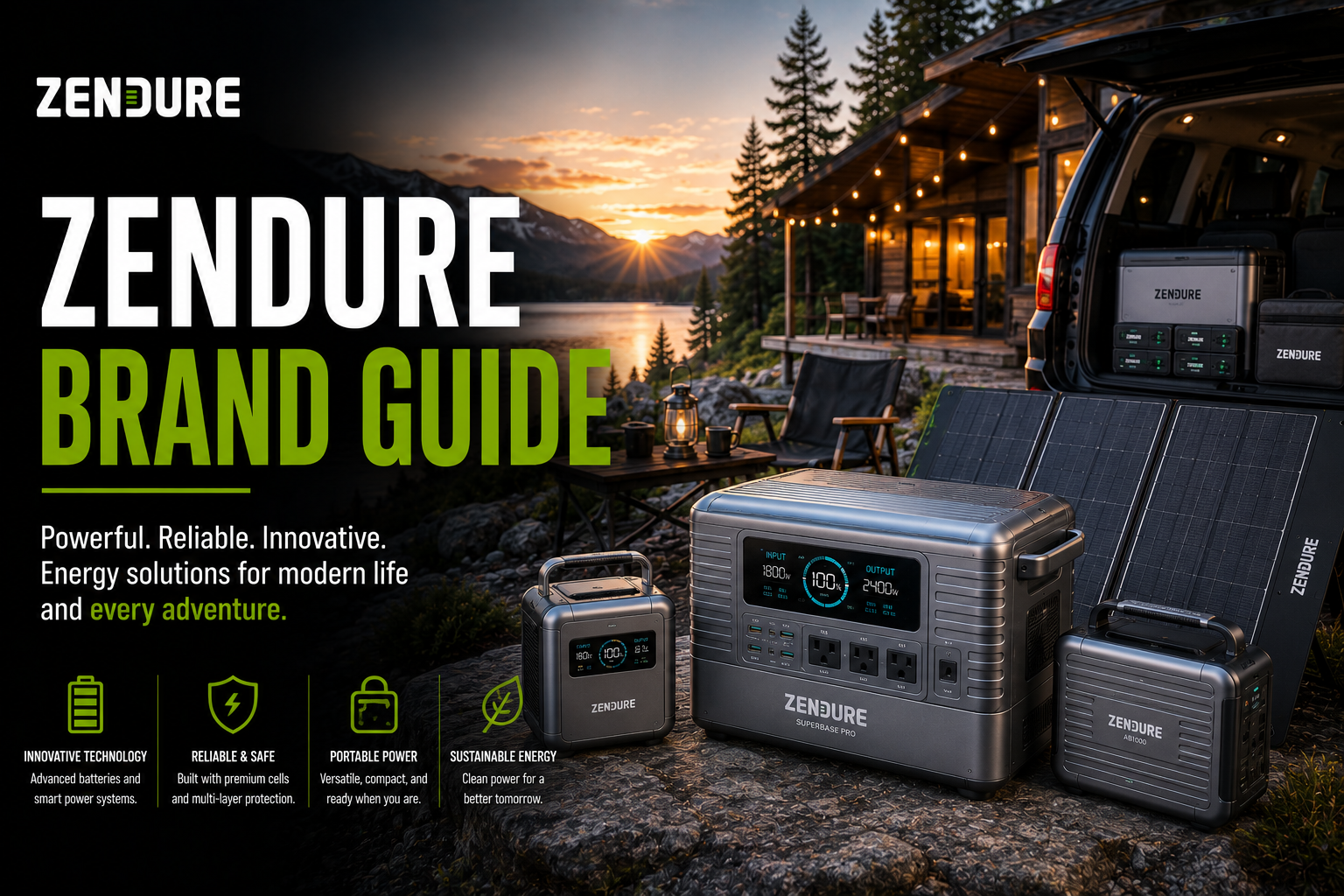
Zendure's portable power lineup is unusual because the SuperBase name covers everything from relatively compact batteries to expandable systems with several kilowatt-hours of storage. Buying the wrong model can leave you with too little output, unnecessary weight or an expansion system that does not fit your needs.
There is also an important availability consideration: several SuperBase models remain documented on Zendure's US website even though their official product pages currently display sold-out configurations. That makes it especially important to distinguish a technically suitable model from one you can actually purchase with reliable warranty coverage.
Which Zendure Power Station Should You Choose?
For expandable home backup: The SuperBase V4600 and V6400 are the most relevant models. Both offer 3,800W rated AC output, but they use different battery chemistries and have different starting capacities.
For mid-size portable power: SuperBase Pro 1500 and 2000 offer more manageable form factors, though they are legacy products whose availability and support should be checked carefully.
For compact travel: SuperBase 600M and 1000M provide smaller-capacity alternatives, but Zendure's US store currently marks the listed variants sold out.
Best practical advice: Do not commit to a Zendure ecosystem until you confirm the exact model, its availability, compatible accessories and warranty eligibility.
Zendure SuperBase Model Comparison
The figures below come from Zendure's official model-comparison information. Battery capacity and rated AC output are different measurements: watt-hours describe stored energy, while watts describe the rate at which the station can supply power.
| Model | Capacity | Battery Chemistry | Rated AC Output | Expansion |
|---|---|---|---|---|
| SuperBase V6400 | 6,438Wh | Semi-solid-state | 3,800W | Compatible B6400 satellite batteries |
| SuperBase V4600 | 4,608Wh | LiFePO4 | 3,800W | Compatible B4600 satellite batteries |
| SuperBase Pro 2000 | 2,096Wh | Lithium-NMC | 2,000W | No satellite expansion listed |
| SuperBase Pro 1500 | 1,440Wh | LiFePO4 | 2,000W | No satellite expansion listed |
| SuperBase 1000M | 1,016Wh | Lithium-ion | 1,000W | No satellite expansion listed |
| SuperBase 600M | 607Wh | Lithium-ion | 600W | No satellite expansion listed |
Specifications refer to these particular product generations, not every product Zendure has sold. Confirm the electrical output and model variant for your market before ordering.
Zendure Models Explained: Who Should Buy Each One?
Zendure SuperBase V6400
The SuperBase V6400 starts with 6,438Wh of nominal storage and a 3,800W rated AC output. Zendure uses semi-solid-state battery technology in this version and specifies expansion through compatible B6400 satellite batteries.
Its main appeal is energy capacity. A 6.4kWh base station stores substantially more energy than a typical 1–2kWh portable power station. Zendure also lists up to 3,000W of direct solar input for the SuperBase V platform.
- Large starting battery capacity.
- Compatible satellite-battery expansion.
- 3,800W rated inverter output.
- Designed for larger backup applications.
- Approximately 130 lb according to Zendure's comparison information.
- Significant space and cost commitment.
- Must use the correct battery chemistry and accessories.
- Availability needs verification before purchase.
Choose it if: You need substantial stored energy and are planning a compatible modular backup system.
Avoid it if: You want a lightweight camping battery, or the same needs can be met with a much smaller system.
Check PriceZendure SuperBase V4600
The V4600 offers 4,608Wh of storage with a LiFePO4 battery and the same published 3,800W rated output as the V6400. It supports compatible B4600 satellite batteries for expansion.
The most important difference is not just the smaller capacity: Zendure specifies a different battery chemistry and a higher published cycle-life figure for the V4600. Buyers planning to expand should compare the complete system, not just the base station.
- LiFePO4 battery chemistry.
- 3,800W rated output.
- Expandable with compatible satellite batteries.
- Lower starting capacity than the V6400 can be sufficient for essential-load backup.
- Approximately 121 lb.
- Still too large for most casual camping uses.
- Expansion components must match the system.
- Official retail availability is not assured.
Choose it if: You want the SuperBase V platform with LiFePO4 chemistry and a smaller starting capacity.
Avoid it if: You need to carry your power station frequently or cannot verify the correct expansion hardware.
Check PriceZendure SuperBase Pro 2000
The SuperBase Pro 2000 has 2,096Wh of nominal storage and a published 2,000W rated output. Zendure's model comparison identifies its battery chemistry as lithium-NMC.
That makes it a different proposition from the LiFePO4-based SuperBase Pro 1500, despite the shared product-family name.
- More than 2kWh of nominal storage.
- 2,000W rated AC output.
- Smaller form factor than the SuperBase V series.
- No SuperBase V-style satellite expansion.
- Older battery chemistry than many newer LFP competitors.
- Official US store lists the model as sold out.
Choose it if: You find a legitimate unit with acceptable warranty coverage and its specifications fit your needs.
Avoid it if: You want a currently supported, readily available expandable system.
Check PriceZendure SuperBase Pro 1500
The SuperBase Pro 1500 provides 1,440Wh of nominal capacity with LiFePO4 chemistry and a published 2,000W rated AC output. Its smaller battery does not automatically mean it has a weaker inverter than the Pro 2000.
For buyers choosing between these two legacy models, the main decision is stored energy versus battery chemistry, rather than assuming the larger model is superior in every respect.
- LiFePO4 chemistry.
- 2,000W rated output.
- More manageable than SuperBase V units.
- Less energy than Pro 2000.
- No satellite expansion system.
- Official US store currently lists it sold out.
Choose it if: Its chemistry and output meet your requirements and you can confirm reliable seller support.
Avoid it if: You require multiple days of stored energy without recharging.
Check PriceZendure SuperBase 1000M
Suitable to investigate for modest off-grid loads and portable electronics. Its 1,000W rated output means high-wattage heating appliances may exceed its capabilities. Zendure's US store currently lists it sold out.
Check PriceZendure SuperBase 600M
A smaller-capacity option for light loads. Its 600W rated output and limited stored energy make it a poor match for large appliances or extended home backup. Official US store configurations currently show sold out.
Check PriceHow Much Zendure Battery Capacity Do You Need?
Start with the appliances you actually intend to run. A large inverter rating does not mean a battery will last a long time under a high load.
The table below illustrates approximate runtime using an assumed 85% usable-energy factor. These are calculations, not measured Zendure performance results.
| Model | At 100W | At 300W | At 800W |
|---|---|---|---|
| SuperBase 600M | 5.2 hr | 1.7 hr | Not supported: exceeds 600W rated output |
| SuperBase 1000M | 8.6 hr | 2.9 hr | 1.1 hr |
| SuperBase Pro 1500 | 12.2 hr | 4.1 hr | 1.5 hr |
| SuperBase Pro 2000 | 17.8 hr | 5.9 hr | 2.2 hr |
| SuperBase V4600 | 39.2 hr | 13.1 hr | 4.9 hr |
| SuperBase V6400 | 54.7 hr | 18.2 hr | 6.8 hr |
Very light AC loads may achieve less runtime than this simplified formula suggests because inverter standby consumption can become significant. Appliances such as refrigerators cycle on and off, so measuring average energy consumption is more useful than multiplying their peak running wattage by 24 hours.
Solar Charging, Expansion and Compatibility
Solar Input Is a Model-Specific Limit
Zendure publishes up to 3,000W of direct solar input for the SuperBase V platform. That does not mean every SuperBase M or Pro model supports the same charging power or electrical input range.
Before connecting panels, confirm the exact station's voltage window, maximum current, input power, connector polarity and allowable panel arrangement. Solar panel open-circuit voltage can rise in cold weather.
How SuperBase V Expansion Works
SuperBase V can be configured with compatible satellite batteries. Zendure describes larger systems using two base units and multiple batteries, with maximum published configurations reaching 64kWh for the V6400 family and 46.08kWh for the V4600 family.
Those figures are maximum configurations, not the capacity of a single base unit. They also require the appropriate hardware and compatible battery modules.
- V6400: use compatible semi-solid-state B6400 components.
- V4600: use compatible LiFePO4 B4600 components.
- SuperBase Pro and M: do not assume SuperBase V satellite-battery compatibility.
- Accessories: verify cables, connectors, control equipment and firmware requirements for the exact configuration.
Can Zendure Replace a Home Generator?
For some loads, yes. A properly sized battery system can provide quiet power without combustion exhaust during discharge. However, it has finite stored energy and needs a charging source.
A fuel generator may be more practical for long-duration high loads when solar charging is limited, while a battery system can be attractive for short outages, nighttime operation and essential electronics.
See our portable power station vs generator comparison for the differences in runtime, refueling, noise and safety.
Which Zendure Family Fits Your Situation?
| Use Case | Start With | Watch Out For |
|---|---|---|
| Weekend camping | SuperBase M class | Weight, availability and high-wattage appliances |
| Remote work and electronics | SuperBase M or Pro class | Actual AC runtime and outlet requirements |
| RV essentials | SuperBase Pro or appropriately sized V system | RV voltage, connector and air-conditioner startup requirements |
| Home outage essentials | SuperBase Pro or V, based on energy demand | Daily energy use and recharge strategy |
| Longer modular backup | SuperBase V4600 or V6400 | Battery-family compatibility and total system cost |
| High-power 240V equipment | Verified SuperBase V configuration only | Do not assume standalone or combined units provide the required voltage and wiring arrangement |
Five Checks Before Buying a Zendure Power Station
1. Confirm Availability
A manufacturer's product page can remain online after the product is sold out. Check the exact model and seller rather than assuming a search result means current inventory.
2. Check Warranty Eligibility
Zendure's US warranty policy lists three years for SuperBase V base units and two years for SuperBase Pro units, subject to its terms. Confirm coverage for your specific purchase and region.
3. Verify the Battery Chemistry
Do not assume every Zendure model uses LiFePO4. SuperBase V6400, V4600 and Pro 2000 have materially different chemistries.
4. Calculate Total System Cost
Include compatible expansion batteries, panels, cables and any approved home-connection equipment. The base-unit price is not necessarily the complete project cost.
5. Check Support and Parts
Confirm access to replacement cables, expansion batteries and support for the product generation. This is particularly important with older or limited-availability models.
6. Check Electrical Compatibility
Verify continuous output, surge requirements, voltage and outlet ratings. Never backfeed home wiring or improvise a connection to household circuits.
Zendure Buying Guide FAQs
Is Zendure a good portable power station brand?
Zendure has documented products spanning compact portable batteries and large expandable systems. Whether it is a good purchase depends on the exact model, its specifications, current availability, warranty and total cost compared with alternatives.
Which Zendure model is best for home backup?
The SuperBase V4600 and V6400 are the most relevant models in the lineup covered here because of their larger capacities and expansion options. The right configuration depends on your daily energy consumption, output requirements and charging plan.
Are all Zendure batteries LiFePO4?
No. Zendure identifies the SuperBase V4600 and SuperBase Pro 1500 as LiFePO4, the V6400 as semi-solid-state, and the Pro 2000 as lithium-NMC.
Can I mix V4600 and V6400 expansion batteries?
No. Zendure states that semi-solid-state and LiFePO4 components should not be mixed within a SuperBase V system.
Can Zendure power a refrigerator?
A compatible model may power a refrigerator if its continuous and starting requirements are supported. Runtime depends on the refrigerator's actual energy consumption and the battery's usable capacity.
Are Zendure SuperBase models still available?
Some official US product listings currently show sold-out configurations. Retail availability can differ by model and seller, so confirm stock and warranty before purchase rather than relying on historical product pages.
Can I use Zendure indoors?
Battery power stations do not generate combustion exhaust during normal discharge, unlike fuel generators. However, they must still be used and charged according to manufacturer instructions, with appropriate ventilation, temperature limits and protection from moisture.
Sources and Editorial Method
This guide compares manufacturer-published specifications and applies practical sizing and compatibility analysis. It does not claim independent hands-on testing, verified current pricing or guaranteed stock availability.
- Zendure — SuperBase V Specifications and FAQ
- Zendure — Official SuperBase Family Comparison
- Zendure — SuperBase Pro Product Information
- Zendure — SuperBase M Product Information
- Zendure — US Warranty Terms
Research distinction: Battery specifications and expansion limits are manufacturer claims. Runtime figures are calculations using stated assumptions. Product suitability recommendations are editorial judgments based on the documented capabilities.
Final Recommendation: Buy for the System You Actually Need
The SuperBase V family makes the most sense when expandable stored energy is the main priority. SuperBase Pro offers a more portable mid-size format, while SuperBase M targets smaller travel and electronics loads.
However, older Zendure models should not be selected on specifications alone. Confirm that the exact unit and necessary accessories can still be purchased with acceptable warranty and service support.
Start with required watt-hours, continuous output and charging options. Then compare complete system cost and availability before committing.
Compare Current Options