
Best Power Inverters for RVs: Choose by Wiring and Loads
Compare pure sine wave RV inverters and inverter-chargers by real continuous output, battery voltage, surge needs, transfer switching and installation requirements.
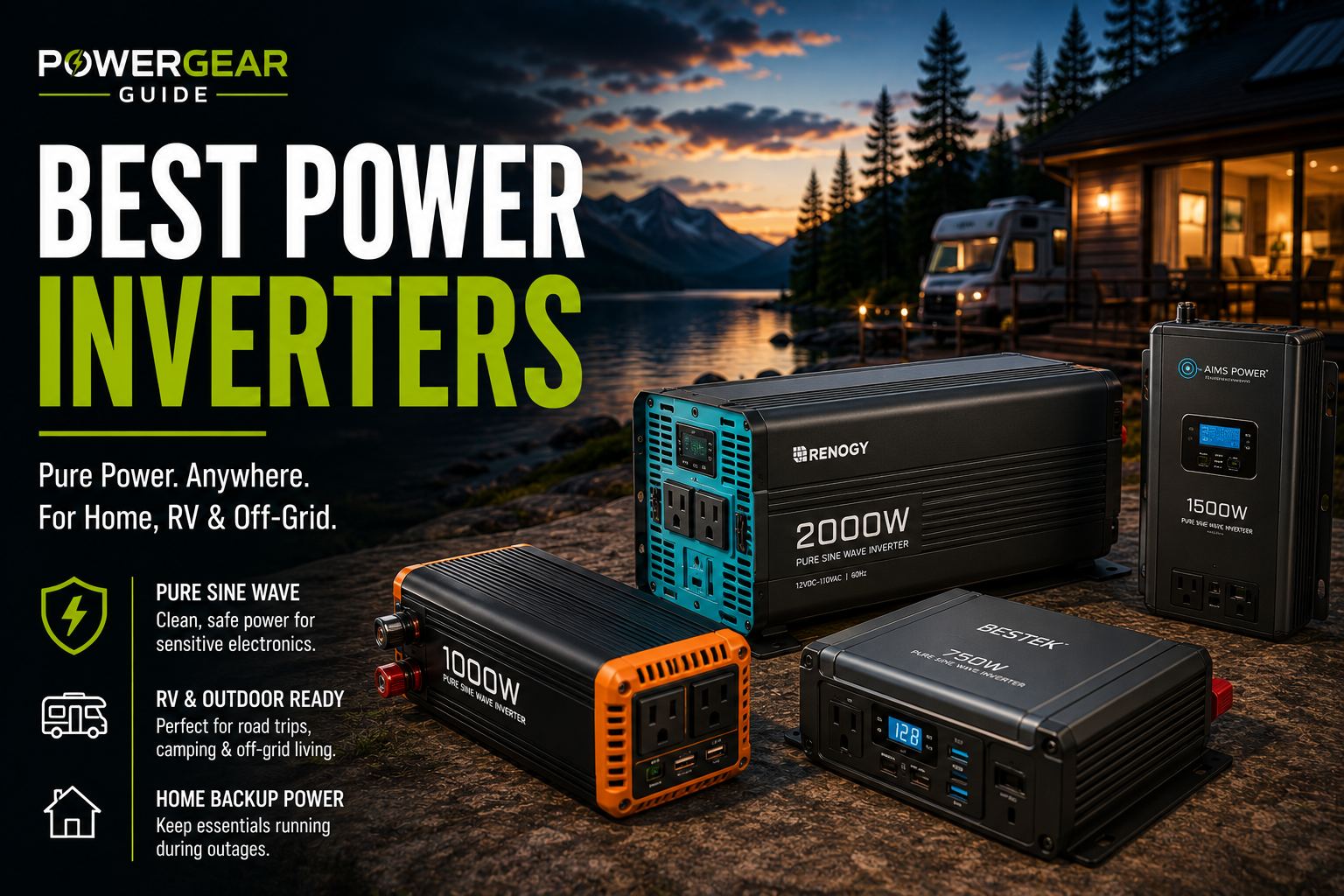
An inverter does not create energy: it converts battery DC into AC. A standalone inverter is not automatically a charger or transfer switch. These models serve different RV wiring needs and should not be treated as drop-in equivalents. Prices and stock change; check current availability.
Choose the inverter architecture before choosing watts
For an existing 12V RV system with a separate charger, a properly installed 2000W pure sine inverter may fit typical outlet loads. For shore-power integration, compare a transfer-equipped inverter or a true inverter-charger. For lighter electronics, a 1000W-class unit can reduce oversizing. Always verify simultaneous loads, surge demand, battery current and the RV electrical layout.
Quick Picks by RV Electrical Need
Renogy 2000W 12V Pure Sine Wave
2000W continuous class | 12V battery input. Choose based on the charging and transfer equipment you already have.
Renogy 2000W 12V Inverter with UPS Transfer
2000W continuous class | 12V battery input. Choose based on the charging and transfer equipment you already have.
Renogy 2000W 12V HF Inverter Charger
2000W continuous class | 12V battery input. Choose based on the charging and transfer equipment you already have.
Victron Phoenix Inverter 12/1200
1000W at 25C continuous class | 12V battery input. Choose based on the charging and transfer equipment you already have.
RV Inverter Comparison Table
| Model | Continuous output | Battery | Surge | System role |
|---|---|---|---|---|
| Renogy 2000W 12V Pure Sine Wave | 2000W | 12V | 4000W peak | Best straightforward 12V inverter |
| Renogy 2000W 12V Inverter with UPS Transfer | 2000W | 12V | 4000W surge (2s) | Best for built-in transfer functionality |
| Renogy 2000W 12V HF Inverter Charger | 2000W | 12V | 3000W surge (3s) | Best for integrated shore charging |
| Victron Phoenix Inverter 12/1200 | 1000W at 25C | 12V | 2400W peak | Best for modest loads and engineering documentation |
Ratings are manufacturer claims under stated conditions. Victron reports output in both VA and watts; the 1200VA label must not be mistaken for 1200W continuous. Surge durations differ by manufacturer, so peak numbers are not directly interchangeable.
Detailed RV Inverter Reviews
Renogy 2000W 12V Pure Sine Wave
For an RV battery bank that already has separate shore charging. Three AC receptacles and a hardwire terminal are documented; a transfer switch and charging are not integrated.
A documented UL 458 listing and a wired remote make it a useful reference point for a dedicated 12V installation.
- A documented UL 458 listing and a wired remote make it a useful reference point for a dedicated 12V installation.
- Separate inverter is simpler when the RV already has a suitable charger.
- At 2000W AC, a 12V bank can demand roughly 185A at 90% efficiency before cabling losses; plan wiring and battery BMS limits with an installer.
- Not for owners expecting automatic shore transfer or battery charging from the inverter alone.
Best for: Separate inverter is simpler when the RV already has a suitable charger.
Not ideal for: Not for owners expecting automatic shore transfer or battery charging from the inverter alone.
See PricesRenogy 2000W 12V Inverter with UPS Transfer
This RIV1220PU-126 version integrates a 20A transfer switch and Bluetooth. Confirm how its switching behavior and existing RV distribution equipment fit together.
Manufacturer specifies 120V output and a 20A transfer rating, making it a distinct alternative to an inverter-only box.
- Manufacturer specifies 120V output and a 20A transfer rating, making it a distinct alternative to an inverter-only box.
- Useful where shore-to-inverter transfer is a requirement and compatible with the existing system.
- A built-in transfer feature is not a substitute for proper circuit isolation, branch-circuit protection or a complete RV wiring plan.
- Not an all-in-one battery charger; verify exact model functions before purchasing.
Best for: Useful where shore-to-inverter transfer is a requirement and compatible with the existing system.
Not ideal for: Not an all-in-one battery charger; verify exact model functions before purchasing.
See PricesRenogy 2000W 12V HF Inverter Charger
Combines inverter and charging functions in a single unit. The 2000W model is specified at 12V DC and includes a wired LCD remote.
More suitable for RV renovations that need a coordinated shore-charging and inversion architecture than a basic inverter-only model.
- More suitable for RV renovations that need a coordinated shore-charging and inversion architecture than a basic inverter-only model.
- Best when replacing separate inverter and charger components with an integrated system.
- Battery type settings, transfer configuration, breaker selection and charger wiring require careful matching to the RV system.
- Not ideal for a plug-in installation or an RV with an already well-integrated charger.
Best for: Best when replacing separate inverter and charger components with an integrated system.
Not ideal for: Not ideal for a plug-in installation or an RV with an already well-integrated charger.
See PricesVictron Phoenix Inverter 12/1200
The 1200VA model is rated at 1000W continuous at 25C and 900W at 40C, not 1200W continuous. This distinction is essential for hot RV compartments.
A credible choice for electronics and lighter loads when a carefully sized battery bank and separate charger are already installed.
- A credible choice for electronics and lighter loads when a carefully sized battery bank and separate charger are already installed.
- Best for smaller steady loads with temperature-aware sizing.
- A microwave, large kettle or air conditioner may exceed the continuous output even when the headline VA number appears adequate.
- Not suitable as a blanket whole-RV 1200W appliance solution.
Best for: Best for smaller steady loads with temperature-aware sizing.
Not ideal for: Not suitable as a blanket whole-RV 1200W appliance solution.
See PricesHow to Size an RV Inverter Without Guessing
Battery amps = AC watts / (battery volts x inverter efficiency). At 2000W AC, 12V and assumed 90% efficiency, current is about 185A. Actual current varies with voltage, load and conversion efficiency.
| Typical need | Selection priority | What to verify |
|---|---|---|
| Laptops, router, small television | Low idle draw and appropriate AC rating | Continuous watts and overnight energy budget |
| Coffee maker or microwave | High continuous wattage | Actual appliance input watts, surge, battery current |
| Compressor fridge or pump | Starting surge capability | Motor starting load and surge duration |
| Air conditioner | High power and suitable battery bank | Compressor startup, soft-start compatibility, runtime and wiring |
Battery capacity determines runtime separately from inverter wattage. For example, a 12V 200Ah nominal battery has approximately 2400Wh before discharge limits and conversion losses. At an assumed 85% usable-and-conversion factor, about 2040Wh reaches the AC load; a 500W steady load would last roughly 4.1 hours in this simplified example. Check battery chemistry, BMS limits, temperature and other loads.
RV Installation and Safety Checklist
Confirm battery current
The battery BMS and bank must safely deliver the inverter input current, including startup loads.
Fuse near the battery
Size conductors and protective devices using the inverter manual, run length and installation conditions.
Prevent backfeed
Confirm whether the inverter is standalone, transfer-equipped or a charger/transfer combination.
Allow cooling clearance
Observe manufacturer airflow and temperature derating requirements.
Inverter Only vs Inverter-Charger: Which Should You Buy?
An inverter-only unit converts DC to AC. A transfer-equipped inverter may switch between shore and inverter AC but does not necessarily charge batteries. An inverter-charger combines AC inversion with shore charging and often transfer management. Review exact model documentation: product families and names can be deceptively similar.
For a small RV already equipped with a good converter/charger and transfer hardware, replacing only the inverter may avoid unnecessary duplication. For a complete electrical renovation, an inverter-charger may simplify system design but usually requires more planning and professional integration.
Final Verdict: Buy for the RV System You Actually Have
The Renogy 2000W standalone inverter is a reasonable comparison starting point for an existing 12V bank with separate charging. Choose its transfer-equipped variant only when the transfer function is compatible with the RV distribution design; choose an inverter-charger when shore charging is part of the project. Victron Phoenix 12/1200 is a better-sized alternative for modest loads, but its actual watt rating is below its VA label. Installation quality and battery capability matter more than the biggest peak-watt number.
Frequently Asked Questions
What size power inverter is best for an RV?
Add the AC input wattages of loads that will run together, account for motor starting surge, then verify the battery and wiring can support that continuous load. A 2000W rating is not automatically sufficient for every RV.
Is pure sine wave important for RV appliances?
Pure sine wave output is a sensible default for electronics, chargers and motor-driven appliances. Compatibility still depends on power, frequency and starting surge.
Can a 2000W inverter run an RV air conditioner?
Not reliably without checking the exact air conditioner running watts, compressor starting demand and any soft-start system. Battery energy may also limit runtime.
Does an RV inverter charge batteries?
A standalone inverter generally does not. An inverter-charger includes a charging function, while a transfer-equipped inverter may not.
Can I connect an inverter directly to an RV outlet?
Do not backfeed an RV outlet or shore inlet. An electrician must design the approved transfer and distribution arrangement.
Can I use a 12V inverter with a 24V battery bank?
No. Input voltage must match the inverter specifications; use a model designed for the battery bank voltage.
How many batteries do I need for a 2000W inverter?
That depends on battery voltage, chemistry, usable capacity, maximum discharge current and desired runtime. Calculate both current capability and watt-hour energy.
Sources and Editorial Methodology
Model specifications and technical differences were researched from the linked manufacturer product pages and technical manuals. No hands-on testing or live price verification was performed. Compare exact SKU, region and model generation before purchasing.