
Can a Home Battery Power an Entire House?
Yes, but only if its inverter can handle the home's simultaneous electrical loads, its stored energy lasts long enough, and the system is installed with the appropriate transfer and protection equipment.
How this guide was researched
This guide separates general electrical principles from site-specific engineering. Worked examples are explicitly illustrative, not measured household data or manufacturer performance guarantees. For permanently connected systems, installation requirements depend on equipment listings, the applicable electrical code, the utility, and the authority having jurisdiction.
Quick Answer: A Home Battery Can Run a Whole House, With Conditions
A battery does not need to power every circuit continuously to support a house during an outage. The decisive questions are the highest simultaneous demand in kilowatts, motor starting requirements, and the total energy used in kilowatt-hours over the outage. Electric resistance heating, large air conditioners, dryers, ranges, and EV charging can overwhelm a modest backup system even when lights, networking, refrigeration, and a few outlets work comfortably.
For many households, a protected critical-load panel is more practical and affordable than unrestricted whole-home backup.
Three Ways to Back Up a Home
Critical-load backup
Dedicated backed-up circuits for a refrigerator, lights, communications, medical equipment where appropriate, and selected outlets. Lower simultaneous demand often means a smaller inverter and battery bank.
Managed whole-home backup
Most household circuits remain available, while smart controls or user behavior shed high-demand loads during outages. Requires compatible electrical equipment and a suitable inverter.
Unrestricted whole-home backup
Designed for very high simultaneous demand, including large motor starts and heavy appliances. Multiple battery/inverter units or another backup source may be needed.
Whole-Home Backup Versus Portable Power Stations
| Feature | Portable power station | Installed home battery system |
|---|---|---|
| Connection | Directly plugged-in appliances | Approved transfer/islanding equipment and home circuits |
| Power class | Varies by model; often hundreds to a few thousand watts | Designed around backed-up panel and system inverter capacity |
| Outage operation | Manual appliance connection unless specifically designed otherwise | Can automatically isolate and energize selected loads |
| Installation | Follow manufacturer's outlet and cord instructions | Electrical design, permits and qualified installation generally required |
Detailed Backup Approach Reviews
Critical-Load Battery Backup
Preserve essential services without paying to support every heavy appliance.
A critical-load approach routes designated circuits through equipment designed for backup operation. It can keep refrigeration, lighting, internet and limited outlets available while avoiding simultaneous electric oven, dryer and EV-charger demand. The system must still accommodate compressor starting and the combined demand of all backed-up circuits.
For example, if essential loads average 450W, a 10-hour outage requires approximately 4.5kWh delivered to appliances before conversion losses and reserves. Actual consumption changes throughout the day; a refrigerator does not draw its nameplate power continuously.
Reasons to consider
- Lower peak inverter requirement than unrestricted backup.
- Energy is reserved for high-priority circuits.
- More predictable outage behavior when loads are identified.
Trade-offs and checks
- Non-backed-up circuits remain off during an outage.
- Electrical panel changes may be required.
- Motor starts and unexpected plug-in loads still need margin.
Best for: households prioritizing refrigeration, lighting and connectivity. Not ideal for: users expecting every major electric appliance to run unchanged.
Managed Whole-Home Battery Backup
Keep broad circuit access while preventing high-demand combinations.
Managed backup uses compatible controls, priority settings or deliberate household behavior to avoid excessive demand. An air conditioner may be permitted while electric water heating is deferred, or EV charging may be disabled until grid service returns. Load-management capability is equipment-specific; do not assume a battery has it without reviewing the installation design.
This strategy can provide a whole-home experience without sizing every component for all appliances operating simultaneously. However, a load-shedding plan must account for the actual breaker layout, 120/240V loads, transfer equipment, and motor-start behavior.
Reasons to consider
- More circuits may remain usable than a small essentials-only panel.
- Controls can prioritize important loads.
- May reduce unnecessary inverter oversizing.
Trade-offs and checks
- Some appliances will be restricted or interrupted.
- Control hardware and commissioning add complexity.
- System compatibility must be confirmed before purchase.
Best for: households comfortable prioritizing circuits. Not ideal for: homes that require all high-demand appliances simultaneously during outages.
High-Capacity Whole-Home Backup
Design for intended peak demand, not just average daily consumption.
An all-electric house may have substantial simultaneous demand from space conditioning, cooking, water heating, clothes drying and EV charging. Supporting these loads requires an inverter with adequate continuous and short-duration output, sufficient stored energy, and an electrical configuration approved for the installation. Several units may need to operate together, but paralleling is only permissible where specifically supported by the manufacturer.
Consider a house averaging 2kW across a 24-hour outage: that is 48kWh delivered to loads. A much smaller battery could still have enough instantaneous power to start an appliance, yet exhaust its stored energy long before the outage ends. Conversely, a large battery bank with an undersized inverter may be unable to start a major load.
Reasons to consider
- Can support a wider set of appliances when correctly designed.
- Less day-to-day load prioritization may be necessary.
- Can integrate with compatible solar and other backup resources.
Trade-offs and checks
- High equipment and installation costs.
- Heavy loads can rapidly deplete stored energy.
- Service entrance, transfer and utility requirements are site-specific.
Best for: engineered systems with documented large-load requirements. Not ideal for: buyers sizing solely from an average utility bill.
How to Size a Home Battery Correctly
Start with a circuit and appliance inventory. Record each load's running watts, expected simultaneous use, starting characteristics and daily hours. For a home with solar, separately estimate daytime generation and whether the inverter can use it during an outage. A grid-tied solar system without suitable islanding and backup equipment normally shuts down during a grid outage.
Illustrative battery capacity (kWh) = desired delivered energy / (usable fraction x conversion efficiency).
Example: 12kWh delivered / (0.90 usable fraction x 0.90 conversion efficiency) = about 14.8kWh nominal battery capacity. Both 90% assumptions are illustrative; use the actual equipment's specifications and design constraints.
| Illustrative backup scenario | Average delivered load | 24-hour delivered energy | Nominal battery at combined 81% factor |
|---|---|---|---|
| Light essentials | 250W | 6kWh | 7.4kWh |
| Broader essentials | 500W | 12kWh | 14.8kWh |
| Mixed household use | 1,000W | 24kWh | 29.6kWh |
| Heavy average usage | 2,000W | 48kWh | 59.3kWh |
What Determines How Long a Home Battery Lasts?
Battery capacity is not the same as runtime. A nominal 15kWh battery at an illustrative combined usable and conversion factor of 81% supplies about 12.15kWh to appliances. At a steady 500W, the simplified estimate is 24.3 hours; at 1,500W, it is 8.1 hours. Actual load cycles, temperature, reserve settings and system limits change the result.
| Average load | Illustrative delivered energy | Estimated duration |
|---|---|---|
| 300W | 12.15kWh | 40.5 hours |
| 500W | 12.15kWh | 24.3 hours |
| 1,000W | 12.15kWh | 12.2 hours |
| 1,500W | 12.15kWh | 8.1 hours |
Solar recharge may extend backup duration if the system supports islanded solar operation and sufficient sunlight is available. Never assume a rooftop array will charge the battery during an outage simply because the panels are installed.
Installation, Transfer Equipment and Safety
A permanently connected battery must be integrated so that it does not energize utility lines during an outage. Applicable installation standards, equipment listings, utility interconnection rules, and local permitting requirements vary by jurisdiction. A qualified electrician or system designer should determine whether a transfer switch, backup gateway, protected-load panel, or other listed assembly is appropriate.
Questions to Ask Before Buying a Whole-Home Battery
Document these first
- Which circuits must stay on, and for how long?
- What is the highest simultaneous running and starting demand?
- What is the actual usable battery energy at the chosen reserve?
- Will rooftop solar operate during a grid outage?
Common sizing mistakes
- Equating inverter kilowatts with battery kilowatt-hours.
- Using a monthly bill without identifying peak loads.
- Assuming all solar systems work when the grid is down.
- Ignoring electrical approvals and transfer equipment.
Final Verdict: Match Peak Power and Stored Energy
A home battery can power an entire house when the installed system is engineered for the intended circuits, their simultaneous power demand, and the desired outage duration. For most buyers, the useful starting point is a critical-load inventory and a 24-hour energy estimate, not the headline battery capacity alone. High-demand electric heating, air conditioning and EV charging can make unrestricted backup substantially more expensive.
Frequently Asked Questions
Can one battery run a house overnight?
Possibly. It depends on usable energy and overnight loads. A 12kWh delivered-energy budget lasts about 24 hours at a steady 500W, but only eight hours at 1,500W.
How many kilowatt-hours does a whole house need?
There is no universal number. Add the energy used by the specific circuits you want backed up. A house averaging 500W over 24 hours uses 12kWh delivered to appliances; a house averaging 2kW uses 48kWh.
Can a home battery run central air conditioning?
Some systems can, but the inverter must support the unit's running demand and startup behavior. The home's other simultaneous loads also matter. Have the exact equipment combination assessed.
Will solar panels work when the grid goes down?
Only if the system includes compatible backup/islanding hardware and controls. Ordinary grid-tied solar typically shuts off during a utility outage for safety.
Is a portable power station the same as a home battery?
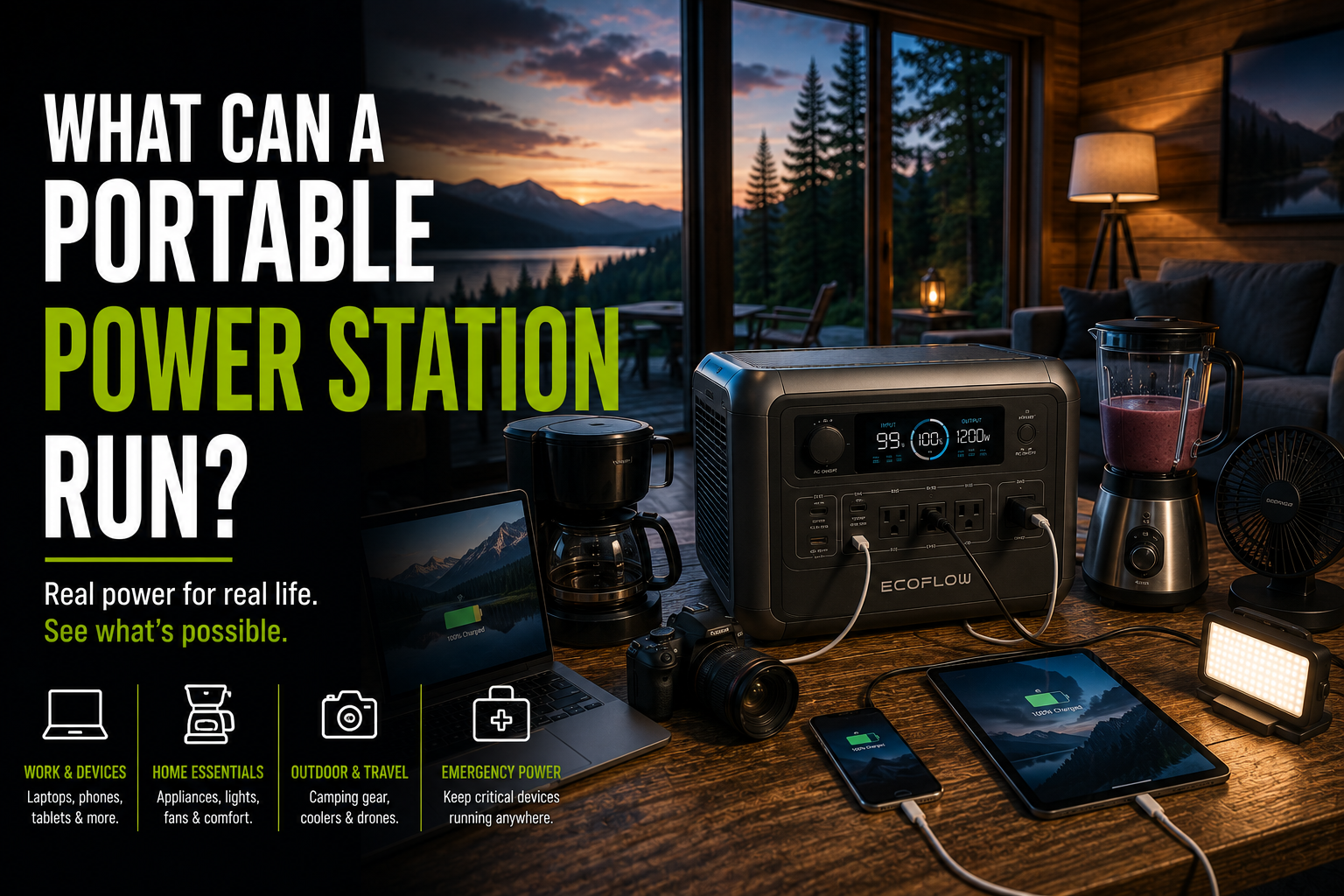
No. A portable station typically powers appliances through its built-in outlets. An installed home battery can energize designated home circuits through approved electrical equipment.
Can I install a whole-home battery myself?
Permanent home electrical integration generally requires professional design, permits, and compliance with local electrical and utility rules. Follow local requirements and manufacturer instructions.
Is a bigger battery always better than a bigger inverter?
No. More battery capacity extends potential runtime; more inverter output supports higher simultaneous demand. The system needs enough of both for its intended loads.
Sources and Editorial Methodology
This article uses standard electrical energy arithmetic, distinguishes peak power from stored energy, and treats example loads and conversion factors as illustrative rather than verified product specifications. Site-specific electrical design must follow the adopted codes, equipment listing and utility requirements.
- U.S. Department of Energy: Solar Systems Integration Basics - grid integration and distributed energy context.
- U.S. Department of Energy: Homeowner's Guide to Going Solar - solar and home energy planning.
- NFPA 70: National Electrical Code - applicable electrical safety framework; local adoption varies.
- UL Solutions: Energy Storage System Testing and Certification - energy-storage system safety and certification context.
Editorial method: No brand-specific inverter, capacity, cycle-life or price claims are asserted without model-level verification. Illustrative energy calculations are rounded and are not promises of runtime.