
Best Power Inverters
Four pure-sine-wave inverter choices for RVs, cabins, mobile systems and off-grid builds—plus the sizing math that matters before you buy.
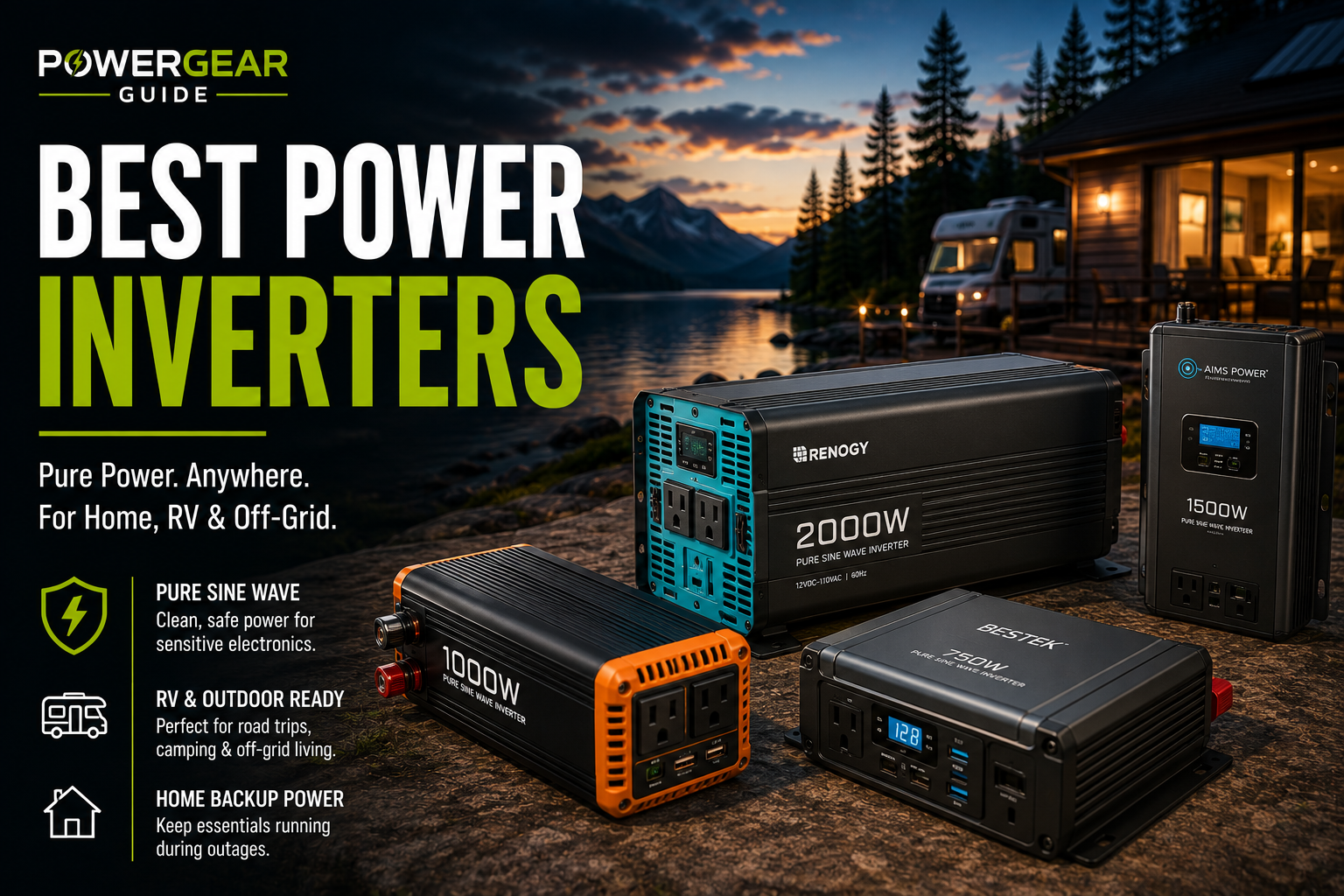
For most 12V RV and cabin systems, a properly sized 2,000W pure sine wave inverter is the safest all-around starting point.
Buy around the electrical system—not just the headline wattage. Continuous output, startup surge, battery voltage, cable current and intended loads all matter.
The best power inverters at a glance
These four picks serve different electrical systems. We prefer a clear use-case winner over pretending every inverter competes in the same class.
Renogy 2000W 12V Pure Sine Wave
A practical 12V choice for RV, cabin and mobile systems that need useful appliance headroom.
Victron Phoenix Inverter Smart
A stronger fit for serious electrical builds where system quality and voltage options matter.
AIMS Power 2000W Pure Sine
A straightforward high-output option for demanding mobile, marine and cabin applications.
Victron Phoenix VE.Direct 1200VA
Better for lower-load systems where reliability and clean power matter more than maximum wattage.
Power inverter comparison
| Model | Best for | Class | Battery system | Waveform | Price |
|---|---|---|---|---|---|
| Renogy 2000W | RV / cabin / mobile | 2,000W | 12V | Pure sine | CHECK RENOGY 2000W PRICE |
| Victron Phoenix Smart | Premium system builds | Multi-model family | 12V / 24V / 48V options | Pure sine | CHECK VICTRON PHOENIX SMART PRICE |
| AIMS Power 2000W | Heavy-duty value | 2,000W | System dependent | Pure sine | CHECK AIMS POWER 2000W PRICE |
| Victron Phoenix VE.Direct 1200VA | Compact lower-load systems | 1200VA | Model dependent | Pure sine | CHECK VICTRON PHOENIX VE.DIRECT 1200VA PRICE |
Our top power inverter recommendations
Renogy 2000W 12V Pure Sine Wave Inverter
Excellent
Renogy’s 2000W inverter lands in the useful middle ground: enough continuous output for many common RV and cabin appliances, while still making sense in a carefully designed 12V battery system. The 4,000W peak rating adds short-duration startup headroom for compatible motor-driven loads.
Pros
- Useful 2,000W output class
- Pure-sine output for broad compatibility
- Strong fit for RV and cabin systems
- Meaningful surge headroom
Cons
- High DC current at full load on 12V
- Needs correctly sized cable and fuse protection
- Not a substitute for adequate battery capacity
Victron Phoenix Inverter Smart
Excellent
The Phoenix Inverter Smart family is the better match when the inverter is one part of a larger battery-and-charging architecture. Multiple battery-voltage choices make it easier to avoid extremely high DC current as system power increases.
Pros
- Strong system-integration reputation
- Multiple voltage options
- Pure-sine output
- Good fit for higher-end builds
Cons
- Typically costs more than basic alternatives
- Requires more deliberate system design
- May be unnecessary for simple low-cost setups
AIMS Power 2000W Pure Sine Wave Inverter
Very good
AIMS Power makes sense when you want a conventional pure-sine inverter with enough output for larger loads and do not need an elaborate connected ecosystem. As with any high-output inverter, the battery bank and DC wiring must be engineered for the current involved.
Pros
- Strong output class
- Pure-sine waveform
- Practical for demanding systems
Cons
- Installation quality matters enormously
- Can expose weak battery banks quickly
- Less attractive for very small systems
Victron Phoenix VE.Direct 1200VA
Very good
This is the choice for buyers who do not actually need 2,000W. Oversizing an inverter can add cost and complexity without improving a modest-load system. A lower-output premium unit can be the more rational choice when the real loads are electronics, chargers and smaller appliances.
How to choose the right power inverter
The inverter is only one part of the system. A “2,000W inverter” tells you almost nothing about runtime, and a large battery tells you nothing about whether a motor can start.
For most new systems, we recommend pure sine wave. Modified sine wave can work with simple resistive loads, but the savings are usually not worth introducing avoidable compatibility issues with motors, chargers, audio equipment and sensitive electronics.
How PowerGearGuide evaluates inverter recommendations
We compare published manufacturer specifications, waveform type, continuous-output class, surge capability, battery-voltage availability, intended use, installation requirements and overall system fit. We do not claim hands-on laboratory testing where none was performed.
Power inverter guides that actually help the decision
Power inverter questions
Is a pure sine wave inverter worth it?
For a new system, usually yes. Pure-sine output is the safer default for modern electronics, chargers, motors and variable-speed equipment.
How large an inverter do I need?
Add the loads that may run together, then account for startup surge and leave reasonable headroom. Do not size the inverter from battery capacity alone.
Can a 2,000W inverter run an air conditioner?
Sometimes, but the answer depends on the air conditioner's running load, compressor startup demand, inverter surge capability and battery system. Check the actual nameplate and startup behavior before sizing.
Can I install a power inverter myself?
Small plug-in units are simple; high-current hardwired battery systems can involve dangerous DC fault current, heavy cable, overcurrent protection and grounding. Follow manufacturer requirements and use qualified help when the installation exceeds your competence.