
LiFePO4 vs Lithium-Ion Power Stations: Which Is Better?
Battery chemistry can change how long a portable power station lasts, how much it weighs and how it behaves under stress. Here is what actually matters when choosing between LiFePO4 and nickel-based lithium-ion batteries.
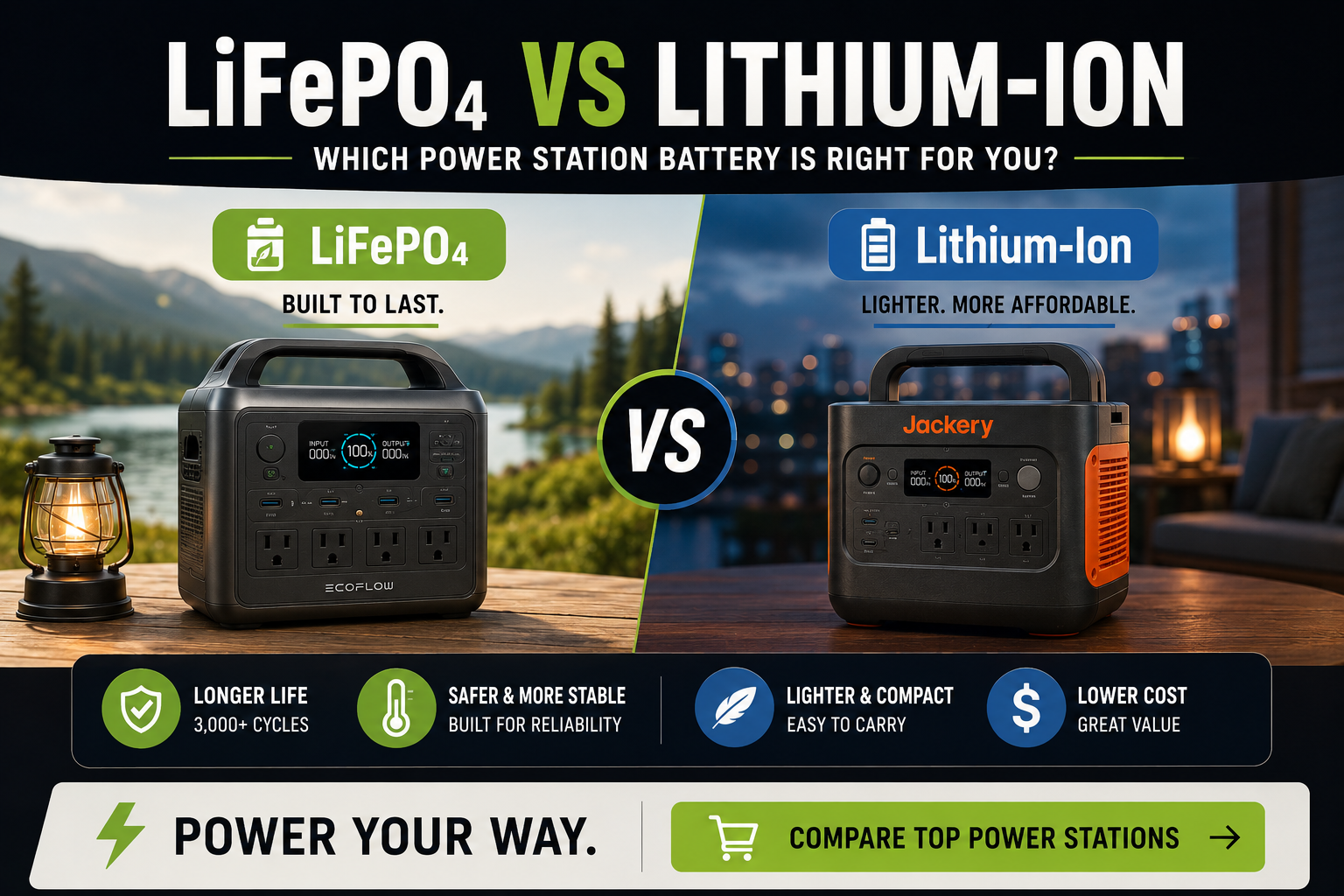
For most buyers shopping for a new power station, LiFePO4 (LFP) is the stronger default choice: it generally offers better cycle longevity and cathode thermal stability. Nickel manganese cobalt (NMC) lithium-ion batteries can still make sense where lower cell weight or smaller size is critical.
Technically, LFP is also a lithium-ion battery. The meaningful comparison is LFP versus nickel-based lithium-ion chemistries such as NMC, not LFP versus all lithium-ion batteries.
Choose LiFePO4 for Frequent Use; Compare NMC When Weight Matters Most
LiFePO4 (LFP)
Better suited to regular solar cycling, RV use and backup systems expected to stay in service for years.
NMC Lithium-Ion
Potentially useful for portable applications where higher cell energy density matters more than maximum cycle longevity.
Neither chemistry guarantees a good power station. Battery-management electronics, inverter performance, product certification, warranty and manufacturer support are equally important.
LiFePO4 vs Lithium-Ion: Side-by-Side Comparison
These are general chemistry trends, not promises for every finished product.
| Factor | LiFePO4 / LFP | NMC Lithium-Ion | What It Means |
|---|---|---|---|
| Cycle life | Generally longer | Generally shorter | LFP is attractive for daily charging. |
| Thermal stability | Generally higher | Generally lower | LFP has a chemistry advantage, but neither is fireproof. |
| Cell energy density | Generally lower | Generally higher | NMC can reduce pack mass for a given energy capacity. |
| Station weight | Design dependent | Design dependent | Compare actual listed pounds. |
| Charging speed | Model dependent | Model dependent | Charger and battery-management system control speed. |
| Cold-weather charging | Requires protection | Requires protection | Check the manual's charging-temperature limits. |
| Price | Varies | Varies | Compare complete products, not cell chemistry alone. |
Battery Lifespan: Why LFP Usually Wins
Cycle life describes how many equivalent full charge-and-discharge cycles a battery can complete before reaching a defined remaining-capacity threshold. Many current LFP stations advertise thousands of cycles; some older NMC products were rated for hundreds.
Assumed to 80% remaining capacity.
Assumed to the same 80% threshold.
Under these hypothetical conditions, the LFP example has 3.75 times the rated cycles. This is not a claim that every LFP station lasts 3.75 times as many years. Heat, time, storage conditions, depth of discharge and cell quality all influence aging.
What About Calendar Life?
Even a battery used only a few times each year ages over time. A rarely used emergency station may never approach its rated cycle limit before calendar aging or another component becomes the limiting factor.
Safety: Is LiFePO4 Safer?
LFP generally has greater cathode thermal stability than nickel-rich chemistries. That is a meaningful advantage, but it does not eliminate fire, electrical or charging hazards.
Why LFP Is Attractive
- More thermally stable cathode chemistry.
- Generally lower propensity for thermal runaway under comparable abusive conditions.
- Well suited to repeated charging and discharging.
What Still Matters
- Battery-management and temperature protection.
- Proper pack construction and overcurrent safeguards.
- Applicable product-level certifications and clear operating instructions.
Weight and Portability: Where NMC Can Win
NMC generally stores more energy per kilogram of battery cells. But total station weight also includes the inverter, case, wiring, cooling hardware and charging electronics. A well-designed LFP station may weigh less than a bulky NMC alternative.
For home backup, weight may be secondary to battery life and capacity. For camping, photography and mobile work, a few pounds can change which product is easiest to live with.
Hot Weather, Cold Weather and Charging
High Temperatures
Heat accelerates battery degradation in both chemistries. Avoid hot parked vehicles, direct sun exposure while charging and blocked ventilation.
Freezing Conditions
Many lithium battery systems restrict charging below 32°F (0°C) unless designed with approved heating or temperature protection. Cold discharge performance can also decline.
Does LFP Charge Faster?
Not inherently. Charging speed depends on the AC charger, solar charge controller, battery-management system, thermal limits and firmware. Compare published 0–80% and 0–100% charging times under the same conditions.
How to Choose the Right Battery Chemistry
Favor LFP
Repeated cycling makes long cycle life more valuable for RV living, solar charging and routine backup.
Compare Both
Weight, size, capacity, ports and price may matter more than maximum cycle rating.
Check the Whole Unit
Calendar aging, storage maintenance, warranty and reliability are critical for infrequent use.
Five Checks Before Buying
- Battery capacity: Watt-hours determine how much energy is stored.
- Continuous AC output: Watts determine which loads can run simultaneously; check motor startup needs.
- Cycle-life definition: Compare both cycles and remaining-capacity threshold.
- Charging compatibility: Verify solar voltage/current limits, connectors and temperature restrictions.
- Weight and support: Compare complete product weight, certifications, warranty and service options.
| Use Case | Starting Choice | Reason |
|---|---|---|
| Daily solar cycling | LFP | Longer cycle-life profile |
| Home backup | LFP | Long-term ownership and stability |
| RV and van living | LFP | Frequent charging and discharging |
| Occasional camping | Either | Compare size, weight and price |
| Weight-sensitive field work | Compare both | NMC may offer a weight advantage |
| Emergency-only storage | Either | Storage care and calendar life matter |
LiFePO4 Power Stations Worth Comparing
These are examples of LFP products with different output and capacity priorities. They are not controlled tests of chemistry.
Jackery Explorer 1000 v2
1,070Wh battery · 1,500W continuous AC output. A useful option for camping and selected emergency loads when portability matters.
Trade-off: It is not designed to run sustained large household loads.
Check PriceAnker SOLIX C1000 Gen 2
1,024Wh battery · 2,000W continuous AC output. A strong candidate for buyers needing more inverter headroom in a 1kWh-class station.
Trade-off: High-wattage appliances can exhaust the battery quickly.
Check PriceBLUETTI AC180
1,152Wh battery · 1,800W continuous AC output. An alternative for buyers who want a little more stored energy.
Trade-off: Check actual unit weight and portability before buying.
Check PriceFrequently Asked Questions
Is LiFePO4 a type of lithium-ion battery?
Yes. LiFePO4 is a lithium-ion chemistry. Consumer comparisons usually contrast LFP with nickel-based lithium-ion types such as NMC.
Does LiFePO4 last longer than NMC?
Generally, LFP has a longer cycle-life profile. Exact longevity depends on battery design, operating conditions and how the cycle rating is defined.
Is LiFePO4 fireproof?
No. It has favorable thermal-stability characteristics, but damaged or improperly operated batteries can still create serious hazards.
Is NMC always lighter?
No. NMC has higher typical cell energy density, but complete station weight depends on the full product design.
Can LFP batteries charge below freezing?
Only if the specific system is designed and approved to do so. Many stations restrict charging below 32°F (0°C).
Which chemistry is better for solar generators?
LFP is generally the better starting point for frequent solar charging and discharging. Solar recharge performance depends on the charge controller and panels, not chemistry alone.
Does a higher cycle rating mean a longer warranty?
No. Battery cycle-life ratings and warranty coverage are different. Check the manufacturer's actual terms.
Final Verdict: LiFePO4 Is the Better Default
For most buyers planning regular use, LiFePO4 offers the more compelling balance of cycle longevity and thermal stability. NMC remains worth considering when lower weight or smaller size materially improves portability.
Choose the complete power station that fits your loads, battery-runtime needs, charging setup and budget—not just the chemistry label.
Compare Current OptionsResearch and Editorial Methodology
This comparison summarizes general battery chemistry characteristics and manufacturer-published product specifications. It does not claim hands-on testing, measured cycle-life results or fixed prices.
- U.S. Department of Energy — Energy Storage
- National Renewable Energy Laboratory — Battery Research
- UL Solutions — Product Safety Standards
- Jackery — Manufacturer Specifications
- Anker — Manufacturer Specifications
- BLUETTI — Manufacturer Specifications
Verify the exact model generation, manufacturer manual, charging limits and warranty before purchase.