
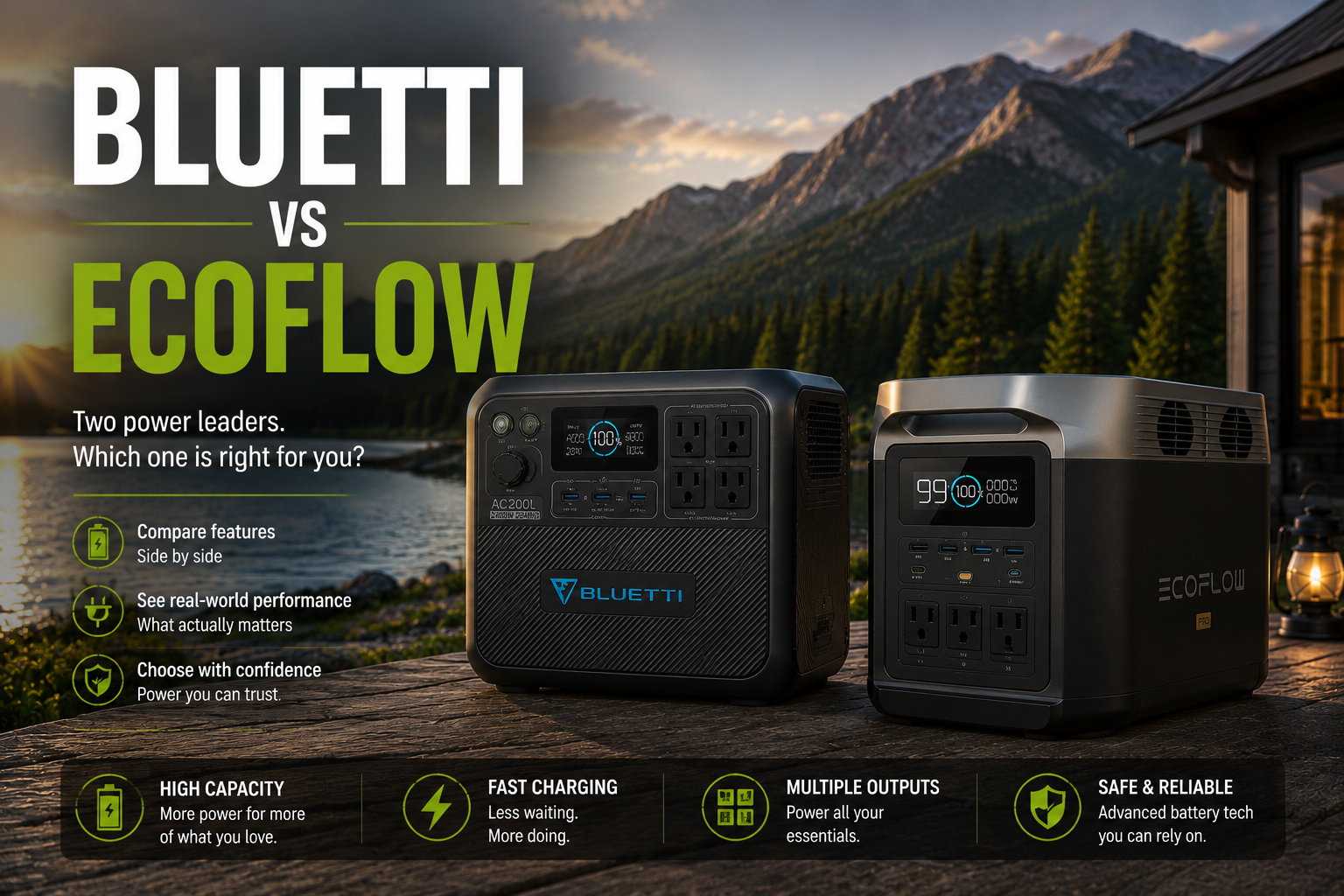
BLUETTI vs EcoFlow
BLUETTI and EcoFlow both offer compact power stations, expandable battery systems and serious home-backup equipment. BLUETTI usually stands out for broad battery expansion and long-running LiFePO4 experience, while EcoFlow is typically stronger in charging speed, software, UPS features and ecosystem polish.
BLUETTI and EcoFlow compete across nearly every portable-power category, from small camping batteries to modular systems designed for home backup. Both brands now rely heavily on lithium iron phosphate batteries, but their product philosophies differ.
BLUETTI often prioritizes capacity, modular expansion and broad model variety. EcoFlow tends to prioritize fast recharging, software control, UPS performance and tightly integrated accessories. The best brand depends on whether you value maximum battery flexibility or a faster, more polished overall system.
EcoFlow Is Better for Speed; BLUETTI Is Better for Battery Expansion
Choose EcoFlow when fast AC charging, refined app control, UPS behavior and a cohesive home-energy ecosystem matter most. Choose BLUETTI when you want flexible battery expansion, a wide range of LiFePO4 systems and strong capacity options across multiple price levels.
Editor's Verdict
EcoFlow is the better overall choice for most buyers who value speed, software and ease of integration. Its current DELTA and RIVER products combine fast charging, strong app controls, polished UPS behavior and a broad smart-energy ecosystem.
BLUETTI is the better choice for buyers focused on battery capacity and modular expansion. Its AC, Elite and larger home-backup systems offer many expansion paths, broad LiFePO4 adoption and strong value when capacity is the main priority.
Best Choice by Buyer Type
BLUETTI
Broad modular battery options, strong LiFePO4 coverage and capacity-focused product families.
EcoFlow
Fast charging, refined software, advanced UPS behavior and a cohesive accessory ecosystem.
Depends on System Size
BLUETTI is strong for modular battery growth, while EcoFlow is stronger for integrated smart-home control.
BLUETTI vs EcoFlow Comparison
| Category | BLUETTI | EcoFlow | Better Choice |
|---|---|---|---|
| Battery chemistry | Extensive LiFePO4 use across current lines | Extensive LiFePO4 use across current RIVER and DELTA lines | Tie |
| Capacity options | Very broad, including modular battery systems | Broad, with strong portable and home-backup ranges | BLUETTI |
| Expandability | Excellent across many AC and home systems | Excellent on selected DELTA systems | BLUETTI |
| AC charging speed | Fast on newer models | Frequently among the fastest in class | EcoFlow |
| App control | Useful monitoring and controls | More polished and feature-rich overall | EcoFlow |
| UPS features | Available on selected models | Strong across many current products | EcoFlow |
| Durability focus | Robust housings and long-cycle batteries | Strong BMS, cooling and protection systems | Tie by model |
| Warranty | Often two to six years depending on model | Often up to five years on current major lines | Depends on model |
| Ease of use | More model variation and accessory combinations | More consistent interface and ecosystem design | EcoFlow |
| Best fit | Capacity and modular growth | Fast, smart, integrated backup | Depends on buyer |
BLUETTI
BLUETTI offers one of the broadest selections of LiFePO4 portable power stations and modular battery systems, with products spanning compact travel units through substantial home-backup platforms.
BLUETTI's lineup includes compact AC-series power stations, larger expandable systems and dedicated home-energy products. The company has used LiFePO4 chemistry across many generations and often gives buyers multiple paths to add external battery modules.
BLUETTI Advantages
- Wide selection of expandable battery systems.
- Long-standing use of LiFePO4 chemistry.
- Strong capacity options at several price levels.
- Many solar input and off-grid configurations.
- Competitive warranty periods on newer models.
BLUETTI Limitations
- Product naming and accessory compatibility can be confusing.
- App experience is less refined than EcoFlow's.
- Some systems use model-specific battery modules.
- Charging speed varies more across the lineup.
- Larger units can be heavy and less portable.
Choose BLUETTI when: you want high battery capacity, modular expansion and a wide range of LiFePO4 systems for off-grid or home-backup use.
EcoFlow
EcoFlow focuses on fast charging, polished app control, advanced UPS behavior and a tightly connected ecosystem spanning compact batteries through integrated home-backup equipment.
EcoFlow's RIVER and DELTA products are designed around rapid recharging and strong software control. Current systems commonly use LiFePO4 cells, and selected DELTA products support extra batteries, smart generators and home-integration accessories.
EcoFlow Advantages
- Very fast AC charging on many models.
- Refined Wi-Fi and Bluetooth app control.
- Strong UPS and backup-switching features.
- Well-integrated batteries and accessories.
- Consistent product design across major lines.
EcoFlow Limitations
- Expansion accessories can be expensive.
- High-speed charging may increase fan noise.
- Some functions depend heavily on software.
- Proprietary ecosystem choices can limit flexibility.
- Premium models may cost more than capacity-focused alternatives.
Choose EcoFlow when: you value fast charging, app control, UPS behavior and a polished ecosystem more than maximum modular flexibility.
Battery Capacity and Cycle Life
Both brands now rely heavily on LiFePO4 batteries, which generally provide long cycle life and strong thermal stability. BLUETTI adopted the chemistry early across many products, while EcoFlow has expanded it throughout current RIVER and DELTA families.
Cycle ratings vary by model. Many current systems from both brands are designed to retain roughly 80% capacity after thousands of cycles. Buyers should verify the exact battery rating, because older inventory may use different chemistry or lower cycle-life specifications.
BLUETTI Strength
Many capacity classes and external battery combinations make it easier to build a larger system over time.
EcoFlow Strength
Current models combine long-life LFP cells with strong battery management and smart monitoring.
What to Verify
Check usable watt-hours, cycle rating, expansion limits and the warranty on both the base unit and extra batteries.
Expandability and Home Backup
BLUETTI has a slight advantage in raw modular variety. Many of its larger power stations support one or more external battery modules, and its home-energy systems are designed around scalable storage.
EcoFlow offers fewer expansion combinations across the entire lineup, but the supported systems are often more polished and easier to manage through one app. Its DELTA Pro and DELTA Pro Ultra ecosystems are especially strong for buyers who want a more integrated home-backup experience.
Charging Speed
EcoFlow generally wins charging speed. Its X-Stream architecture allows many current models to recharge rapidly from AC power, and selected systems can combine wall, solar, vehicle or generator inputs.
BLUETTI's newer models have improved substantially and can also charge quickly, but performance varies more by product generation. Buyers who need to recharge between outages, road-trip stops or short solar windows may prefer EcoFlow.
Durability and Thermal Management
Both brands use robust battery management systems and protective housings. BLUETTI often emphasizes solid construction and long-life batteries, while EcoFlow invests heavily in active cooling, software monitoring and multi-layer electrical protection.
Neither brand should be treated as weatherproof unless the exact product carries an appropriate ingress-protection rating. Most portable power stations still require protection from rain, standing water, extreme heat and freezing storage conditions.
BLUETTI Durability Strengths
- Long-cycle LiFePO4 batteries.
- Substantial housings on larger systems.
- Broad BMS protection.
- Extended warranties on selected models.
EcoFlow Durability Strengths
- Advanced cooling on higher-output units.
- Detailed battery monitoring.
- Strong current and temperature protections.
- Consistent five-year coverage on many current products.
Apps, Controls and Everyday Use
EcoFlow has the stronger app experience. Depending on model, users can monitor power flow, change charge limits, control outlets, schedule charging and configure backup behavior.
BLUETTI's app provides useful monitoring and remote control, but the interface and available settings can feel less consistent across different generations. Buyers who prefer direct physical controls may not care, but software-focused users will usually favor EcoFlow.
Price and Overall Value
BLUETTI often provides strong value when battery capacity is the main priority, especially during promotions on expandable AC-series systems. EcoFlow can justify a higher price through faster charging, better software and a more cohesive accessory ecosystem.
Compare the full system cost rather than only the base unit. Extra batteries, solar panels, transfer equipment, proprietary cables and shipping can materially change the final value.
How to Choose Between BLUETTI and EcoFlow
Choose BLUETTI If
You want the broadest battery expansion options, strong LiFePO4 coverage and capacity-focused value.
Choose EcoFlow If
You prioritize fast charging, refined software, UPS behavior and easier ecosystem integration.
Compare Exact Models If
You have a fixed budget, because promotions and product generations can outweigh brand-level differences.
Plan the Full System
Include solar input, extra batteries, home integration and accessory costs before deciding.
Final Recommendation
BLUETTI is the stronger choice for buyers focused on modular battery expansion, broad capacity options and long-life LiFePO4 systems. EcoFlow is the stronger overall choice for fast charging, software control, UPS performance and polished home-backup integration.
For most buyers who want the easiest high-performance system, EcoFlow gets the overall win. For buyers building a larger battery bank over time, BLUETTI may provide the better path.
Frequently Asked Questions
Is BLUETTI better than EcoFlow?
BLUETTI is often better for battery expansion and capacity-focused value. EcoFlow is generally better for charging speed, software and UPS features.
Which brand has better batteries?
Both brands use LiFePO4 batteries extensively. The better choice depends on the exact cycle rating, capacity, warranty and expansion support of the model.
Which charges faster, BLUETTI or EcoFlow?
EcoFlow usually has the advantage in AC charging speed, although newer BLUETTI models can also recharge quickly.
Which is better for home backup?
BLUETTI is strong for modular storage expansion, while EcoFlow is generally stronger for integrated software, UPS behavior and smart-home accessories.
Which is better for camping?
Both brands offer compact models. EcoFlow is attractive for fast charging and app controls, while BLUETTI may offer more capacity choices at a given budget.
Do BLUETTI and EcoFlow use LiFePO4 batteries?
Many current products from both brands use LiFePO4 chemistry, but older inventory may use different lithium battery types.
Which brand has the better app?
EcoFlow generally provides the more polished and feature-rich app experience.
Which brand offers the better warranty?
Coverage varies by model. BLUETTI commonly offers two to six years on current portable systems, while EcoFlow commonly offers up to five years on major current lines.
Product specifications and warranty terms can change. Confirm current details on the manufacturer's product and warranty pages before purchasing.