
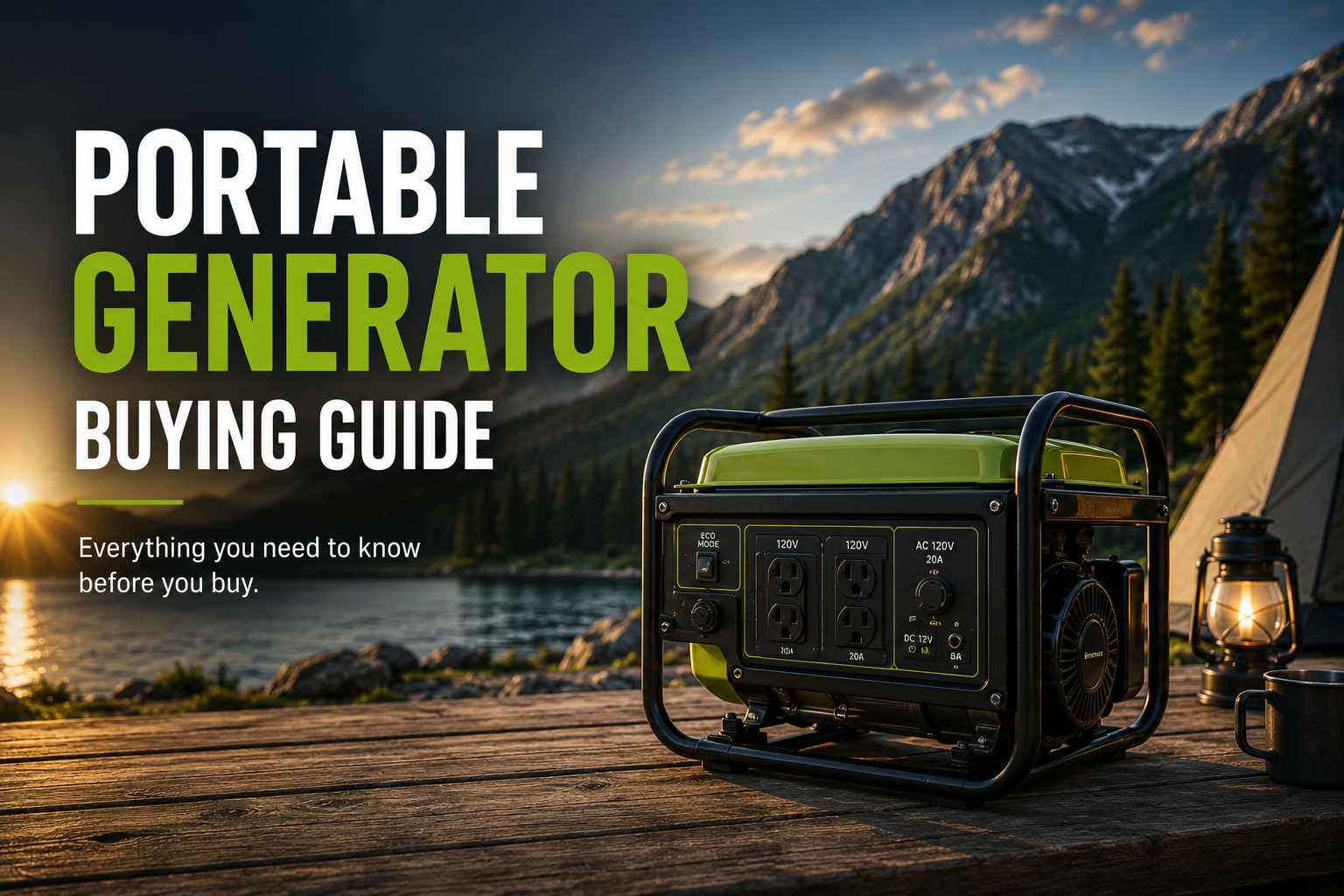
How to Choose the Right Portable Generator
The right portable generator must provide enough running and starting power for your essential equipment, use a fuel you can store safely, operate for the expected outage duration and connect to your home without creating electrical or carbon-monoxide hazards.
Portable generators range from compact inverter models designed for electronics and camping to powerful open-frame machines capable of supporting pumps, refrigerators, furnaces and selected household circuits. The best choice depends less on the advertised maximum wattage and more on the loads you need to start, how long you need to run them and how you will connect the generator safely.
This guide explains the major generator types, how to calculate wattage, which fuels make sense, what noise and runtime numbers really mean and which safety features should be considered essential.
Choose by Running Watts, Starting Watts and Fuel Access
For basic household essentials, many buyers are well served by a 3,000- to 5,000-watt inverter or dual-fuel generator. Homes with well pumps, larger furnaces, multiple refrigerators or heavier loads often need 7,000 to 10,000 running watts. Always size from the appliances you plan to operate, then add margin for startup surges and future needs.
Editor's Verdict
Most homeowners should begin with an inverter or dual-fuel generator because these options provide a useful balance of efficiency, manageable noise and emergency versatility. Choose a conventional open-frame or high-output portable model when maximum wattage and long-duration home backup matter more than quiet operation.
Choose the Right Generator Type
Inverter Generator
Cleaner power, lower noise and better fuel efficiency for electronics, RVs and essentials.
Open-Frame Generator
Higher output per dollar for jobsites and outage backup where noise is less important.
Dual-Fuel Generator
Runs on gasoline or propane for easier fuel planning during emergencies.
Tri-Fuel Generator
Adds natural-gas capability to gasoline and propane for extended home backup.
High-Output Portable
Large portable units designed for transfer-switch use and heavier household loads.
Portable Generator Type Comparison
| Generator Type | Typical Output | Noise | Fuel Options | Portability | Best For |
|---|---|---|---|---|---|
| Inverter generator | 1,000–7,000 W | Low to moderate | Gasoline; some dual-fuel models | Excellent to good | Electronics and quiet backup |
| Open-frame generator | 3,500–12,000+ W | Moderate to high | Gasoline, propane or dual fuel | Good with wheel kit | High output at lower cost |
| Dual-fuel generator | 3,000–12,000+ W | Depends on design | Gasoline and propane | Good | Emergency fuel flexibility |
| Tri-fuel generator | 5,000–13,000+ W | Moderate to high | Gasoline, propane, natural gas | Moderate | Extended home outages |
| High-output portable | 9,000–15,000+ W | High | Gasoline, dual fuel or tri fuel | Limited by size and weight | Multiple household circuits |
What Matters Most When Buying
Running Wattage
The continuous power available after appliances have started and stabilized.
Starting Wattage
Short-duration surge power for refrigerators, pumps, compressors and air conditioners.
Fuel Strategy
The fuel you can store safely, obtain during emergencies and rotate over time.
Runtime
How long the unit operates at a stated load before refueling.
Noise
Critical for neighborhoods, campgrounds, overnight use and operator comfort.
Safe Connection
Transfer equipment, outlets, grounding guidance and carbon-monoxide protection.
1. Inverter Generators
The best option for quiet operation, fuel efficiency and sensitive electronics.
Inverter generators electronically regulate engine speed and power output. They usually run more quietly than conventional open-frame models, consume less fuel at light loads and produce stable electricity suitable for laptops, televisions, communications equipment and modern appliances.
Compact models are ideal for camping and small emergency loads. Larger inverter generators can support refrigerators, furnaces, sump pumps and selected circuits while remaining quieter than comparably sized conventional machines.
Why Choose One
- Lower operating noise
- Improved fuel efficiency at partial load
- Stable power for electronics
- Often easier to transport
- Some models support parallel operation
What to Consider
- Higher cost per watt
- Very high-output models can be expensive
- Compact units may lack 240V output
- Enclosed designs can be harder to service
Best for: homeowners, RV owners and campers who value quiet operation, fuel efficiency and clean power.
2. Conventional Open-Frame Generators
A practical way to obtain substantial output without paying inverter-generator prices.
Open-frame generators place the engine, alternator and fuel tank inside a protective steel frame. They are generally louder and heavier than inverter models, but they deliver more wattage for the money and are widely used for outage backup, construction work and larger tools.
This category is a strong fit when the generator will operate outdoors at a safe distance from the home and noise is not the primary concern.
Why Choose One
- Strong output for the price
- Wide range of sizes and outlets
- Simple, proven design
- Often includes 120/240V capability
- Good for pumps and larger tools
What to Consider
- Higher noise levels
- Less efficient at light loads
- Heavier and bulkier
- Power quality varies by model
Best for: buyers who prioritize output and affordability over quiet operation.
3. Dual-Fuel Generators
Gasoline performance with propane storage convenience in one machine.
Dual-fuel generators can operate on gasoline or propane. Gasoline usually provides slightly higher output, while propane stores longer, burns cleaner and can be easier to maintain as an emergency fuel.
This flexibility is valuable during regional outages because one fuel may remain available when the other is difficult to obtain. Buyers should compare the generator's rated output on each fuel rather than assuming the ratings are identical.
Why Choose One
- Two emergency fuel options
- Propane stores longer than gasoline
- Easier long-term preparedness
- Available in inverter and open-frame designs
- Fuel switching on many models
What to Consider
- Lower output on propane is common
- More components than single-fuel units
- Propane consumption can be substantial
- Cold weather may affect vaporization
Best for: households that want dependable emergency flexibility without relying on gasoline alone.
4. Tri-Fuel Generators
Gasoline, propane and natural-gas capability for households planning around extended outages.
Tri-fuel generators add natural gas to the usual gasoline and propane options. This can be useful for homes with an existing natural-gas service because the generator may operate for extended periods without refilling portable fuel containers.
Natural-gas output is typically lower than gasoline output, and a qualified professional should evaluate gas-line capacity, connection equipment and local code requirements.
Why Choose One
- Three fuel choices
- Natural gas can support long runtime
- Less dependence on stored gasoline
- Useful for serious outage planning
- Often includes 120/240V output
What to Consider
- Lowest output often occurs on natural gas
- Gas service may fail in some disasters
- Connection setup requires planning
- Units are usually heavy and expensive
Best for: homeowners who want maximum fuel choice and expect multi-day outages.
5. High-Output Portable Generators
Large wheeled generators designed to support multiple household circuits through approved transfer equipment.
High-output portable generators can power refrigerators, freezers, well pumps, furnaces, sump pumps and selected larger appliances when connected through a properly installed transfer switch or interlock system.
These machines are not true whole-home substitutes in every situation. Central air conditioning, electric water heaters, electric ranges and multiple large loads may still require active load management.
Why Choose One
- Strong 120/240V output
- Supports multiple household circuits
- Useful for pumps and motor loads
- Often transfer-switch ready
- Available with dual- or tri-fuel capability
What to Consider
- Very heavy and difficult to move
- High fuel consumption
- Significant operating noise
- Requires careful load management
Best for: homeowners who need to support several essential circuits and larger appliances during prolonged outages.
How to Choose the Right Portable Generator
The selection process should begin with a load list, not a generator model. Identify everything you want to power, determine which items may run at the same time and note which appliances have motors or compressors.
1. List Essential Loads
Include refrigerators, freezers, lights, internet equipment, medical devices, furnaces, pumps and any other must-run equipment.
2. Add Running Watts
Total the continuous wattage of the appliances likely to operate simultaneously.
3. Add the Largest Surge
Add the highest starting-watt requirement from any motor-driven appliance to the running total.
4. Include Safety Margin
Avoid planning to operate continuously at the generator's absolute limit. Leave practical headroom.
5. Select Fuel Strategy
Consider storage life, local availability, winter performance and how much fuel the generator consumes.
6. Plan the Connection
Decide whether you will use extension cords, a transfer switch, an inlet box or an approved interlock system.
How Many Watts Do You Need?
| Appliance | Typical Running Watts | Typical Starting Watts | Notes |
|---|---|---|---|
| Refrigerator | 150–800 W | 1,000–2,200 W | Compressor surge varies |
| Chest freezer | 150–700 W | 1,000–2,000 W | May cycle with refrigerator |
| Gas furnace blower | 400–900 W | 800–1,800 W | Check motor label |
| Sump pump | 800–1,500 W | 2,000–4,000 W | High startup demand |
| Well pump | 1,000–2,000 W | 3,000–6,000 W | Often requires 240V |
| Window AC | 500–1,500 W | 1,200–3,000 W | Depends on BTU rating |
| Microwave | 900–1,500 W | Usually near running draw | Use intermittently |
| LED lights and electronics | 50–500 W total | Minimal | Easy to manage |
Starting Watts vs Running Watts
Running watts describe continuous output. Starting watts describe a brief surge available when motors start. A generator may advertise 10,000 starting watts but provide only 8,000 running watts. The lower continuous number is usually the more important rating for sustained operation.
Never add every appliance's starting watts together unless they will start at exactly the same moment. A more realistic approach is to add all simultaneous running loads, then add the largest individual startup surge.
Gasoline vs Propane vs Natural Gas
| Fuel | Main Advantage | Main Limitation | Best Use |
|---|---|---|---|
| Gasoline | Highest output and widespread availability | Short storage life and difficult long-term rotation | Maximum portable performance |
| Propane | Long storage life and cleaner handling | Lower output and cylinder consumption | Emergency preparedness |
| Natural gas | Continuous supply where service remains active | Lowest output and fixed connection needs | Extended residential outages |
Runtime and Fuel Consumption
Generator runtime is often published at 25% or 50% load. A machine advertised to run 12 hours may operate much less time when heavily loaded. Compare runtime at the same load percentage and fuel type whenever possible.
Fuel consumption rises quickly as load increases. A larger generator running lightly may still consume more fuel than a smaller inverter generator matched closely to the actual demand.
How Loud Is a Portable Generator?
Inverter generators are generally the quietest because they can reduce engine speed at light loads and use enclosed housings. Open-frame generators usually operate at a more constant engine speed and produce substantially more mechanical and exhaust noise.
Noise ratings are not always measured under identical conditions. Consider the stated distance, load level and whether the manufacturer publishes a true decibel figure. Local ordinances and campground rules may also limit acceptable noise.
120V vs 120/240V Output
Compact generators often provide only 120V power. This is sufficient for extension-cord loads and many household appliances. Larger home-backup generators typically provide 120/240V output, which may be required for well pumps, certain HVAC equipment and transfer-switch connections.
Do not assume that a large wattage rating automatically includes 240V output. Verify the receptacles and voltage specifications.
Extension Cords, Transfer Switches and Interlocks
Extension Cords
Heavy-duty outdoor-rated cords are appropriate for directly powering selected appliances. Cord gauge and length must match the load to reduce voltage drop and overheating.
Transfer Switch
A transfer switch allows selected household circuits to be powered safely while preventing electricity from feeding back into utility lines.
Generator Interlock
An approved interlock may provide a less expensive way to connect a generator to a compatible panel, but it must be installed correctly and meet local code requirements.
Essential Safety Features
Carbon-Monoxide Shutdown
Automatically stops the engine when dangerous carbon-monoxide levels are detected near the generator.
Low-Oil Shutdown
Protects the engine by stopping operation when lubrication falls below a safe level.
Overload Protection
Prevents damage when connected loads exceed generator capacity.
GFCI Protection
Reduces shock risk on supported outlets, especially around jobsites and damp environments.
Weather Protection
A generator must remain outdoors, but should be protected using equipment specifically designed for safe generator operation.
Correct Placement
Operate outdoors far from doors, windows, vents and attached structures where exhaust can enter.
Electric Start, Remote Start and Automatic Choke
Electric start is particularly valuable on larger engines that can be difficult to pull-start. Remote start adds convenience when the generator is already placed safely outdoors. Automatic choke can simplify cold starts, but a manual backup starting method remains useful if the battery is discharged.
Maintenance and Storage
Portable generators require regular oil changes, air-filter inspection, spark-plug service and periodic test runs. Gasoline should be stabilized and rotated according to safe storage practices. Carburetors can clog when untreated fuel remains inside for long periods.
Store the generator clean and dry, keep the starter battery charged when applicable and follow the manufacturer's maintenance schedule. A generator that has not been tested may fail exactly when it is needed.
Common Portable Generator Buying Mistakes
Buying by Peak Watts
The large advertised number may be starting watts rather than continuous output.
Ignoring Motor Surges
Pumps, refrigerators and air conditioners can demand several times their running wattage during startup.
Choosing Only by Price
Noise, fuel use, safety features, warranty support and outlet configuration matter over years of ownership.
Skipping the Connection Plan
A powerful generator is less useful when there is no safe way to connect it to essential circuits.
Underestimating Fuel Needs
Large generators can consume significant fuel during multi-day outages.
Operating Too Close to the Home
Carbon monoxide can enter through openings even when the generator is outdoors.
Final Recommendation
Choose an inverter generator for quiet operation, electronics and moderate essential loads. Choose a dual-fuel model when fuel flexibility is a priority. Select a high-output 120/240V generator only after calculating your household loads and planning a safe transfer connection. In every case, prioritize carbon-monoxide protection, realistic running wattage and a fuel plan you can maintain.
Frequently Asked Questions
What size portable generator do I need for a house?
Many homes can cover basic essentials with 3,000 to 5,000 running watts. Homes with well pumps, larger furnaces or more extensive circuit backup often need 7,000 to 10,000 running watts or more. Calculate the actual loads before choosing.
What is the difference between starting watts and running watts?
Running watts are the continuous power the generator can deliver. Starting watts are a short surge used to start motors and compressors.
Is an inverter generator better than a regular generator?
An inverter generator is usually quieter, more fuel-efficient at light loads and better suited to sensitive electronics. A conventional generator usually provides more wattage for the money.
Is dual fuel worth it on a generator?
Dual fuel is valuable for emergency preparedness because it allows gasoline or propane operation. Propane stores longer, while gasoline often provides higher output.
Can a portable generator power central air conditioning?
Some large 120/240V generators can run certain central air systems, but compressor startup demand can be very high. A professional load calculation and soft-start equipment may be necessary.
How far should a generator be from the house?
Follow the manufacturer's placement instructions and local guidance. The generator must operate outdoors far from doors, windows, vents and any opening where exhaust could enter.
Can I plug a portable generator into a wall outlet?
No. Backfeeding through a household receptacle is extremely dangerous and illegal in many areas. Use approved transfer equipment installed by a qualified professional.
How long can a portable generator run continuously?
Runtime depends on tank size, load, fuel type and manufacturer limits. Many units require shutdown for refueling, oil checks or maintenance during extended operation.
What fuel is best for emergency generator storage?
Propane is convenient for long-term storage. Gasoline often provides higher output but requires careful rotation and stabilization. Natural gas is useful when service remains available.
Do portable generators need grounding?
Grounding requirements depend on the generator design and how it is connected. Follow the manual and local electrical requirements, especially when using transfer equipment.