
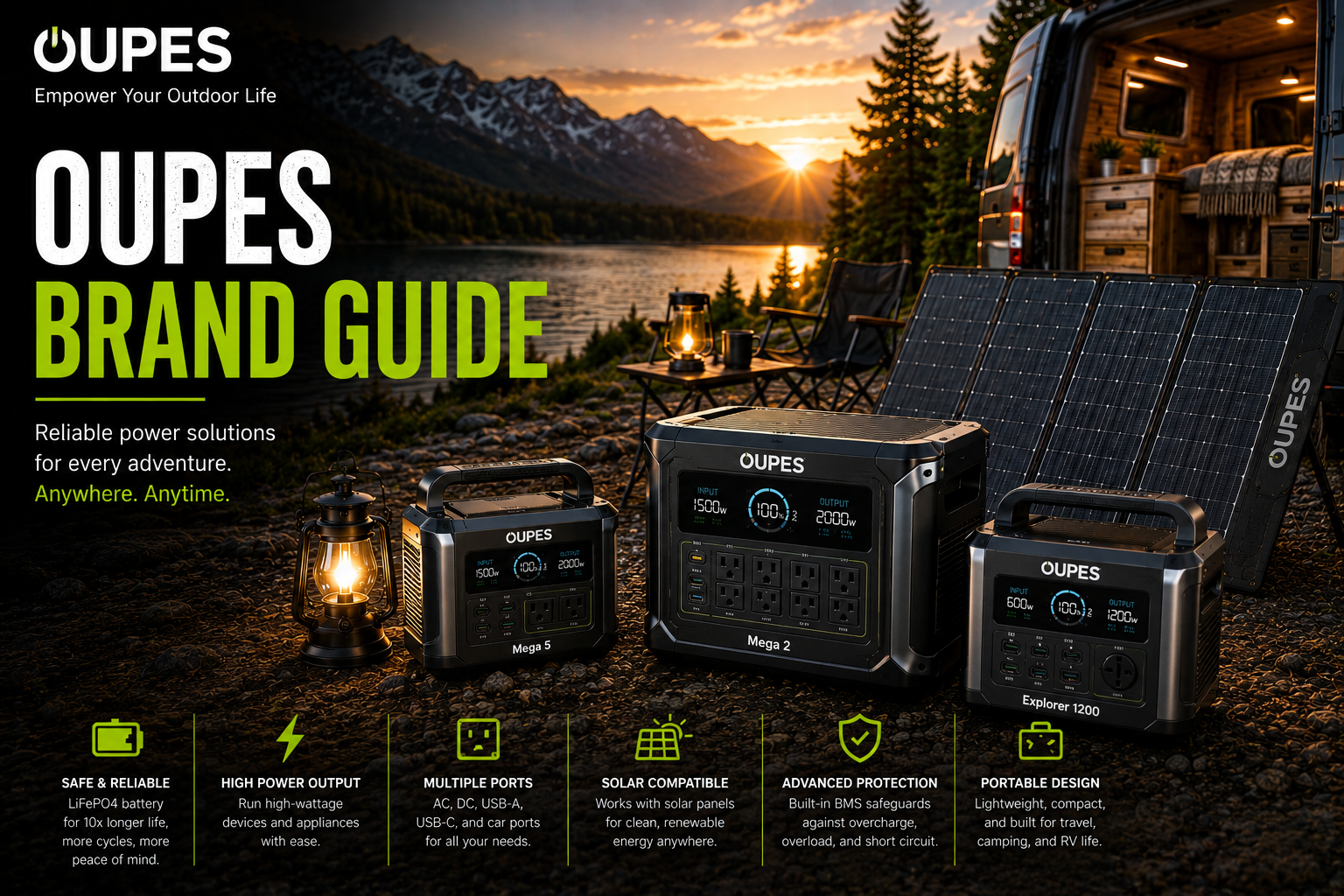
OUPES vs EcoFlow
OUPES emphasizes high output and expansion value; EcoFlow offers a more mature charging ecosystem, app platform and current accessory network.
OUPES emphasizes high output and expansion value; EcoFlow offers a more mature charging ecosystem, app platform and current accessory network.
This comparison evaluates capacity, rated output, charging, expansion, portability, software and ownership.
Main Difference
OUPES emphasizes high output and expansion value; EcoFlow offers a more mature charging ecosystem, app platform and current accessory network.
Comparison Verdict
OUPES emphasizes high output and expansion value; EcoFlow offers a more mature charging ecosystem, app platform and current accessory network.
Quick Comparison
| Factor | OUPES | Competitor |
|---|---|---|
| 1kWh example | Mega 1: 1024Wh/2000W | DELTA 3 Plus: 1024Wh/1800W |
| 2kWh example | Mega 2: 2048Wh/2500W | DELTA 3 Max Plus: 2048Wh/3000W |
| Expansion | B2/B5 systems | Broad DELTA batteries |
| App | OUPES app | Advanced OASIS app |
| Best for | Value and high output | Integrated current ecosystems |
Performance
OUPES leads the 1kWh output comparison; EcoFlow leads the current 2kWh example.
Charging
Both charge quickly, but EcoFlow offers more alternator, generator and automation options.
Ecosystem
EcoFlow has the broader current platform.
Value
OUPES can offer more expandable capacity per dollar during sales.
Who Should Buy Each?
Choose OUPES
When expansion value, high output or direct pricing matters.
Choose the Competitor
When lower weight, retail access or deeper software matters.
Skip Both
When native 240V from one unit is essential.
Check Battery Family
B2 and B5 are different systems.
Compare Current Pricing
OUPES is promotion-sensitive.
Use Rated Output
Do not size from surge alone.
Frequently Asked Questions
Who should buy OUPES vs EcoFlow?
Buy it when OUPES’ high inverter output, rapid charging, app control and expansion pricing match your actual backup plan.
Who should skip OUPES vs EcoFlow?
Skip it when native 240V, lower weight or a larger retail service network matters more.
How should OUPES runtime be estimated?
Multiply rated watt-hours by roughly 0.80 to 0.90 for usable AC energy, then divide by average load watts.
Can OUPES run a refrigerator?
Mega 1 and larger models can generally run common refrigerators when compressor startup remains within surge limits.
Can third-party solar panels be used?
Yes, when voltage, current, polarity and connectors remain within the exact model’s MPPT specifications.
Does OUPES work as a UPS?
Mega models advertise UPS or EPS operation, but transfer time should be verified for sensitive servers or medical equipment.
How long do OUPES batteries last?
Current Mega LFP models generally claim more than 3,500 cycles to about 80% capacity.
Are OUPES expansion batteries universal?
No. B2 batteries serve Mega 1, Mega 2 and Mega 3 families, while B5 is for Mega 5.
How should an OUPES station be stored?
Keep it cool, dry and ventilated, and follow the manual’s periodic charging guidance.
What is the biggest OUPES buying mistake?
Assuming all Mega models use the same battery pack, charging limit or UPS rating.
Which is better for a new long-term ecosystem?
EcoFlow.
Which offers more 1kWh output?
OUPES Mega 1.