
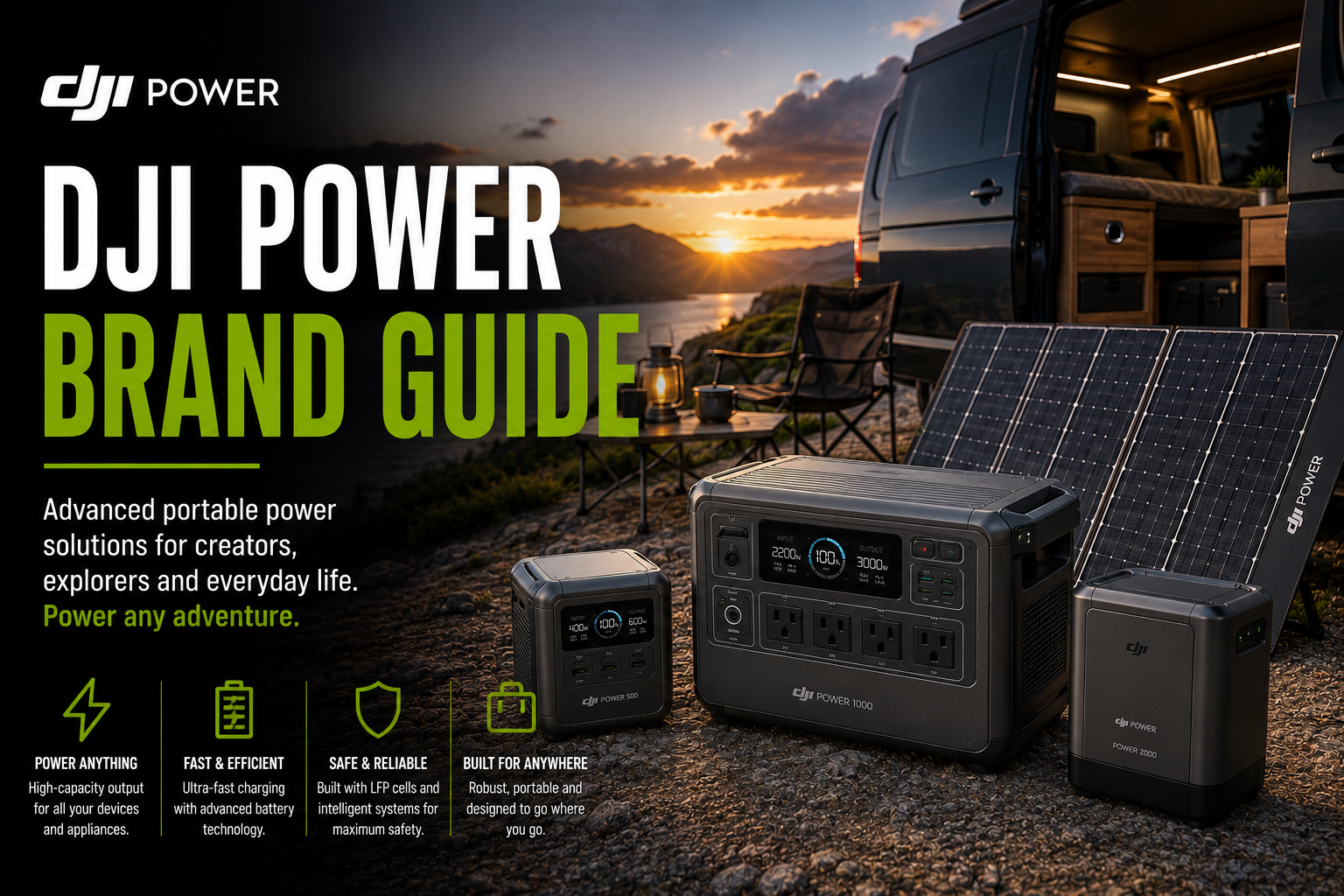
DJI Power 1000 vs Power 2000
Choose Power 1000 for lower weight and discounted 1kWh high output; choose Power 2000 for double the energy, 3,000W output, faster 0–80% recovery and deep expansion.
Choose Power 1000 for lower weight and discounted 1kWh high output; choose Power 2000 for double the energy, 3,000W output, faster 0–80% recovery and deep expansion.
This comparison examines practical output, runtime, charging, expansion, noise, portability and long-term ecosystem value.
Main Difference
Choose Power 1000 for lower weight and discounted 1kWh high output; choose Power 2000 for double the energy, 3,000W output, faster 0–80% recovery and deep expansion.
Comparison Verdict
Choose Power 1000 for lower weight and discounted 1kWh high output; choose Power 2000 for double the energy, 3,000W output, faster 0–80% recovery and deep expansion.
Quick Comparison
| Factor | DJI Power 1000 | DJI Power 2000 |
|---|---|---|
| Capacity | 1,024Wh | 2,048Wh |
| Stable Output | 2,200W | 3,000W |
| Peak | 4,400W | Model-specific high surge |
| Weight | Approx. 13 kg | Approx. 22 kg |
| Expansion | Original platform limits | Up to five 2,048Wh packs |
| Best use | Portable high output | Longer backup |
Runtime
Power 2000 provides roughly twice the base runtime at the same load.
Portability
Power 1000 is significantly easier to move and store.
Expansion
Power 2000 is designed around the Expansion Battery 2000 and larger system planning.
Value
Power 1000 can be excellent at clearance pricing; Power 2000 is the stronger long-term platform.
Who Should Buy Each?
Choose the Smaller Option
When weight, price and portability matter most.
Choose the Larger Option
When runtime, outlet count or expansion matters more.
Skip Both
When native 240V output or another ecosystem is required.
Check Accessory Cost
Car chargers and expansion batteries change total value.
Verify Model Generation
Power 1000 and 1000 V2 differ materially.
Measure Actual Loads
Use running watts and startup surge.
Frequently Asked Questions
Who should buy DJI Power 1000 vs Power 2000?
Buy it when DJI’s unusually high inverter output, quiet operation, SDC charging or drone-battery integration solves a real need.
Who should skip DJI Power 1000 vs Power 2000?
Skip it when you need native 240V output, the lowest weight in class or a broader third-party accessory market.
How should DJI Power runtime be estimated?
Multiply rated watt-hours by roughly 0.80 to 0.90 for usable AC energy, then divide by the appliance’s average running watts.
Can DJI Power run a refrigerator?
Power 1000-class and Power 2000 models can generally run refrigerators when compressor startup remains within inverter limits.
Can DJI Power charge from solar panels?
Yes, through compatible DJI MPPT or super-fast solar/car charging accessories and panels that remain within voltage and current limits.
Can DJI Power work as a UPS?
DJI supports UPS-style operation on current models, but transfer behavior and compatibility should be verified for sensitive medical or server equipment.
How long do DJI Power batteries last?
Current LFP models are generally rated to retain more than 80% capacity after 4,000 cycles.
Are DJI Power accessories universal?
No. SDC and SDC Lite capabilities differ, and expansion compatibility varies by model generation.
Can DJI Power fast-charge drone batteries?
Yes. Model-specific SDC cables support fast charging for selected DJI consumer and enterprise drone batteries.
What is the biggest DJI Power buying mistake?
Choosing only from inverter watts while ignoring base energy, expansion cost, outlet count and accessory compatibility.
Is Power 2000 worth the added weight?
Yes when refrigerator, RV or household runtime matters.
Should I compare Power 1000 V2 instead?
Yes for a current 1kWh expandable alternative.