
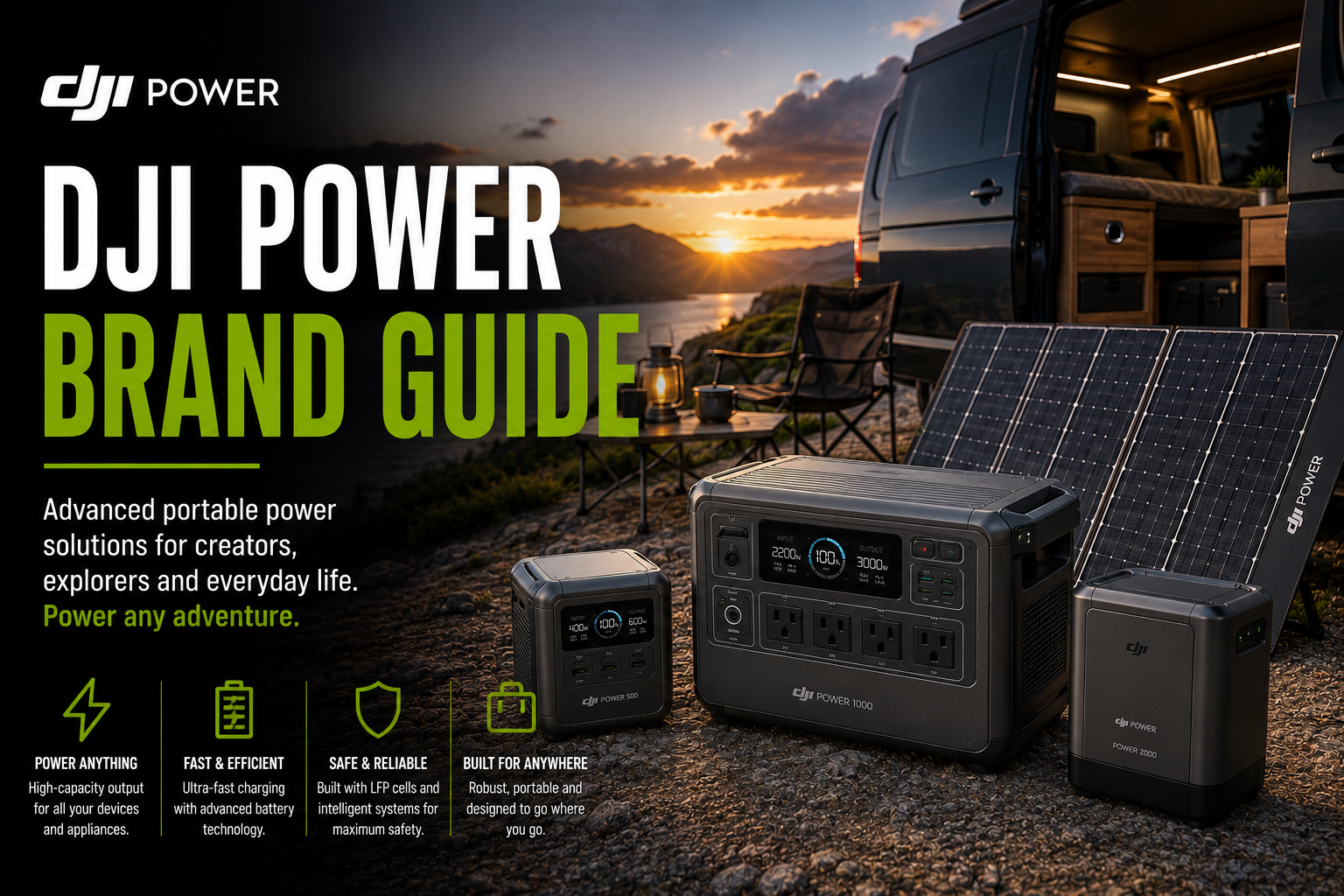
DJI Power Series Comparison
Power 500 serves compact travel, Power 1000 and 1000 V2 dominate high-output 1kWh use, and Power 2000 adds the runtime and expansion needed for serious backup.
Power 500 serves compact travel, Power 1000 and 1000 V2 dominate high-output 1kWh use, and Power 2000 adds the runtime and expansion needed for serious backup.
This comparison examines practical output, runtime, charging, expansion, noise, portability and long-term ecosystem value.
Main Difference
Power 500 serves compact travel, Power 1000 and 1000 V2 dominate high-output 1kWh use, and Power 2000 adds the runtime and expansion needed for serious backup.
Comparison Verdict
Power 500 serves compact travel, Power 1000 and 1000 V2 dominate high-output 1kWh use, and Power 2000 adds the runtime and expansion needed for serious backup.
Quick Comparison
| Model | Capacity | Continuous Output | Weight | Best Use |
|---|---|---|---|---|
| Power 500 | 512Wh | 1,000W | 7.3 kg | Camping |
| Power 1000 | 1,024Wh | 2,200W | 13 kg | Value |
| Power 1000 V2 | 1,024Wh | 2,600W | 14.2 kg | High-output 1kWh |
| Power 2000 | 2,048Wh | 3,000W | 22 kg | Backup/RV |
Platform Evolution
DJI progressed from compact fixed-capacity stations to app-connected expandable systems.
Runtime
Power 2000 doubles base energy versus the 1kWh models.
Charging
All models emphasize rapid AC recovery, while larger systems support more powerful vehicle and solar accessories.
Noise and Indoor Use
DJI emphasizes low-noise operation, making the range attractive for production sets and overnight backup.
Who Should Buy Each?
Choose the Smaller Option
When weight, price and portability matter most.
Choose the Larger Option
When runtime, outlet count or expansion matters more.
Skip Both
When native 240V output or another ecosystem is required.
Check Accessory Cost
Car chargers and expansion batteries change total value.
Verify Model Generation
Power 1000 and 1000 V2 differ materially.
Measure Actual Loads
Use running watts and startup surge.
Frequently Asked Questions
Who should buy DJI Power Series Comparison?
Buy it when DJI’s unusually high inverter output, quiet operation, SDC charging or drone-battery integration solves a real need.
Who should skip DJI Power Series Comparison?
Skip it when you need native 240V output, the lowest weight in class or a broader third-party accessory market.
How should DJI Power runtime be estimated?
Multiply rated watt-hours by roughly 0.80 to 0.90 for usable AC energy, then divide by the appliance’s average running watts.
Can DJI Power run a refrigerator?
Power 1000-class and Power 2000 models can generally run refrigerators when compressor startup remains within inverter limits.
Can DJI Power charge from solar panels?
Yes, through compatible DJI MPPT or super-fast solar/car charging accessories and panels that remain within voltage and current limits.
Can DJI Power work as a UPS?
DJI supports UPS-style operation on current models, but transfer behavior and compatibility should be verified for sensitive medical or server equipment.
How long do DJI Power batteries last?
Current LFP models are generally rated to retain more than 80% capacity after 4,000 cycles.
Are DJI Power accessories universal?
No. SDC and SDC Lite capabilities differ, and expansion compatibility varies by model generation.
Can DJI Power fast-charge drone batteries?
Yes. Model-specific SDC cables support fast charging for selected DJI consumer and enterprise drone batteries.
What is the biggest DJI Power buying mistake?
Choosing only from inverter watts while ignoring base energy, expansion cost, outlet count and accessory compatibility.
Which DJI Power model is easiest to carry?
Power 500.
Which supports the highest continuous output?
Power 2000 at 3,000W.