
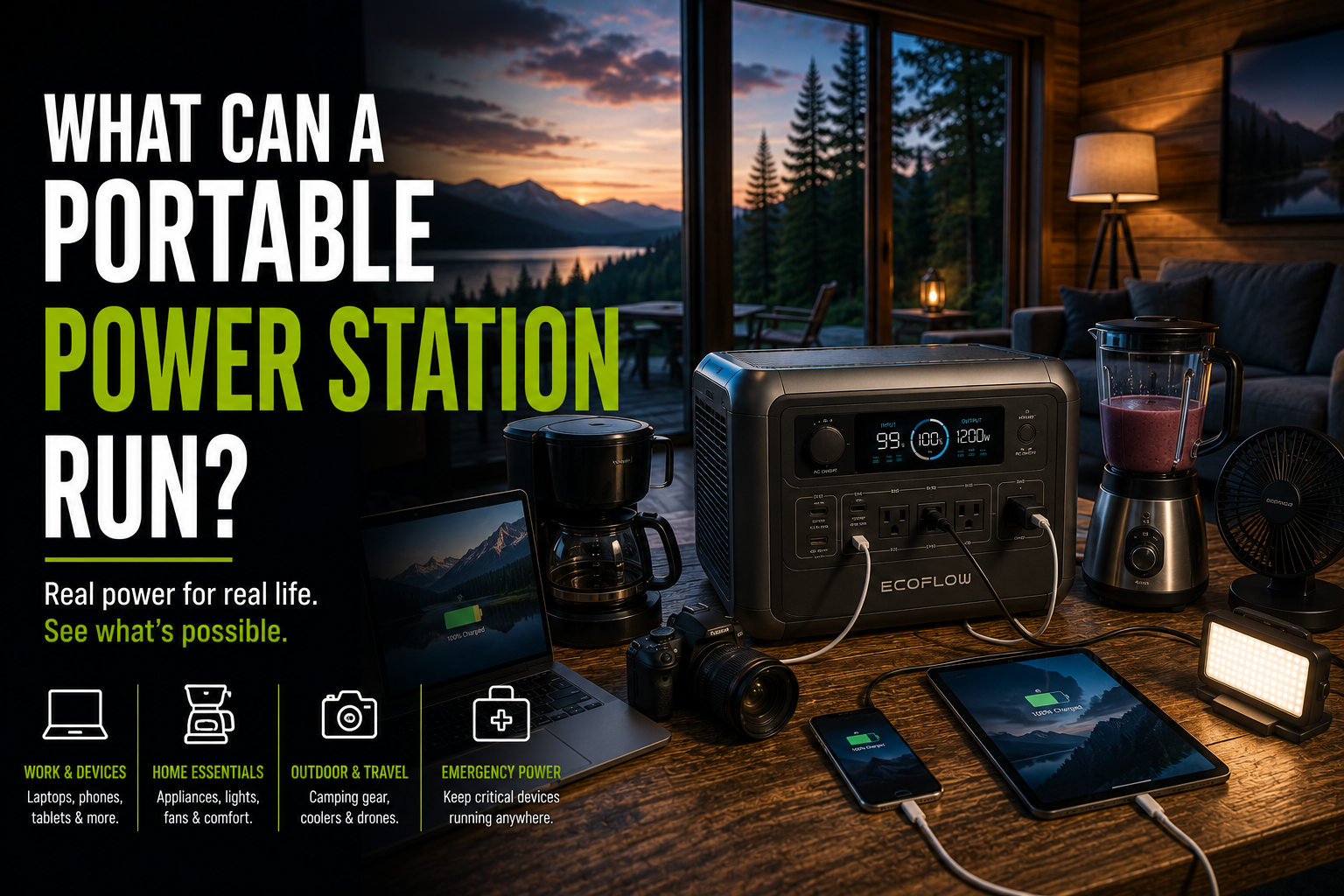
Best Backup Power for Apartments
Quiet, indoor-safe battery stations are the practical apartment choice, with 1kWh-class systems offering the best balance of storage, output and portability.
Apartment backup should prioritize safety, compact storage and essential-load runtime rather than whole-home ambitions.
The best options can keep a refrigerator, router, lights and computers running without combustion exhaust.
Best Overall: EcoFlow DELTA 3 Plus
Its quiet operation, 1,800W output and optional expansion make it adaptable without requiring a large permanent installation.
Editor's Verdict
Choose a compact 1kWh LiFePO4 station and size it around essential loads. Never use a gasoline, propane or dual-fuel generator inside an apartment, hallway, garage or balcony enclosure.
Top Picks
EcoFlow DELTA 3 Plus
1,024Wh, 1,800W output, rapid charging and expandable capacity.
Jackery Explorer 1000 v2
1,070Wh, 1,500W output and a 23.8-pound LiFePO4 design.
BLUETTI Elite 100 V2
1,024Wh, 1,800W output, 25-pound body and 1,000W solar input.
Anker SOLIX C1000
1,056Wh, 1,800W output, 600W solar input and app control.
Quick Comparison
| Model | Capacity | Output | Best Use |
|---|---|---|---|
| EcoFlow DELTA 3 Plus | 1,024Wh | 1,800W | Best overall |
| Jackery Explorer 1000 v2 | 1,070Wh | 1,500W | Best lightweight |
| BLUETTI Elite 100 V2 | 1,024Wh | 1,800W | Best solar input |
| Anker SOLIX C1000 | 1,056Wh | 1,800W | Best value |
EcoFlow DELTA 3 Plus
1,024Wh, 1,800W output, rapid charging and expandable capacity.
DELTA 3 Plus balances manageable size, quiet operation, app control and enough inverter output for refrigerators, office equipment and many kitchen appliances.
Why It Stands Out
- Fast charging
- Expandable
- Quiet mode
- 10ms-class backup switching
- Mature app
What to Consider
- Expansion adds cost
- Not lightweight
- Boost modes are not full rated output
- No native 240V
Best for: apartments, home offices and refrigerator backup.
Jackery Explorer 1000 v2
1,070Wh, 1,500W output and a 23.8-pound LiFePO4 design.
Explorer 1000 v2 is one of the easiest 1kWh-class stations to carry and offers enough output for common home and camping loads.
Why It Stands Out
- Low weight
- Fast emergency charging
- LFP chemistry
- Simple interface
- Good retail availability
What to Consider
- No large expansion path
- Less output than 1,800W rivals
- Limited AC outlets
- Solar bundles cost extra
Best for: lightweight backup, apartments and camping.
BLUETTI Elite 100 V2
1,024Wh, 1,800W output, 25-pound body and 1,000W solar input.
Elite 100 V2 delivers unusually strong solar input and inverter output in a compact 1kWh package.
Why It Stands Out
- High solar input
- Compact
- 4,000+ cycle claim
- App and UPS
- Fast charging
What to Consider
- Not broadly expandable
- Fans under heavy charging
- Price varies
- No native 240V
Best for: apartments, solar users and high-output portable backup.
Anker SOLIX C1000
1,056Wh, 1,800W output, 600W solar input and app control.
SOLIX C1000 remains a strong value when priced below larger competitors and provides balanced output, charging and connectivity.
Why It Stands Out
- Strong output
- Fast recharge
- App control
- LFP chemistry
- Good sale pricing
What to Consider
- Older than Gen 2
- Expansion varies by accessory
- Fan noise under load
- No 240V
Best for: under-$1,000 shopping and home essentials.
How to Choose
Choose Indoor-Safe Battery Power
Never operate fuel-burning generators indoors or on balconies.
Prioritize Quiet Modes
Shared walls make fan noise important.
Measure Essential Loads
Refrigerator, router, lights and laptop first.
Check Building Rules
Confirm charging and storage policies.
Avoid Oversizing
A 1kWh station is often easier to store.
Plan Solar Realistically
Apartment solar access may be limited.
Frequently Asked Questions
Who should buy apartment backup power?
Buy it when the system's continuous output, startup capability, usable capacity and charging method match the actual loads you need to protect.
Who should skip apartment backup power?
Skip it when the product is being chosen from headline watt-hours alone or when installation, medical, electrical or building rules make another solution more appropriate.
How should runtime be estimated?
Multiply rated watt-hours by roughly 0.80 to 0.90 for usable AC energy, then divide by the appliance's average running watts.
Why do starting watts matter?
Compressors, pumps and motors can draw several times their normal running power for a short period, so the inverter must handle both continuous and surge demand.
Is LiFePO4 better for frequent use?
LiFePO4 generally offers longer cycle life and strong thermal stability, making it attractive for systems that will be charged and discharged regularly.
Can solar panels recharge the system during an outage?
Yes when the panel voltage, current, polarity and connector match the power station's input limits and sunlight is adequate.
Can a power station be connected directly to a home panel?
Only through manufacturer-approved transfer equipment and qualified installation. Never backfeed a receptacle.
How much reserve capacity should be planned?
A 20% to 30% reserve helps cover inverter losses, cold weather, battery aging and loads that cycle unpredictably.
Should price be compared per watt-hour?
Cost per watt-hour is useful, but output, charging speed, warranty, battery chemistry and accessory compatibility can matter more.
What is the most common buying mistake?
Buying a unit that has enough stored energy but not enough continuous or surge output for the intended appliance.
Can I use a gas generator on an apartment balcony?
No. Carbon monoxide can enter the building and endanger multiple units.
Is a 1kWh station enough for an apartment refrigerator?
Often for several hours to roughly a day depending on the refrigerator, ambient temperature and other loads.