
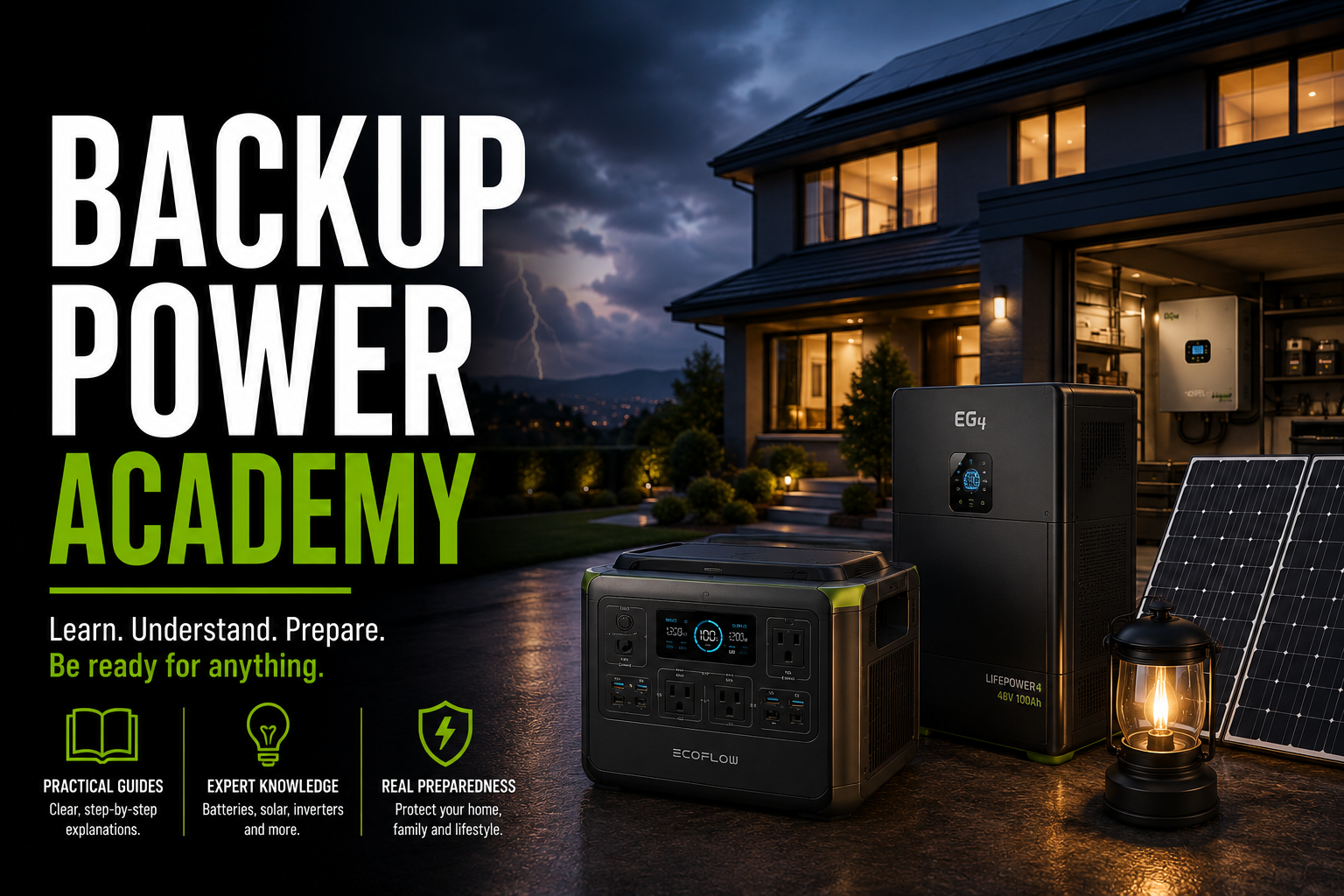
Home Backup Power Buying Guide
Choose home backup by essential loads, outage duration, transfer requirements, fuel tolerance, installation limits and budget—not by product category alone.
The right solution may be a UPS, portable station, installed battery, generator or layered combination.
This guide provides a framework for comparing them safely.
Start With Loads, Then Choose the Technology
A small UPS protects electronics, a portable station covers short indoor-safe outages, and an installed battery or generator handles larger home circuits.
Buying Guidance
Build an essential-load worksheet and obtain professional quotes before buying whole-home equipment.
Backup Power Options
| Option | Typical Strength | Primary Limitation |
|---|---|---|
| UPS | Instant transfer for electronics | Minutes, not hours |
| Portable Power Station | Indoor-safe movable battery | Limited energy/output |
| Expandable Power Station | Grows from portable to home backup | Proprietary accessories |
| Installed Home Battery | Automatic 120/240V circuit backup | High installed cost |
| Portable Generator | High sustained power | Fuel, noise and carbon monoxide |
| Standby Generator | Automatic long-duration backup | Installation and fuel dependence |
Build an Essential-Load List
Refrigeration
Measure daily kWh and startup.
Water and Sump Pumps
Check motor surge and voltage.
Medical Equipment
Follow manufacturer and clinical plans.
Communications
Router, modem and phones.
Heating Controls
Furnace blower and ignition.
Cooling
Window or central AC may dominate sizing.
Sizing Method
Add simultaneous running watts, identify the largest motor-starting surge, and multiply expected daily watt-hours by the desired outage days. Add 20–30% reserve for losses and uncertainty.
Safety and Installation
Never Backfeed
Use approved transfer equipment.
Keep Combustion Outdoors
Far from openings.
Use Qualified Electricians
For panels and 240V.
Follow Battery Clearances
Temperature and fire code matter.
Test the System
Before storm season.
Maintain Fuel and Batteries
On schedule.
Frequently Asked Questions
Who should buy home backup power?
Buy it when the system's continuous output, startup capability, usable capacity and charging method match the actual loads you need to protect.
Who should skip home backup power?
Skip it when the product is being chosen from headline watt-hours alone or when installation, medical, electrical or building rules make another solution more appropriate.
How should runtime be estimated?
Multiply rated watt-hours by roughly 0.80 to 0.90 for usable AC energy, then divide by the appliance's average running watts.
Why do starting watts matter?
Compressors, pumps and motors can draw several times their normal running power for a short period, so the inverter must handle both continuous and surge demand.
Is LiFePO4 better for frequent use?
LiFePO4 generally offers longer cycle life and strong thermal stability, making it attractive for systems that will be charged and discharged regularly.
Can solar panels recharge the system during an outage?
Yes when the panel voltage, current, polarity and connector match the power station's input limits and sunlight is adequate.
Can a power station be connected directly to a home panel?
Only through manufacturer-approved transfer equipment and qualified installation. Never backfeed a receptacle.
How much reserve capacity should be planned?
A 20% to 30% reserve helps cover inverter losses, cold weather, battery aging and loads that cycle unpredictably.
Should price be compared per watt-hour?
Cost per watt-hour is useful, but output, charging speed, warranty, battery chemistry and accessory compatibility can matter more.
What is the most common buying mistake?
Buying a unit that has enough stored energy but not enough continuous or surge output for the intended appliance.
Should I combine a UPS and power station?
Yes. A UPS can bridge sensitive equipment while a larger station provides longer runtime.
Is a battery or generator better for multi-day outages?
Generators provide sustained power with fuel; batteries are quieter and indoor-safe but require recharging.
How much reserve should a home system have?
A 20–30% planning reserve is a reasonable starting point.