
VTOMAN Portable Power Stations & Backup Power: Which Model Should You Choose?
VTOMAN's Jump and FlashSpeed families cover everything from compact camping batteries to large backup power systems. This guide explains which models make sense, how their capacities compare, and the important differences that product names alone won't tell you.
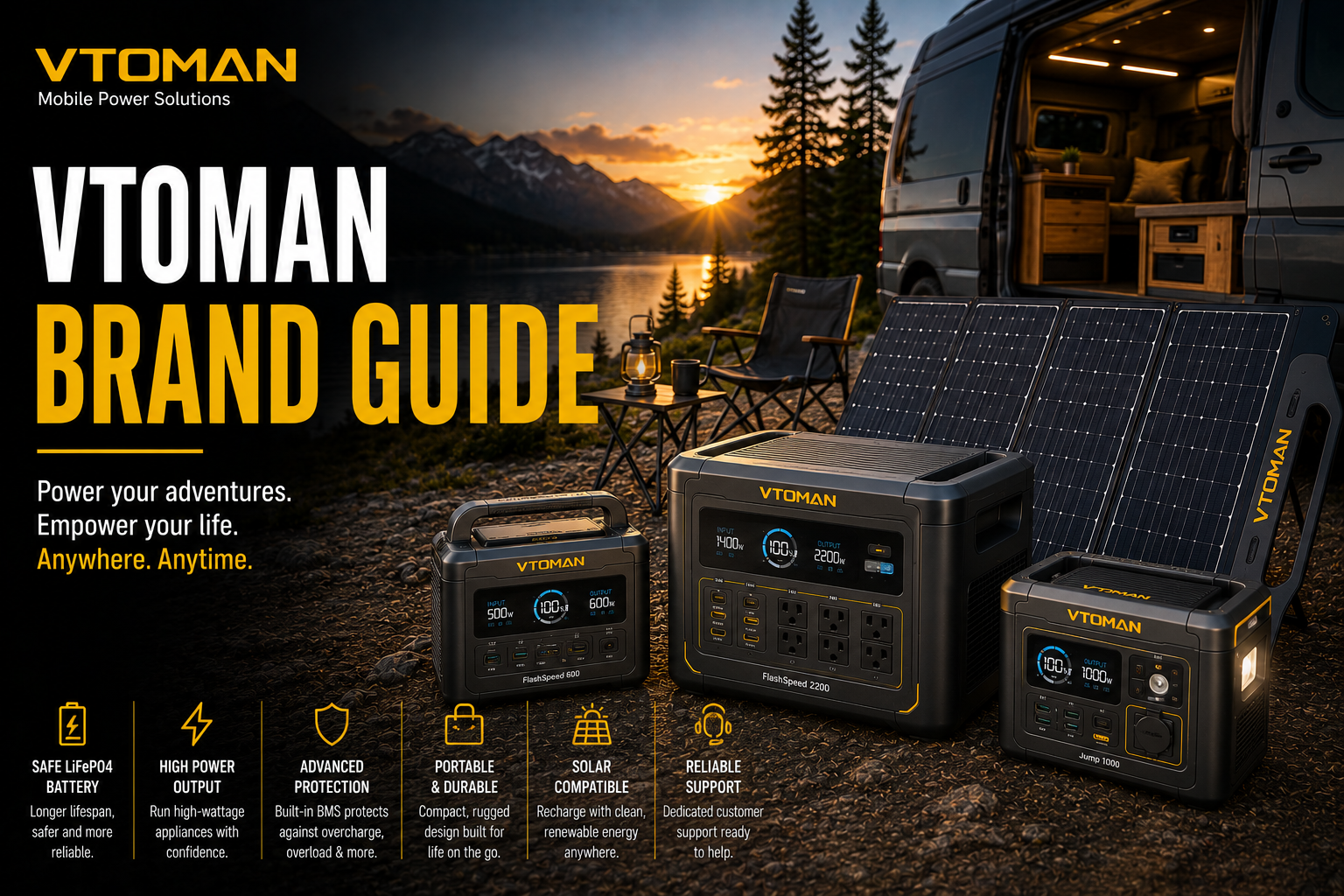
Quick recommendation: Choose the VTOMAN Jump 600X for lightweight electronics and short camping trips; the FlashSpeed 1000 for a compact midrange power station; the Jump 1800 or FlashSpeed 1500 for more substantial backup needs; and the FlashSpeed Pro 3600 when you need considerably greater capacity and inverter output.
The critical distinction is that watts determine what a power station can run, while watt-hours determine approximately how long it can run. VTOMAN's model names do not consistently represent battery capacity, and some models have changed specifications between generations.
Which VTOMAN Power Station Is Right for You?
For Lightweight Camping
Jump 600X: A 299Wh station with 600W rated AC output. A practical option for small electronics when low carrying weight matters more than long runtime.
For Compact Everyday Backup
FlashSpeed 1000: An 828Wh, 1,000W model that offers more stored energy than the Jump 600X without moving into the largest power-station category.
For Higher-Wattage Appliances
Jump 1800: Its 1,800W continuous AC output makes it more suitable for compatible appliances with greater electrical demand. Verify the battery-capacity version.
For Extended Backup
FlashSpeed Pro 3600: A 3,096Wh station with 3,600W rated AC output. Its size makes it better suited to a planned backup location than frequent hand-carrying.
VTOMAN Portable Power Station Comparison Chart
These figures reflect published VTOMAN model information. The Jump 1800 capacity is shown as a range because different versions are documented. Confirm the precise SKU before purchasing.
| Model | Battery | Rated AC Output | Approx. Weight | Best Fit |
|---|---|---|---|---|
| Jump 600X | 299Wh | 600W | 14.8 lb | Compact camping |
| FlashSpeed 1000 | 828Wh | 1,000W | Check exact listing | Electronics and light backup |
| FlashSpeed 1500 | 1,548Wh | 1,500W | 41.4 lb | Longer backup runtime |
| Jump 1800 | 1,408Wh or 1,548Wh* | 1,800W | Varies by version | Higher AC output |
| FlashSpeed Pro 3600 | 3,096Wh | 3,600W | 83.8 lb | Large backup loads |
*Jump 1800 capacity depends on the generation and regional variant. Manufacturer comparison information also lists model-specific peak output; peak power is not continuous power. Weights are manufacturer-published approximations.
VTOMAN Models Explained: Strengths, Limitations & Best Uses
VTOMAN Jump 600X
Small, relatively light and suitable for modest electrical loads.
The Jump 600X makes the most sense when portability is the priority. It offers useful AC and DC connectivity for small electronics, but its 299Wh battery is not intended for extended household backup.
VTOMAN also advertises compatible battery expansion for this model. However, buyers should verify that the correct accessory is available before treating expandability as a purchase advantage.
- Compact footprint
- 600W AC output
- LiFePO4 battery
- Expansion option
- Only 299Wh
- Shorter AC runtime
- Not for large appliances
Buy it for: Charging electronics, campsite lighting and short-duration compatible loads.
Avoid it for: Refrigerators during long outages or appliances that require more than 600W continuously.
Check PriceVTOMAN FlashSpeed 1000
A more substantial battery for electronics and moderate backup needs.
The FlashSpeed 1000 offers substantially more energy storage than the Jump 600X. That makes it a more useful starting point for a mobile workstation, internet equipment and compatible lower-wattage appliances.
The limitation is its 1,000W rated AC output. More battery capacity does not make it suitable for every high-power appliance.
- 828Wh capacity
- 1,000W rated AC
- Fast-charging product family
- Good middle ground
- Lower inverter output
- Not for major home loads
- Verify charging specifications
Buy it for: Mobile work, moderate camping loads and backup for selected electronics.
Avoid it for: Appliances with sustained or startup requirements beyond its rated output.
Check PriceVTOMAN FlashSpeed 1500
A larger battery for buyers who need more stored energy.
The FlashSpeed 1500 is a useful step up when battery capacity matters more than minimum size. Its 1,548Wh battery can support longer periods of moderate electrical demand.
The trade-off is weight and a 1,500W continuous inverter rating. It provides more stored energy than the FlashSpeed 1000, but not unlimited appliance compatibility.
- 1,548Wh storage
- 1,500W AC output
- LiFePO4 battery
- Compatible expansion options
- Heavier to transport
- Lower output than Jump 1800
- Accessories add cost
Buy it for: Longer camping stays, compatible appliances and moderate emergency backup.
Avoid it for: Users who primarily need lightweight charging for phones and laptops.
Check PriceVTOMAN Jump 1800
More inverter headroom for compatible higher-wattage equipment.
The Jump 1800 occupies a useful position between midrange camping stations and larger backup systems. Its 1,800W rated AC output offers greater appliance compatibility than a 1,000W or 1,500W inverter.
Version matters: VTOMAN has published 1,408Wh and 1,548Wh Jump 1800 variants. Confirm which one the seller is offering.
- 1,800W continuous AC
- LiFePO4 chemistry
- Jump-series features
- Expansion on compatible versions
- Version-specific capacity
- Substantial carrying weight
- Accessory compatibility varies
Buy it for: A combination of useful battery capacity and higher continuous AC output.
Avoid it for: Buyers who cannot verify the precise model version and supported accessories.
Check PriceVTOMAN FlashSpeed Pro 3600
A high-output, large-battery system for planned backup and demanding portable-power applications.
The FlashSpeed Pro 3600 sits in a different category from the compact Jump models. Its larger battery and 3,600W rated inverter make it more appropriate for substantial compatible electrical loads and extended backup planning.
Its manufacturer-published weight is approximately 83.8 pounds, so it is better treated as transportable equipment than something to carry casually on a hike.
- Large 3,096Wh battery
- 3,600W rated AC output
- Suitable for larger backup plans
- More headroom for combined loads
- Approximately 83.8 lb
- Requires more storage space
- Greater purchase investment
- Must verify outlet and voltage limits
Buy it for: A planned home or off-grid backup setup where capacity and inverter output matter more than portability.
Avoid it for: Occasional phone charging or short trips where a smaller station is sufficient.
Check PriceVTOMAN Jump vs FlashSpeed: What Is the Difference?
VTOMAN uses two major product-family names: Jump and FlashSpeed. The difference is more than branding, but individual model specifications matter more than the family name.
Jump Series
The Jump family emphasizes versatile portable power, with selected models supporting a vehicle jump-start function through compatible cables and connections.
This can be appealing for road trips, vehicle-based camping and emergency kits.
However, the presence of a jump-start feature is model-specific. Do not assume every VTOMAN product supports it.
FlashSpeed Series
FlashSpeed models emphasize power-station charging performance and conventional AC/DC backup functionality.
The family spans relatively compact units through much larger backup-capable stations.
Compare charging input ratings, battery capacity and inverter output for the exact model you are considering.
How Long Can a VTOMAN Power Station Run Your Devices?
Battery capacity is measured in watt-hours (Wh). A 1,500Wh-class station can generally run the same constant load longer than a 300Wh station, assuming similar conversion efficiency.
The table below assumes 85% of nominal battery energy is available to AC loads. It does not represent measured VTOMAN test results.
| Battery Capacity | 50W Load | 100W Load | 300W Load | 500W Load |
|---|---|---|---|---|
| 299Wh — Jump 600X | 5.1 hr | 2.5 hr | 0.8 hr | 0.5 hr |
| 828Wh — FlashSpeed 1000 | 14.1 hr | 7.0 hr | 2.3 hr | 1.4 hr |
| 1,548Wh — FlashSpeed 1500 | 26.3 hr | 13.2 hr | 4.4 hr | 2.6 hr |
| 3,096Wh — FlashSpeed Pro 3600 | 52.6 hr | 26.3 hr | 8.8 hr | 5.3 hr |
Estimates assume constant loads, no solar charging, no expansion battery, 85% usable AC energy and no additional standby losses beyond that allowance. Low-power AC loads may experience proportionally greater inverter overhead.
VTOMAN Expansion Batteries: What Buyers Need to Know
Some VTOMAN stations support additional battery modules, increasing total energy storage without necessarily increasing the inverter's rated AC output.
What Expansion Adds
- More total watt-hours
- Potentially longer runtime
- More flexibility for future backup needs
- Additional battery storage without replacing the main station
What Expansion Does Not Guarantee
- Higher continuous AC wattage
- Compatibility with every VTOMAN model
- Unlimited battery additions
- Compatibility across different generations
Can VTOMAN Portable Power Stations Charge With Solar Panels?
Yes. Compatible VTOMAN stations support solar charging, but the allowed voltage, current, connectors and maximum input power vary by model.
Panel Wattage
A panel's advertised wattage is measured under standardized conditions. Real-world production is often lower.
Voltage Limits
Panel open-circuit voltage must stay within the station's allowed input range, including during cold weather.
Connector Matching
Use the approved cable and polarity. A physically compatible plug does not automatically mean electrical compatibility.
How to Choose the Right VTOMAN Backup Power System
List Your Essential Devices
Record the running watts and startup requirements for every appliance you intend to power.
Calculate Your Energy Requirement
Multiply average watts by required operating hours. Add a realistic allowance for conversion losses and battery reserve.
Check Continuous and Startup Power
Make sure combined simultaneous loads fit the station's continuous AC rating, with sufficient startup capability for motors.
Decide Whether You Need Expansion
Check accessory compatibility and availability now, not after the base unit arrives.
Compare Charging and Portability
Consider AC charging, solar input, total system weight, storage space and how often the unit will move.
Verify the Seller and Warranty
Confirm the exact SKU, current support, return policy, warranty coverage and included accessories.
VTOMAN Backup Power Safety: Important Limitations
Household electrical connections: Never backfeed home wiring with a homemade male-to-male cord. Use appropriate transfer equipment and qualified electrical installation.
120V versus 240V: Verify the output voltage and receptacle configuration of the exact regional model. High wattage alone does not prove compatibility with 240V appliances.
UPS/EPS functionality: Do not assume every VTOMAN station provides uninterrupted power for sensitive electronics. Verify model-specific transfer behavior and device tolerance.
Medical equipment: Do not rely on an unverified portable power station as the sole backup for life-sustaining equipment. Follow the equipment manufacturer's guidance and an appropriate emergency power plan.
Weather and ventilation: Keep equipment dry, avoid blocked vents and follow the operating and charging temperature limits in its manual.
VTOMAN Portable Power Station FAQs
Are VTOMAN portable power stations good for home backup?
Some models can provide useful backup power for selected devices. The right choice depends on total electrical load, battery capacity, runtime requirements and appliance compatibility.
What is the difference between VTOMAN Jump and FlashSpeed?
Jump models emphasize versatile portable power and may include a compatible vehicle jump-start function. FlashSpeed models emphasize charging performance and portable backup. Always compare the exact models.
Does the Jump 1800 have a 1,408Wh or 1,548Wh battery?
Both capacities appear in VTOMAN documentation for different Jump 1800 versions or regional listings. Confirm the product's exact generation and battery rating before purchasing.
Can a VTOMAN power station run a refrigerator?
Potentially, if the refrigerator's running and startup requirements fit the station. Runtime depends on the refrigerator's actual energy consumption.
Can VTOMAN stations use third-party solar panels?
A compatible third-party panel may work when voltage, current, polarity, connectors and the charging configuration match the station's published specifications.
Does an expansion battery increase AC output?
Usually, expansion adds energy storage, not inverter wattage. Verify the exact station and accessory specifications.
Is a larger VTOMAN always the better value?
No. A larger station can provide more energy and power, but also costs more and weighs more. The best value depends on how much of that capacity you will use.
Final Verdict: Which VTOMAN Should You Buy?
For light camping and electronics, start with the Jump 600X. For moderate portable backup, compare the FlashSpeed 1000. For longer runtime, the FlashSpeed 1500 deserves attention.
The Jump 1800 is more compelling when higher AC output matters, while the FlashSpeed Pro 3600 is the stronger starting point for large backup requirements.
Before buying, verify the precise model generation, battery capacity, output specifications and current warranty support. Those details matter more than the number printed in the product name.
Compare Current OptionsSources and Editorial Methodology
This guide compares published VTOMAN specifications and manufacturer documentation. Recommendations reflect the relationship between battery capacity, inverter output, portability and intended use. No hands-on testing is claimed.
- VTOMAN — Official Product Specifications — product families and manufacturer specification resources.
- VTOMAN — Official User Manuals — model-specific operation, charging and accessory documentation.
- VTOMAN — Jump Series — Jump product family and version information.
- VTOMAN — Jump 600X — battery capacity, output and expansion details.
Specifications, regional variants, product availability and warranty policies can change. Check the exact manufacturer model number and documentation before purchase. Runtime estimates are calculations, not measured test results.