
Goal Zero Yeti 1000X vs 1500X: Which Should You Buy?
The Yeti 1500X stores more energy and runs higher-wattage appliances; the 1000X is lighter and more manageable. Compare actual capacity, AC power, solar input, portability and battery age before buying either model.
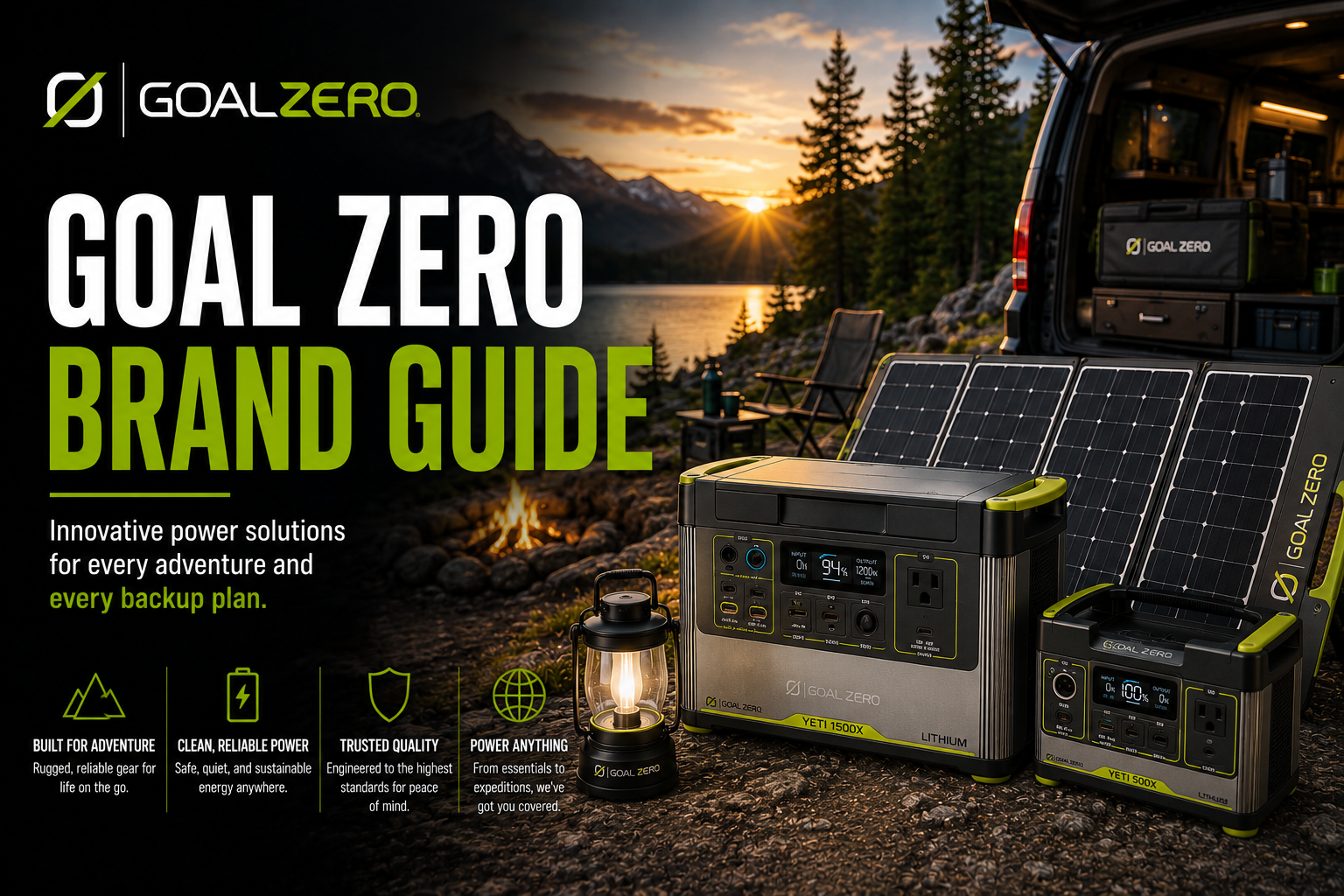
These are two older-generation Goal Zero Yeti X portable power stations. Both use lithium-ion NMC cells rather than the LFP chemistry common in many newer units. This comparison uses published manufacturer specifications; we have not independently tested battery condition, runtime or current retail inventory.
Some Goal Zero support articles refer to newer products called Yeti 1000 and Yeti 1500. Those are not automatically the same as the 1000X and 1500X. Check the full product name and SKU before ordering.
1000X for Portability; 1500X for More Runtime and AC Output
Yeti 1000X: 983Wh, 1,500W continuous AC, 31.68 lb. Better if your loads are modest and moving the station matters.
Yeti 1500X: 1,516Wh, 2,000W continuous AC, 45.64 lb. Better if you need more energy or a higher AC output ceiling.
Buying caveat: Compare any available X-series unit with current-generation LFP alternatives, especially for repeated daily cycling.
Goal Zero Yeti Quick Picks
Goal Zero Yeti 1000X
The smaller battery makes the 1000X easier to move, while the 1,500W inverter still supports many appliances. Choose it if 983Wh meets your energy budget; do not mistake 1,500W output for 1,500Wh storage.
Goal Zero Yeti 1500X
The 1500X offers roughly 54% more nominal stored energy and a higher continuous AC rating, at about 14 lb more weight. It is better for longer off-grid sessions or appliances above the 1000X continuous output limit.
Yeti 1000X vs 1500X: Specification Comparison
| Model | Battery | Continuous AC | Surge | Weight | High Power solar input |
|---|---|---|---|---|---|
| Yeti 1000X | 983Wh | 1,500W | 3,000W | 31.68 lb | 600W |
| Yeti 1500X | 1,516Wh | 2,000W | 3,500W | 45.64 lb | 600W |
Individual Model Reviews
Goal Zero Yeti 1000X
The smaller battery makes the 1000X easier to move, while the 1,500W inverter still supports many appliances. Choose it if 983Wh meets your energy budget; do not mistake 1,500W output for 1,500Wh storage.
Published specifications: 983Wh lithium-ion NMC battery; 1,500W continuous pure sine wave AC; 3,000W manufacturer-listed surge; 31.68 lb unit weight; up to 600W charging through the High Power input. These figures are manufacturer ratings, not hands-on test results.
The smaller battery makes the 1000X easier to move, while the 1,500W inverter still supports many appliances. Choose it if 983Wh meets your energy budget; do not mistake 1,500W output for 1,500Wh storage.
Battery chemistry is NMC, not modern LFP. Confirm condition, seller, support, available accessories and exact US 120V variant. Neither unit should be assumed to have current-generation UPS behavior.
Goal Zero Yeti 1500X
The 1500X offers roughly 54% more nominal stored energy and a higher continuous AC rating, at about 14 lb more weight. It is better for longer off-grid sessions or appliances above the 1000X continuous output limit.
Published specifications: 1,516Wh lithium-ion NMC battery; 2,000W continuous pure sine wave AC; 3,500W manufacturer-listed surge; 45.64 lb unit weight; up to 600W charging through the High Power input. These figures are manufacturer ratings, not hands-on test results.
The 1500X offers roughly 54% more nominal stored energy and a higher continuous AC rating, at about 14 lb more weight. It is better for longer off-grid sessions or appliances above the 1000X continuous output limit.
Battery chemistry is NMC, not modern LFP. Confirm condition, seller, support, available accessories and exact US 120V variant. Neither unit should be assumed to have current-generation UPS behavior.
Runtime: What Does the Extra 533Wh Buy You?
The Yeti 1500X holds 533Wh more nominal energy, or about 54% more than the 1000X. Under the same steady load and an illustrative 85% usable AC fraction, that can translate into roughly 54% longer runtime. This is a calculation, not a measured result.
| Steady AC load | 1000X (983Wh) | 1500X (1,516Wh) |
|---|---|---|
| 50W | 16.7 hours | 25.8 hours |
| 100W | 8.4 hours | 12.9 hours |
| 500W | 1.7 hours | 2.6 hours |
| 1,000W | 0.8 hours | 1.3 hours |
A refrigerator's compressor cycles, so use measured average consumption over time rather than its instantaneous nameplate rating. The battery must also support startup surge; never assume a station can start every appliance below its nominal wattage.
Solar Charging and Port Compatibility
Both X-series units support solar charging through their documented inputs. Goal Zero specifies a 600W maximum High Power charging input (14 - 50V, up to 50A) and an 8mm charging input (14 - 50V, up to 10A, 150W maximum). Do not add those limits together without confirming simultaneous-input behavior in the exact user guide.
Verify panel open-circuit voltage, especially in cold weather.
The 8mm and High Power ports have different limits.
Use approved wiring and adapters for the exact model.
Should You Still Buy an Older Yeti X Model?
There is a meaningful age and chemistry trade-off. Both models use NMC batteries, with manufacturer cycle-life references of 500 cycles to 80% capacity under specified conditions. Newer LFP stations may offer substantially higher cycle-life ratings, although actual longevity depends on use and storage. Do not pay a current-generation price solely for a larger X-series battery.
- You already own compatible Goal Zero accessories.
- The unit is demonstrably healthy and reasonably priced.
- Its exact output and runtime meet your needs.
- You value the known 12V outputs and familiar interface.
- You expect frequent deep battery cycling.
- Weight and recharge time are priorities.
- You need modern UPS or app-control features.
- The seller cannot document battery condition or return rights.
Purchase Checklist
- Confirm X-series: Check 1000X or 1500X, not newer 1000/1500 products.
- Check battery health: Particularly important with used or older stock.
- Match output: 1,500W continuous on 1000X versus 2,000W on 1500X.
- Plan energy: Compare 983Wh versus 1,516Wh against measured loads.
- Check charging: Verify compatible solar and wall chargers for the exact SKU.
- Compare total value: Include accessories, seller support and newer LFP alternatives.
Final Verdict: Buy the Size You Actually Need
For lighter use and easier carrying, the Yeti 1000X is the more manageable choice. The Yeti 1500X offers about 54% more stored energy and a 2,000W continuous inverter, but adds weight. Because both are older NMC models, compare current LFP alternatives and battery condition before committing.
Frequently Asked Questions
Which is better, Goal Zero Yeti 1000X or 1500X?
Choose the 1000X for lighter weight and moderate energy needs. Choose the 1500X for longer runtime and its higher 2,000W continuous inverter rating. Both are older NMC platforms.
How much more battery capacity does the Yeti 1500X have?
The 1500X has 1,516Wh versus 983Wh in the 1000X: 533Wh more nominal storage, about 54% higher.
Can the Yeti 1000X run a refrigerator?
Possibly. The compressor running load and startup surge must fit within the 1,500W continuous and 3,000W surge specifications. Runtime depends on measured average watts.
Does the Yeti 1500X have a 1500W inverter?
No. Goal Zero lists a 2,000W continuous AC inverter for the 1500X. The 1500 in the model name is not its inverter output rating.
Are the Yeti 1000X and 1500X LiFePO4?
No. Goal Zero lists lithium-ion NMC chemistry for both models. Do not confuse them with newer Goal Zero LFP models.
Do both accept solar panels?
Yes, with compatible solar equipment. Goal Zero lists up to 600W input through the High Power port for these models; observe the voltage, current and connector limits.
How long does a 1500X last at 100W?
At an illustrative 85% usable AC fraction, 1,516Wh divided by 100W yields about 12.9 hours. Real runtime varies with inverter losses, battery age and cycling loads.
Should I buy a used Yeti X power station?
Only after checking battery health, exact model, charging behavior, included accessories, warranty or return protection, and price against current LFP alternatives.
Sources and Editorial Methodology
This is a manufacturer-specification comparison, not hands-on testing. Specifications cited are for documented US 120V variants where stated. Current prices, stock, unit health and seller warranties have not been verified.