
Best Solar Generators Under $1,000: Top Models Compared
You do not need to spend several thousand dollars to get a capable battery-powered solar generator. Around the $1,000 mark, there are portable power stations with roughly 1kWh of storage, strong AC inverters and meaningful solar charging capability. The challenge is choosing the right balance of battery capacity, output, portability and total kit cost.
Quick answer: The Anker SOLIX C1000 Gen 2 is a strong all-around choice for shoppers prioritizing 2,000W continuous AC output and rapid charging. The BLUETTI AC180 offers a larger 1,152Wh battery and 1,800W output. The Jackery Explorer 1000 v2 is attractive when carrying weight matters, while the Jackery HomePower 1000 v2 deserves attention when a complete solar-panel bundle fits the budget.
Our Top Solar Generator Picks Under $1,000
These recommendations prioritize manufacturer-documented specifications, practical use cases and the availability of sub-$1,000 station configurations. They are not based on claimed hands-on testing or a fixed retail price.
Best Overall Balance
Anker SOLIX C1000 Gen 2
1,024Wh battery · 2,000W continuous AC output
Best for buyers who want a relatively compact station with substantial inverter power and fast AC recharging.
Best for More Stored Energy
BLUETTI AC180
1,152Wh battery · 1,800W continuous AC output
Best for shoppers who value extra nominal capacity and do not mind a heavier unit.
Best for Portable Camping Power
Jackery Explorer 1000 v2
1,070Wh battery · 1,500W continuous AC output
Best for camping and travel when weight and ease of transport matter more than maximum inverter wattage.
Best Bundle to Compare
Jackery HomePower 1000 v2
1,024Wh battery · 1,500W continuous AC output
Best for buyers comparing ready-to-use solar kits rather than purchasing the panel separately.
Best Solar Generators Under $1,000: Specification Comparison
Battery capacity tells you how much energy is stored. Continuous AC output tells you how much electrical power the inverter can supply at once. Both matter, but they answer different questions.
| Model | Battery | Continuous AC Output | Battery Chemistry | Solar Input | Best Fit |
|---|---|---|---|---|---|
| Anker SOLIX C1000 Gen 2 | 1,024Wh | 2,000W | LiFePO4 | Up to 600W | High-output portable power |
| BLUETTI AC180 | 1,152Wh | 1,800W | LiFePO4 | Up to 500W | Extra stored energy |
| Jackery Explorer 1000 v2 | 1,070Wh | 1,500W | LiFePO4 | Check exact input configuration | Camping and portable backup |
| Jackery HomePower 1000 v2 | 1,024Wh | 1,500W | LiFePO4 | Check exact input configuration | Solar-kit comparisons |
Figures are nominal manufacturer specifications for the named models, not independent test results. Solar input limits, connectors, charging behavior and included accessories depend on the exact model and bundle. Verify current manufacturer documentation before purchase.
Detailed Reviews: Which Solar Generator Should You Buy?
Anker SOLIX C1000 Gen 2
A high-output 1kWh-class power station with rapid AC charging and meaningful solar input capacity.
The C1000 Gen 2 stands out because it pairs a 1,024Wh LiFePO4 battery with 2,000W continuous AC output. That gives it substantial power capability for its battery size, although running near the inverter's maximum output will drain the battery quickly.
Anker advertises a 49-minute full recharge using its high-speed AC charging mode, which requires the appropriate settings and conditions. The manufacturer also specifies up to 600W solar input, subject to the solar voltage and current limits in the manual.
- 2,000W continuous output
- Fast AC charging capability
- 600W maximum solar input
- LiFePO4 battery
- Only 1,024Wh of stored energy
- High-wattage loads reduce runtime rapidly
- Solar panels generally sold separately
Choose it if: You need strong AC output, rapid recharging and a portable station for mixed camping or backup use.
Skip it if: Your priority is running a modest load for the longest possible time; a larger-capacity station may be more suitable.
Check PriceBLUETTI AC180
A practical choice for shoppers who want more than 1kWh of capacity without moving into much larger power systems.
The AC180 provides a 1,152Wh LiFePO4 battery, 1,800W continuous AC output and up to 500W solar input. Its larger nominal battery offers a potential runtime advantage over 1,024Wh models at comparable loads.
BLUETTI also advertises a power-lifting mode for selected resistive appliances. This is not the same as increasing normal continuous inverter output, and it should not be treated as a guarantee that every high-wattage appliance will operate correctly.
- 1,152Wh nominal capacity
- 1,800W continuous output
- 500W maximum solar input
- App monitoring
- Heavier than some 1kWh alternatives
- Power-lifting mode has restrictions
- Check current stock and kit price
Choose it if: You want a useful balance of capacity, inverter output and solar charging for backup or outdoor power.
Skip it if: Carrying weight is your main concern or you require a substantially larger multi-day battery reserve.
Check PriceJackery Explorer 1000 v2
A 1kWh-class LiFePO4 station suited to buyers who value easier transport and straightforward portable power.
Jackery's Explorer 1000 v2 offers 1,070Wh of nominal capacity and 1,500W continuous AC output. Its approximately 23.8-pound listed weight makes it appealing for buyers who frequently move the station between a vehicle, campsite and home.
The model supports solar charging with compatible panels and adapters. Jackery markets an emergency fast-charging mode, but charging speed varies by mode, power source and operating conditions.
- Relatively portable
- 1,070Wh battery
- LiFePO4 chemistry
- Compatible solar charging options
- Lower continuous output than Anker C1000 Gen 2
- Panel bundle increases total cost
- Verify solar connector requirements
Choose it if: You regularly transport the station and your expected appliances fit within its continuous output rating.
Skip it if: Your intended loads require more than 1,500W continuously or a different output configuration.
Check PriceJackery HomePower 1000 v2
A newer 1,024Wh platform worth considering when shopping for a station-and-panel package.
The HomePower 1000 v2 provides a 1,024Wh battery and 1,500W continuous AC output. It competes with the Explorer 1000 v2 but should not be confused with it: these are separately named products with different capacities and potentially different bundles and accessories.
Its main attraction for this guide is the opportunity to compare a complete solar generator package. A bundled panel can simplify purchasing, provided the kit's total checkout price remains within the budget.
- 1,024Wh capacity
- 1,500W continuous output
- LiFePO4 chemistry
- Solar-kit configurations available
- Lower AC output than some alternatives
- Bundle contents vary
- Panel wattage affects recharge speed
Choose it if: You want to compare a matched solar kit rather than source the power station and panels independently.
Skip it if: You need maximum continuous inverter output for the money.
Check PriceHow Long Will a Solar Generator Under $1,000 Last?
Runtime depends on battery capacity and the average power consumed by connected devices. For AC appliances, inverter conversion losses and the station's own operating consumption also matter.
The estimates below use 85% usable AC energy as a simplified planning assumption. They are not manufacturer runtime guarantees.
| Average Continuous Load | 1,024Wh Station | 1,070Wh Station | 1,152Wh Station |
|---|---|---|---|
| 50W | 17.4 hours | 18.2 hours | 19.6 hours |
| 100W | 8.7 hours | 9.1 hours | 9.8 hours |
| 200W | 4.4 hours | 4.5 hours | 4.9 hours |
| 500W | 1.7 hours | 1.8 hours | 2.0 hours |
| 1,000W | 0.9 hours | 0.9 hours | 1.0 hour |
Formula: battery Wh × 0.85 ÷ average AC watts. Values rounded to one decimal place. At low loads, inverter idle consumption can make this simplified calculation optimistic. For refrigerators and other cycling appliances, use measured average energy consumption rather than the nameplate running wattage alone.
Why a Bigger Inverter Does Not Mean Longer Runtime
A 2,000W inverter can support a larger instantaneous load than a 1,500W inverter, but the battery may still store roughly the same amount of energy. A 1,000Wh-class station running a sustained 1,500W load has well under one hour of theoretical runtime after losses.
Choose inverter watts based on what your appliances demand simultaneously. Choose battery watt-hours based on how long you need them to operate.
Solar Charging: How Much Panel Power Do You Need?
The term “solar generator” usually refers to a rechargeable battery power station that can accept compatible solar panels. It does not mean the station creates electricity on its own. The panels are the generating component.
100W Panel
Portable and easier to carry, but slow for recharging a 1kWh-class battery.
Best for modest daily energy needs and occasional topping up.
200W Panel
A more useful starting point for camping and off-grid charging.
Still dependent on weather, orientation and available daylight.
400–600W Array
Can meaningfully reduce recharge time in favorable conditions.
Requires careful voltage, current, connector and budget checks.
Illustrative Solar Recharging Times
The following calculation assumes a 1,024Wh battery, a 75% average yield relative to the panels' rated power and an additional 10% allowance for charging losses. It excludes charging taper, standby consumption and interruptions from clouds or shade.
| Solar Array Rating | Assumed Effective Charging Power | Illustrative Full-Recharge Sun Hours |
|---|---|---|
| 100W | 67.5W | About 15.2 hours |
| 200W | 135W | About 7.6 hours |
| 400W | 270W | About 3.8 hours |
| 600W | 405W | About 2.5 hours |
Calculation: 1,024Wh ÷ (rated solar watts × 0.75 × 0.90). These are equivalent effective-sun-hour estimates, not elapsed clock time or a promise of full recharge in one day. Actual solar input may be capped by the station's charge controller.
How to Choose a Solar Generator Under $1,000
Decide Whether Your Budget Includes Panels
A station-only purchase can leave more of your budget for battery capacity and inverter output. A complete kit is more convenient but may require compromises in either station size or panel wattage. Compare the total cost, including required adapters.
Measure Your Appliance Loads
List the running watts of each device and identify any motor startup surges. Add the watts of devices you expect to use simultaneously. Do not treat an inverter's advertised surge or power-lifting mode as its continuous rating.
Calculate the Battery Energy You Need
Estimate average watt-hours consumed over your intended period. A 100W continuous load uses 800Wh in eight hours before conversion losses. A 1kWh-class station is useful for short backup periods, but not a substitute for a large home battery system.
Check Solar Input Limits and Accessories
Verify the station's maximum solar voltage, current and watts. Check whether the solar cable and connectors are included. A panel bundle is not necessarily the best value if the panel is too small for your daily energy requirements.
Consider Weight, Charging Speed and Storage
A station moved frequently between a vehicle and campsite should be comfortable to carry. For home outage preparation, weight may matter less than battery capacity, AC output and the ability to recharge between outages.
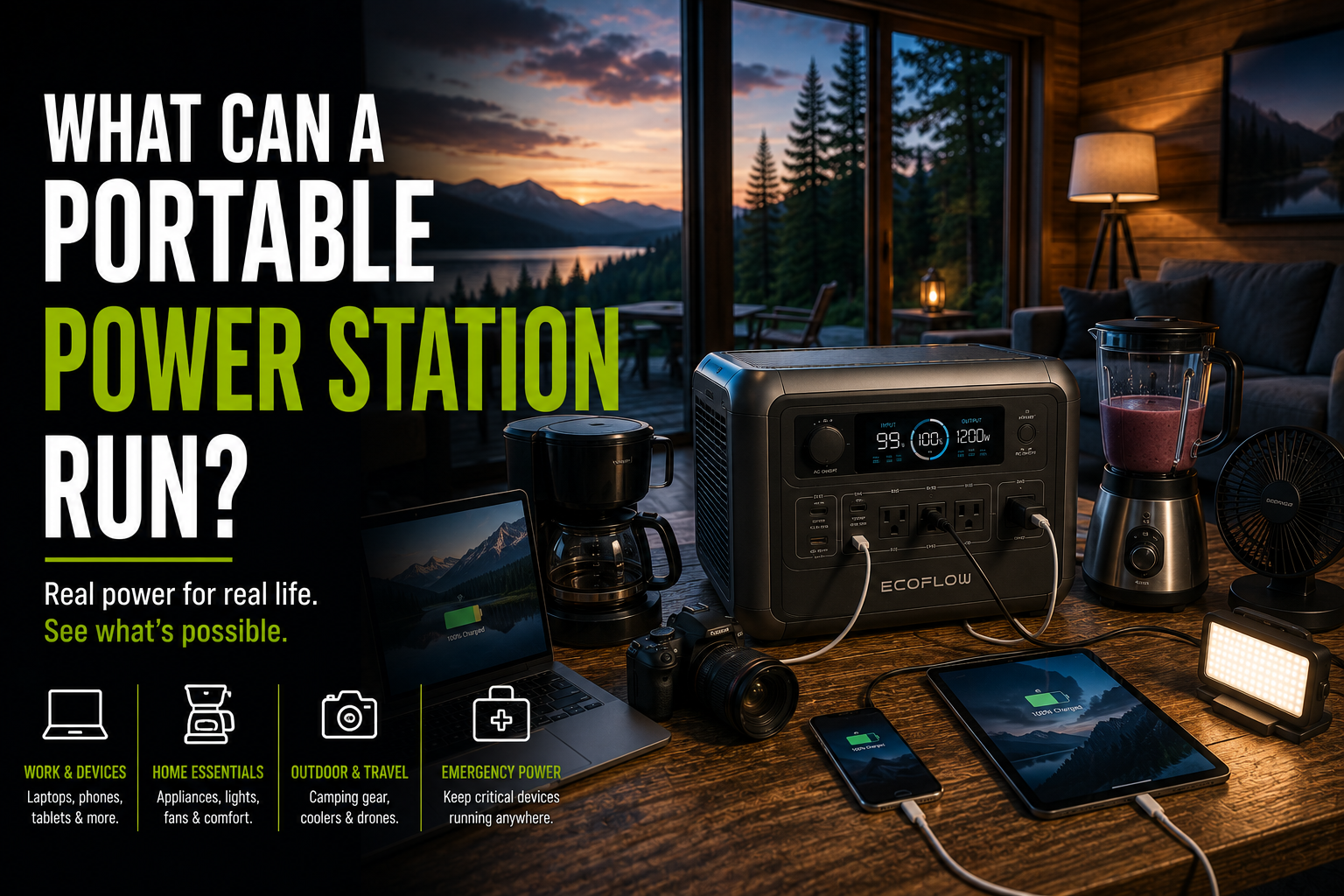
What Can a Solar Generator Under $1,000 Actually Run?
Phones, Tablets and Small Electronics
Usually a good match for this class of station. USB-C output and DC charging may be more efficient than running a separate AC charger through the inverter.
Laptops, Networking and Lighting
Often practical for several hours, depending on combined average consumption. Check the station's output ports and any requirements for uninterrupted operation.
Refrigerators and Freezers
Potentially suitable when running watts and compressor startup demand fit the inverter's ratings. Runtime depends heavily on temperature, insulation and compressor duty cycle.
Microwaves, Kettles and Coffee Makers
Some models can power these for short periods, but appliance input wattage can be much higher than expected. A 1kWh battery drains quickly under sustained high loads.
Which Model Fits Your Situation?
| Your Priority | Start With | Why |
|---|---|---|
| Higher continuous AC output | Anker SOLIX C1000 Gen 2 | 2,000W continuous inverter rating |
| More nominal stored energy | BLUETTI AC180 | 1,152Wh battery capacity |
| Carrying the station regularly | Jackery Explorer 1000 v2 | Relatively low listed weight for the capacity |
| Comparing complete solar kits | Jackery HomePower 1000 v2 | Station-and-panel configurations worth pricing |
| Multiple days of high household consumption | Consider a larger system | A 1kWh battery may be insufficient even with a capable inverter |
Frequently Asked Questions
Can you get a good solar generator for under $1,000?
Yes. Several reputable manufacturers offer 1kWh-class LiFePO4 portable power stations below that threshold. The key distinction is whether your budget covers only the station or a complete station-and-panel kit.
Is a 1,000Wh solar generator enough for a power outage?
It can support selected electronics and other modest loads for a limited period. It is not enough for whole-home backup or sustained operation of large electrical appliances. Measure your essential loads and estimate runtime before buying.
Do solar generators work at night?
Yes, when the battery has stored energy. The solar panels do not generate meaningful power at night, so connected devices draw from the battery until sunlight or another charging source is available.
Are solar panels included with portable power stations?
Not always. Many listings are station-only purchases. Look for an explicitly identified solar generator kit and verify the panel model, wattage, connectors and complete checkout price.
Is LiFePO4 better for a portable solar generator?
LiFePO4 batteries are commonly favored for their cycle-life characteristics and thermal stability compared with some other lithium-ion chemistries. Overall product safety still depends on battery management, construction, certifications and correct use.
Can I use a solar generator indoors?
Battery-powered portable power stations can generally be used indoors when the manufacturer permits it and ventilation and environmental requirements are followed. Fuel-burning generators must not be operated indoors because of carbon monoxide hazards.
Can a portable solar generator replace a UPS?
Not automatically. Some stations advertise UPS or EPS transfer functionality, but transfer time, waveform, operating mode and device tolerance vary. Do not assume uninterrupted operation for a computer, server, medical device or other critical load without verifying the specific system.
Should I prioritize battery capacity or inverter watts?
Prioritize inverter watts when you need to run higher-power appliances. Prioritize battery capacity when you need longer runtime at a load the inverter already supports. Both specifications must be adequate.
Final Verdict: The Best Solar Generator Under $1,000 Depends on the Load
The Anker SOLIX C1000 Gen 2 is our starting point for a versatile, high-output portable power station. Its 2,000W continuous rating and 1,024Wh battery make it attractive for mixed-use backup and camping.
Choose the BLUETTI AC180 if its additional battery capacity better fits your needs. Choose the Jackery Explorer 1000 v2 when portability is especially important, or compare the Jackery HomePower 1000 v2 when you want a complete solar kit.
Before purchasing, confirm the exact package price, whether panels are included and whether the station can power your intended appliances. The best purchase is the system that meets your actual power and runtime requirements without exceeding the total budget.
Compare Current OptionsSources and How We Evaluated These Models
This guide compares published manufacturer specifications, current product configurations and practical buyer requirements. It does not claim firsthand testing, measured runtime results or permanent prices. Runtime and solar charging figures are labeled estimates with their assumptions.
- Anker — SOLIX C1000 Gen 2 — battery capacity, continuous output and charging features.
- BLUETTI — AC180 — capacity, AC output, solar input and charging specifications.
- Jackery — Solar Generator 1000 v2 — Explorer 1000 v2 system specifications and solar configurations.
- Jackery — Official Product Catalog — HomePower product family and current kit configurations.
Product prices, solar-kit contents and availability can change. Check the manufacturer's current specifications and the retailer's exact listing before purchase. Electrical limits and warranty terms apply to the specific model and region.