
Best BougeRV Accessories for Solar Setups
Choose useful solar cables, parallel connectors and mounting hardware by electrical compatibility and installation needs, not by brand name alone.
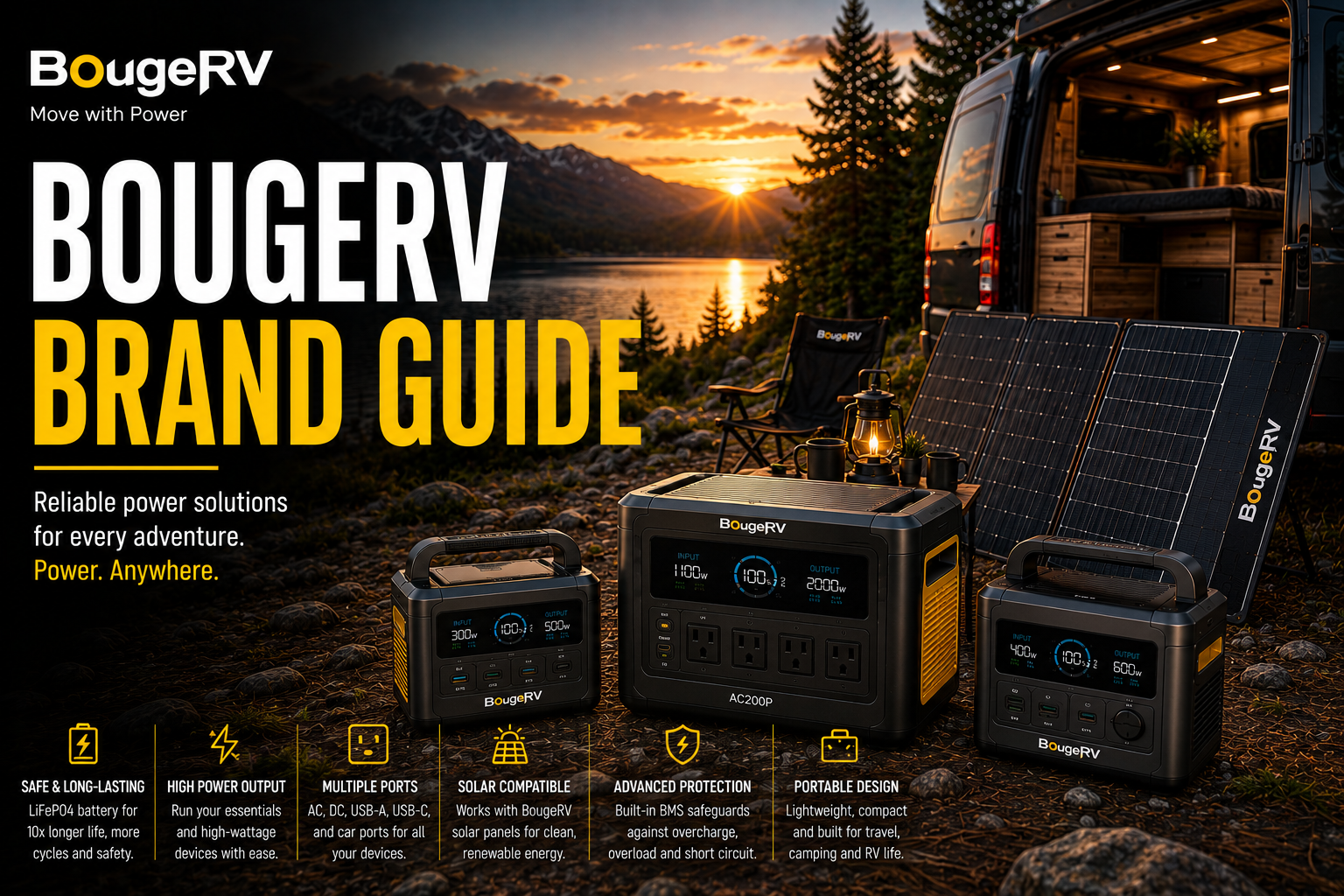
Accessory features below are based on BougeRV manufacturer product pages. This is a compatibility-focused editorial comparison, not a hands-on test. Manufacturer component ratings do not replace checking the limits of your full solar system. Prices, available variants and fit can change.
Buy the Accessory That Solves a Specific Solar Setup Problem
Panels too far from the battery? Start with a correctly sized extension cable. Two compatible panels in parallel? Check a Y-branch connector pair and combined current limits. Mounting a rigid panel permanently? Consider a Z-bracket kit only after checking frame, roof and fastener compatibility.
These accessories do different jobs. A cable cannot solve an unsafe mounting location, and a connector cannot increase the power station's published solar-input limit.
BougeRV Solar Accessories: Quick Picks
BougeRV MC4 Solar Panel Extension Cable
A paired solar extension lead can position a panel in sunlight while the battery or charge controller stays shaded and protected.
BougeRV Solar Y Branch Connectors
A matched pair of Y connectors joins two compatible solar panels in parallel while preserving nominal array voltage.
BougeRV Solar Panel Z Bracket Kit
Low-profile Z brackets are intended for fixed framed-panel installations on suitable RV, boat or other mounting structures.
BougeRV Accessory Specifications and Intended Uses
| Accessory | Key published specification | Use case | Critical check |
|---|---|---|---|
| BougeRV MC4 Solar Panel Extension Cable | 8/10/12/16 AWG options | Panel extension | Wire size, run length, input connector |
| BougeRV Solar Y Branch Connectors | 20A / DC 1,000V / IP67 | Two panels in parallel | Combined current and protective devices |
| BougeRV Solar Panel Z Bracket Kit | Aluminum / 24mm slots / 4 or 8 units | Rigid panel mounting | Roof strength, frame holes, sealing |
Detailed BougeRV Solar Accessory Reviews
BougeRV MC4 Solar Panel Extension Cable
Manufacturer-listed specifications with installation and compatibility checks.
BougeRV lists multiple conductor-size variants on its extension-cable product page, including 8, 10, 12 and 16 AWG options. These are not interchangeable at high current or long distance: choose the exact gauge and length for your circuit.
Voltage drop is a practical reason to avoid unnecessary cable length. As an illustration, a 10A circuit with 0.2 ohm total round-trip resistance loses 2V and dissipates 20W as heat (I x R and I squared x R). Those are hypothetical resistance values, not measured performance of this cable.
Before ordering, check whether the panel and receiving device actually use compatible solar connectors. A portable power station with XT60, DC7909 or another input may require a separate manufacturer-approved adapter.
- Multiple gauge choices allow a better fit for current and distance.
- Lets a solar panel reach unobstructed sunlight while the station remains sheltered.
- Paired conductors keep the positive and negative path organized.
- Long thin cables can waste charging energy and heat under load.
- An MC4-style connector does not directly fit every power-station input.
- Verify polarity, current rating and exact connector dimensions.
Best for: RV, cabin and portable panel layouts needing a properly sized longer cable run. Not ideal for: installations where connector type or cable ampacity has not been verified.
Check PriceBougeRV Solar Y Branch Connectors
Manufacturer-listed specifications with installation and compatibility checks.
BougeRV documents a 20A current rating, DC 1,000V voltage rating and IP67 protection for its Y-branch connector pair. Those are component ratings, not permission to exceed the lower limits of the solar input, wiring, fuse or connected panels.
In a parallel connection, currents add while operating voltage stays near that of an individual panel. Two panels delivering 8A each can approach 16A at their operating point; the controller must support the combined current and the panels should have suitably matched operating voltages.
Parallel connections also raise questions about backfeed protection and whether additional overcurrent protection is required. Follow the panel and controller instructions, especially with more than two strings; never assume a plug-in branch connector replaces a proper combiner or protective device.
- Purpose-built pair for two-panel parallel wiring.
- Published 20A, DC 1,000V and IP67 ratings.
- Can simplify a compatible two-panel layout.
- Parallel panel currents can exceed a controller or cable limit.
- Mismatched panels may reduce array efficiency.
- Fusing and backfeed protection require a system-level check.
Best for: two-panel parallel solar arrays with verified electrical limits. Not ideal for: series-only installations or arrays exceeding the connector and controller ratings.
Check PriceBougeRV Solar Panel Z Bracket Kit
Manufacturer-listed specifications with installation and compatibility checks.
BougeRV describes aluminum-alloy brackets with elongated 24mm mounting holes, supplied in four- and eight-piece configurations. A bracket kit does not establish that an RV roof, boat deck or building structure is strong enough for the wind and vibration loads.
For a fixed mount, verify the solar-panel frame mounting locations and approved clamp zones. Brackets should not be installed where they interfere with drainage or damage the frame. Follow the panel maker's torque guidance and the mounting-surface maker's sealing and fastening requirements.
The product page distinguishes four-bracket and eight-bracket options. Its wattage guidance is general and does not replace a mechanical load calculation; panel dimensions, frame design, roof substrate and expected wind loads are more important than wattage alone.
- Aluminum hardware suited to many outdoor mounting environments.
- Elongated holes allow some mounting-position adjustment.
- Four- and eight-bracket kits accommodate different layouts.
- Not suitable for a folding portable panel without a rigid compatible frame.
- Roof penetrations require correct weather sealing and structure checks.
- Wind and vibration ratings are not established by the bracket count alone.
Best for: permanent framed-panel mounts with verified roof and frame compatibility. Not ideal for: temporary ground setups or mounting surfaces that cannot be safely drilled.
Check PriceElectrical Compatibility: Voltage, Current and Connectors
Solar accessories must be selected around the complete circuit. A solar panel has an open-circuit voltage (Voc), maximum-power voltage (Vmp), short-circuit current (Isc) and maximum-power current (Imp). A charge controller or portable power station has its own voltage window and current or power ceiling. Verify these values before connecting panels, especially in cold weather when Voc can rise.
In series, voltages add while string current stays approximately the same. In parallel, currents add while array voltage stays near one panel's voltage. A Y branch is therefore not a universal solution: it is specifically for compatible parallel arrangements.
| Configuration | Illustrative panel figures | Array result | What to verify |
|---|---|---|---|
| Two 20V / 8A panels in series | 20V x 8A each | About 40V / 8A operating | Maximum input voltage including cold-weather Voc |
| Two 20V / 8A panels in parallel | 20V x 8A each | About 20V / 16A operating | Input current limit, connector rating, wiring and fusing |
| Single panel on 10A extension | 10A circuit | Voltage drop depends on round-trip resistance | Cable gauge, length, temperature and connector quality |
These examples are simplified operating-point calculations, not a design approval. Real panel output changes with sunlight and temperature; product manuals and applicable electrical requirements take priority.
Mounting and Weatherproofing: What Buyers Often Miss
Outdoor installation reliability depends on more than the accessory label. A connector rated IP67 is not necessarily waterproof when disconnected or poorly mated. Keep connections away from standing water, provide strain relief, and inspect for damage before energizing the system.
For roof-mounted brackets, confirm panel-frame hole placement and structural loading. Use corrosion-compatible fasteners and the roof manufacturer's approved sealing method. Improperly sealed penetrations can create leaks; insufficient anchoring can create a wind hazard. Seek a qualified installer for structural or code-sensitive work.
Route extension cables so they do not rub against sharp metal edges, pinch under doors or lie in pooled water. Secure cables without crushing insulation. Disconnect or isolate sources following equipment instructions before altering the wiring.
Buying Checklist Before Ordering BougeRV Accessories
- Identify the exact system: panel model, charge controller or station input, and installation location.
- Read the electrical labels: Voc, Isc, controller input range and allowed current.
- Match the connector: inspect polarity, plug geometry and any required approved adapter.
- Size the cable: check AWG, route length, current, expected voltage drop and temperature rating.
- Verify mounting compatibility: rigid frame, approved holes, roof substrate, fasteners and wind exposure.
- Choose the actual SKU: the same product page may offer different lengths, gauges or pack sizes.
- Plan safe installation: weatherproofing, strain relief, overcurrent protection and manufacturer instructions.
Final Verdict: Match the Accessory to the Limiting Factor
For a portable panel that cannot reach full sunlight, a correctly sized BougeRV extension cable is the most directly useful upgrade. For a verified two-panel parallel array, BougeRV Y connectors may simplify wiring, provided combined current and protection requirements are met. For permanent rigid-panel installation, the Z bracket kit is the relevant choice only when the mounting structure and panel frame are compatible.
No accessory overrides the power station's solar-input limits. Check the full electrical and mechanical system first, then buy the exact part that solves the identified problem.
Frequently Asked Questions
Can BougeRV MC4 extension cables connect directly to every portable power station?
No. Many power stations use proprietary or different DC solar-input connectors. Verify the station input and use only a compatible, correctly wired adapter.
Will a longer solar extension cable reduce charging speed?
It can. More conductor resistance causes voltage drop and power loss. The effect depends on cable gauge, round-trip length and current.
Do Y branch connectors increase solar panel voltage?
No. Parallel connections generally add current while keeping operating voltage near one panel's voltage. Series wiring adds voltage.
Can I connect panels with different wattages using a Y connector?
Sometimes, but mismatched operating voltages and electrical characteristics can reduce performance. Check the controller and panel manuals before combining them.
Are BougeRV solar Y connectors waterproof?
BougeRV lists IP67 for the cited connector pair when properly mated. That does not mean an unplugged or damaged connection can be left exposed.
Can Z brackets be installed on any RV roof?
No. The roof substrate, load capacity, fasteners, sealing method and panel frame must all be compatible. Consult the vehicle or roof manufacturer.
Are four Z brackets enough for every solar panel?
No. Bracket quantity alone does not establish safe wind-load performance. Follow the panel and mount manufacturer's mechanical installation guidance.
Sources and Editorial Methodology
Primary specifications were checked against the following BougeRV manufacturer pages. Manufacturer descriptions are not independent lab tests. Installation calculations are explicitly illustrative; verify exact SKUs and current documentation before purchase.
- BougeRV: BougeRV MC4 Solar Panel Extension Cable specifications
- BougeRV: BougeRV Solar Y Branch Connectors specifications
- BougeRV: BougeRV Solar Panel Z Bracket Kit specifications
Editorial method: identify three distinct accessory needs, compare published electrical or mechanical specifications, and flag system-level compatibility and safety constraints. No hands-on performance or waterproof testing was conducted.