
Renogy vs Jackery: Which Portable Power Station Brand Is Better?
Jackery specializes in portable power stations and solar-generator bundles. Renogy combines portable power stations with a broader ecosystem of RV, off-grid and solar electrical components. The better choice depends on whether you want an easy-to-use battery appliance or a system you can build around.
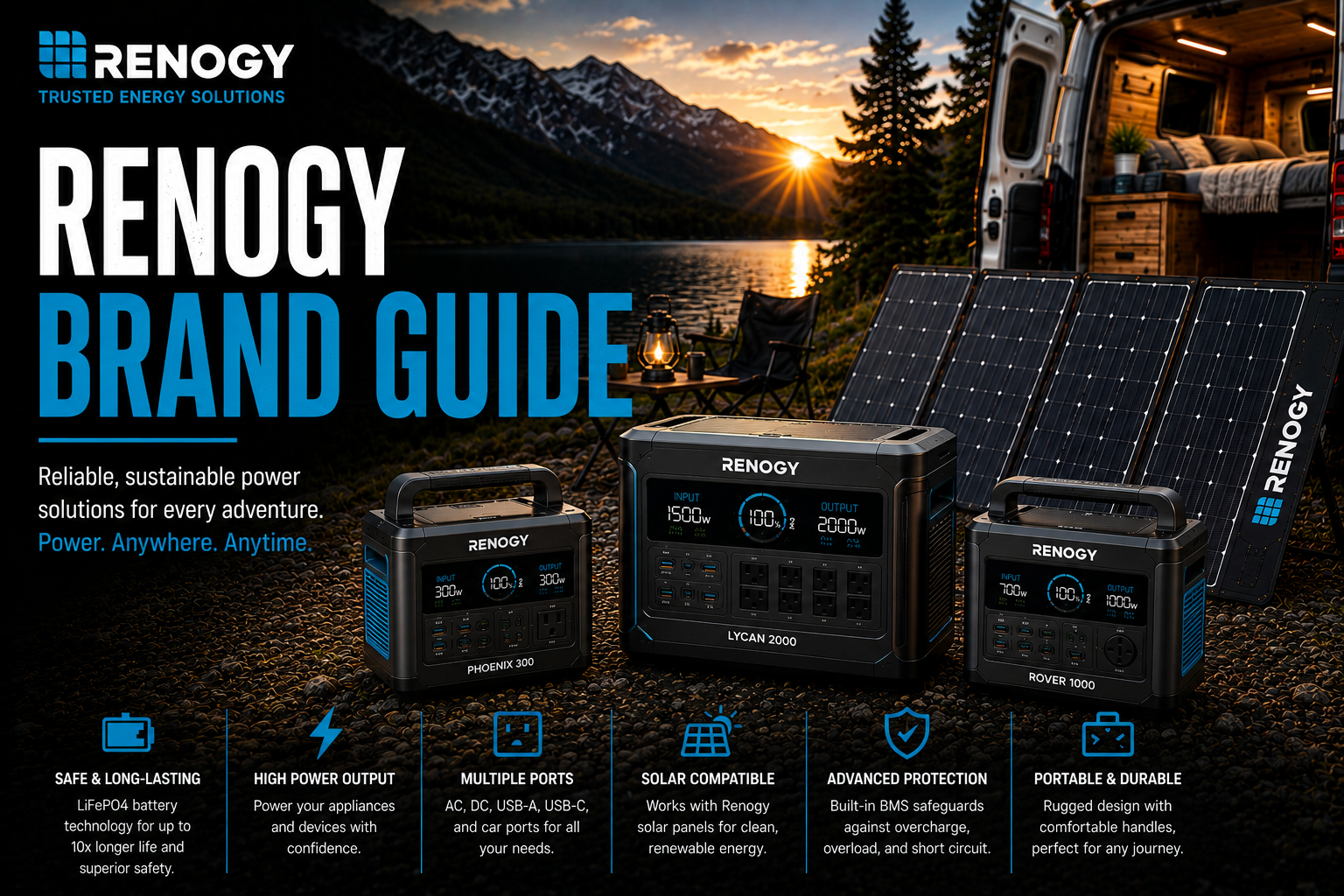
For most people buying a standalone portable power station, Jackery is the simpler brand to start with. For RV owners and off-grid builders, Renogy deserves closer attention because its product ecosystem extends well beyond portable stations.
That does not mean Jackery automatically has better batteries or that Renogy automatically offers better value. Both brands sell different generations of products, and the comparison changes substantially depending on which models you choose.
In particular, an older Renogy PHOENIX station should not be compared with a newer Jackery LiFePO4 model as though they were launched at the same time. Likewise, Renogy's current PowerStation 2000 deserves a different comparison from its older PHOENIX products.
Quick Verdict: Renogy vs Jackery
Choose Jackery if: you want a self-contained portable power station for camping, emergency essentials, travel or occasional household backup. Its Explorer and HomePower product families provide multiple capacity choices, and some models support expansion batteries.
Choose Renogy if: you are also considering permanent RV solar, DC-DC charging, house batteries, solar charge controllers or a more customized off-grid setup. Renogy's broader electrical catalog can be useful when planning an integrated system.
For a portable 2kWh-class station: compare Renogy's PowerStation 2000 against a current Jackery 2kWh-class model using actual capacity, continuous output, outlet configuration, charging and warranty terms.
For a lightweight 1kWh-class station: Jackery's Explorer 1000 v2 is a clearly documented option with 1,070Wh capacity, 1,500W continuous output and LiFePO4 cells.
The Biggest Difference Is the Product Ecosystem
Better Fit for System Builders
Renogy sells portable stations, but its wider business includes solar panels, lithium house batteries, charge controllers, inverters, DC-DC chargers and monitoring equipment.
That matters if you are planning a camper van, RV, trailer, off-grid cabin or other electrical project.
Main advantage: the ability to source multiple parts of a custom power system from one brand.
Main limitation: owning Renogy components does not automatically make them compatible with every Renogy portable power station.
Better Fit for Plug-and-Play Power
Jackery concentrates on portable power stations, compatible solar panels, expansion batteries and larger home-backup product families.
That focus makes it relatively straightforward to compare a station, matching solar panels and manufacturer-approved accessories.
Main advantage: clearly defined portable power products for common consumer uses.
Main limitation: a Jackery station is not a substitute for a complete custom RV electrical system when permanent wiring and charging infrastructure are required.
Renogy vs Jackery: Side-by-Side Comparison
| Category | Renogy | Jackery | Practical Takeaway |
|---|---|---|---|
| Main Strength | Broad RV, solar and off-grid electrical ecosystem | Consumer-focused portable stations and solar generators | Match the brand to the complete project, not just the battery |
| Battery Chemistry | Varies by model; PowerStation 2000 uses LiFePO4 | Varies by generation; newer 1000 v2 and 1000 Plus use LiFePO4 | Check exact model and generation |
| Solar Options | Portable panels plus broader solar hardware | SolarSaga panels and compatible station accessories | Electrical compatibility matters more than brand matching alone |
| RV Integration | Strong broader product ecosystem; PowerStation 2000 includes TT-30 output | Portable station solutions; connector options vary by model | Renogy merits particular attention for RV projects |
| Expandable Storage | Depends on specific product architecture | Supported by selected models, including 1000 Plus | Never assume expansion is universal |
| UPS/EPS Features | PowerStation 2000 advertises up to 20ms switchover | Varies across product families | Neither brand guarantees zero interruption for every device |
| Best Starting Point | RV/off-grid system planning | Standalone portable power shopping | Choose based on how the power will be used |
Actual Models Worth Comparing
Brand-level comparisons become useful only when they lead to real product choices. These models illustrate the different approaches without treating all Renogy or Jackery generations as equivalent.
Renogy PowerStation 2000
A newer Renogy portable station with RV-oriented connectivity and substantial inverter output.
Renogy's PowerStation 2000 is more relevant to a current buying decision than many older PHOENIX comparisons. The manufacturer lists 2,048Wh of battery capacity, 2,400W continuous AC output and 3,600W surge.
Its built-in TT-30 outlet is a meaningful distinction for RV owners who need an appropriate connection to a compatible RV electrical system.
Renogy also advertises LiFePO4 cells rated for more than 3,000 charging cycles and UPS switchover of 20 milliseconds or less under specified conditions.
Advantages
- 2,048Wh battery capacity.
- 2,400W continuous output.
- Built-in TT-30 RV outlet.
- LiFePO4 battery chemistry.
- Manufacturer-advertised UPS function.
Considerations
- Substantially larger than a compact 1kWh station.
- TT-30 is a 120V RV connection, not 240V split-phase output.
- UPS transfer time may not suit sensitive equipment.
- Verify current accessory and warranty terms.
Choose it for: RV use, a 2kWh-class portable battery or backup applications that benefit from its output configuration.
Avoid it if: your main priority is a small, lightweight station for short trips.
Check PriceJackery Explorer 1000 v2
A portable 1kWh-class option with a modern LiFePO4 battery and comparatively low weight.
The Explorer 1000 v2 is a useful benchmark for everyday portable power. Jackery lists a 1,070Wh LiFePO4 battery, 1,500W continuous output and approximately 23.8 pounds of weight.
Jackery advertises a cycle-life rating of 4,000 cycles to at least 70% remaining capacity. It also specifies up to 400W of solar input through its two DC ports.
This model makes more sense than a much larger station when the main loads are electronics, lights, communications and selected small appliances.
Advantages
- Portable 1kWh-class size.
- 1,500W continuous output.
- LiFePO4 battery chemistry.
- Up to 400W solar input.
- Manufacturer-documented technical specifications.
Considerations
- Less stored energy than a 2kWh-class station.
- No expansion-battery support comparable to 1000 Plus.
- Not designed as a complete RV electrical system.
Choose it for: camping, travel, emergency essentials and portable backup where size and weight matter.
Avoid it if: you need long runtime for high-wattage appliances or expandable storage.
Check PriceJackery Explorer 1000 Plus
A higher-output 1kWh-class platform with compatible external battery expansion.
The Explorer 1000 Plus is an important alternative because it addresses two limitations of the smaller 1000 v2: inverter output and battery expansion.
Jackery lists a 1,264Wh LiFePO4 battery, 2,000W continuous output and up to 800W solar input. The model supports compatible expansion batteries, unlike the 1000 v2.
That makes it worth comparing against larger fixed-capacity stations when future runtime expansion is a priority.
Advantages
- 2,000W continuous output.
- Expandable storage.
- Up to 800W solar input.
- LiFePO4 battery chemistry.
Considerations
- Heavier than Explorer 1000 v2.
- Expansion batteries add cost and weight.
- Additional storage does not increase inverter output.
Choose it for: higher-output portable backup with a manufacturer-supported expansion pathway.
Avoid it if: you want the lightest practical 1kWh-class station.
Check PriceBattery Chemistry: Avoid Comparing Old and New Generations
Battery chemistry is one of the most common sources of confusion in Renogy vs Jackery comparisons.
Older Jackery Explorer 1000 and 1000 Pro models used nickel-cobalt-manganese lithium-ion chemistry. The Explorer 1000 v2 and 1000 Plus use lithium iron phosphate, commonly called LiFePO4 or LFP.
Similarly, Renogy's portable station lineup spans different generations. The current PowerStation 2000 uses LiFePO4, but buyers should not assume that every historical PHOENIX model uses the same chemistry.
Why It Matters
- Often offers longer cycle life than older NCM portable-station designs.
- Well suited to frequent charging and regular backup use.
- Still requires proper charging, temperature management and protection.
Why It Can Still Be Relevant
- Some older products remain useful for occasional portable power.
- Energy density and portability may be favorable.
- Battery age, remaining capacity and warranty matter when buying older inventory.
Bottom line: compare battery chemistry and cycle-life specifications by exact model, not by brand. Neither Renogy nor Jackery should receive a blanket advantage based on one product generation.
Renogy vs Jackery for Solar Charging
Both brands support solar charging, but they approach it from somewhat different directions.
Renogy: Broader Solar-System Options
Renogy's catalog includes portable panels as well as components for permanently installed solar systems. This can be advantageous for buyers planning a vehicle roof array, charge controller, lithium house battery and inverter.
However, those components do not automatically connect to a Renogy portable station. The station's solar input voltage, current, power limit and connector requirements still govern compatibility.
Jackery: Portable Solar-Generator Bundles
Jackery offers SolarSaga panels and model-specific solar charging accessories. This approach can be convenient for buyers who want a portable station and folding panels without designing a permanent electrical system.
For example, the Explorer 1000 v2 supports up to 400W solar input, while the 1000 Plus supports up to 800W, according to Jackery's US specifications.
Which Brand Wins for Solar?
Jackery is a natural starting point for portable solar bundles. Renogy is particularly relevant for buyers planning broader RV or off-grid solar systems.
Neither conclusion means one brand's panels are automatically more efficient or that one station charges faster in every configuration. Actual solar performance depends on panel conditions, input limits and battery charging behavior.
Which Brand Is Better for RVs and Camper Vans?
This is the category where Renogy's broader ecosystem makes the clearest difference.
For Permanent RV Electrical Systems
Renogy offers components commonly used in customized RV installations: solar panels, lithium house batteries, DC-DC chargers, charge controllers, inverters and monitoring hardware.
A properly designed system can support alternator charging, permanent solar and dedicated house loads.
This flexibility comes with additional design and installation responsibilities.
For Portable RV and Campsite Power
Jackery makes sense when the goal is to bring a self-contained battery to the campsite, charge devices and run compatible appliances.
It is convenient for users who do not want to build a permanent electrical system.
For whole-RV power, verify the exact station's outlets, electrical limits and connection method.
Why the TT-30 Outlet Matters
Renogy's PowerStation 2000 includes a TT-30 RV outlet. This is a 120V connection format used by many 30-amp RVs.
The presence of a TT-30 receptacle does not mean the station can continuously supply 30A at 120V. The PowerStation 2000's advertised continuous output is 2,400W, and all applicable outlet and total-system limits remain in force.
Recommendation: If you are building a permanent camper van system, investigate Renogy's component ecosystem. If you need portable campsite power, compare Jackery and Renogy stations based on their exact outlets and watt-hour capacity.
Renogy vs Jackery for Home Backup
For home backup, brand reputation is less important than matching the station to your actual electrical requirements.
| Backup Need | What Matters Most | Buying Direction |
|---|---|---|
| Router, phones and lights | Low-load efficiency, capacity and portability | Compact Jackery or Renogy station |
| Refrigerator and essentials | Compressor startup, runtime and continuous output | Compare 1–2kWh and larger compatible models |
| Longer outage duration | Stored watt-hours, recharge options and expansion | Evaluate supported expansion or larger-capacity systems |
| Home circuit integration | Voltage, output connectors and approved transfer equipment | Use a professionally designed, compatible setup |
| Sensitive electronics | UPS transfer behavior and equipment tolerance | Verify model-specific switching performance |
Example: Estimating Backup Runtime
Consider a continuous 150W average load. Assuming 85% of nominal battery capacity is available to AC devices:
| Example Station | Nominal Capacity | Estimated Runtime at 150W |
|---|---|---|
| Jackery Explorer 1000 v2 | 1,070Wh | About 6.1 hours |
| Jackery Explorer 1000 Plus | 1,264Wh | About 7.2 hours |
| Renogy PowerStation 2000 | 2,048Wh | About 11.6 hours |
Estimates use: battery Wh × 0.85 ÷ 150W. These are calculated examples, not measured product runtimes. Actual results depend on inverter efficiency, idle consumption, load variation, temperature and battery condition.
The Renogy station lasts longer in this example primarily because it stores substantially more energy, not because its brand is inherently more efficient.
Charging Speed, Noise and Everyday Ownership
Charging time is not directly comparable unless the battery capacities and charging conditions are similar.
Renogy advertises a 0–80% recharge in approximately one hour for its PowerStation 2000 under specified conditions. Jackery lists approximately 1.6 hours for a standard AC recharge of the Explorer 1000 v2, with faster emergency charging available under designated settings.
Those figures do not establish a universal winner: the Renogy has a larger battery, and the measurements use different charge endpoints.
Noise also varies with inverter load, battery temperature and charging power. Manufacturer minimum noise figures should not be interpreted as constant sound levels during heavy operation.
Five Ownership Questions Worth Asking
- Is the battery chemistry and cycle-life rating clearly documented for this exact model?
- Are compatible solar panels, cables and expansion batteries available?
- Does the warranty cover the product through the seller you plan to use?
- Are replacement accessories and technical support practical to obtain?
- Does the total system cost make sense compared with alternatives of similar capacity and output?
Who Should Buy Renogy—and Who Should Buy Jackery?
Start With Jackery
For portable electronics, lighting and modest campsite loads, the Explorer 1000 v2 is a sensible reference point because its specifications and weight are clearly documented.
Compare Renogy alternatives when a specific outlet, charging feature or better total package suits your needs.
Investigate Renogy
If your project includes permanent solar, alternator charging, house batteries and an inverter, Renogy's broader component ecosystem is relevant.
For a standalone portable station, compare both brands normally.
Compare Exact Models
Neither brand wins automatically. Match capacity, output, charging, expansion and transfer behavior to the loads you actually need to support.
A larger battery often matters more than a small difference in advertised inverter power.
Renogy vs Jackery: Frequently Asked Questions
Is Renogy better than Jackery?
Renogy can be a better fit for custom RV and off-grid electrical projects. Jackery is a strong starting point for standalone portable power stations and solar-generator bundles. For battery performance, compare exact models rather than assuming one brand is always superior.
Are Renogy and Jackery batteries both LiFePO4?
Not universally. Renogy's PowerStation 2000 uses LiFePO4, and Jackery's Explorer 1000 v2 and 1000 Plus use LiFePO4. Older products may use other lithium-ion chemistries. Check the exact model.
Can I use Renogy solar panels with a Jackery?
Some third-party panels may be compatible if voltage, current, total input power, connector type and polarity match the Jackery model's specifications. Never assume compatibility from wattage alone.
Is Renogy better for an RV?
Renogy offers a broader range of components for permanent RV electrical systems. Its PowerStation 2000 also includes a TT-30 outlet. However, for portable campsite power, a Jackery station may be equally suitable depending on capacity and outlet needs.
Can Jackery power an RV?
Selected Jackery stations can power compatible RV appliances or equipment, subject to voltage, output and connection limits. A portable station is not automatically a substitute for the RV's permanent electrical system.
Which brand is better for home backup?
The best choice depends on the required battery capacity, continuous output, starting surge, voltage and backup duration. Both brands offer products worth considering. Verify any home-integration requirements before purchasing.
Does Jackery have expandable batteries?
Yes, selected Jackery models support compatible expansion batteries. The Explorer 1000 Plus is one example. The Explorer 1000 v2 does not offer the same expansion pathway.
Can Renogy PowerStation 2000 run a 30-amp RV?
It includes a TT-30 connection, but the station's 2,400W continuous output remains the governing overall power limit. A 30A RV can contain appliances whose combined demand exceeds that rating. Manage loads and verify electrical compatibility.
Which brand has the better warranty?
Warranty terms vary by exact model, purchase channel and region. Compare the current written manufacturer policies for the specific products you are considering, including registration or extended-coverage requirements.
Can either brand replace a dedicated UPS?
Not automatically. Some models advertise UPS or EPS switching, but transfer time and output behavior may not meet the requirements of sensitive equipment. Verify compatibility with the device manufacturer and consider a dedicated UPS when uninterrupted operation is essential.
Final Recommendation: Renogy or Jackery?
Jackery is the more straightforward starting point for shoppers who want a standalone portable power station. Its Explorer 1000 v2 and 1000 Plus demonstrate two clear approaches: portability versus higher output and expansion.
Renogy is especially attractive when portable power is only one part of a larger RV or off-grid project. Its broader solar and electrical catalog gives system builders more components to evaluate. The PowerStation 2000 also deserves consideration as a substantial standalone unit.
For a fair purchase decision, compare stations of similar capacity, confirm the exact battery chemistry and continuous output, and include all required accessories in the total cost.
Compare Current OptionsSources and Editorial Methodology
This comparison uses manufacturer-published specifications and product documentation. Recommendations are editorial conclusions based on use case, electrical capability, battery capacity and product ecosystem.
No firsthand testing, measured runtime, customer rating or guaranteed current price is claimed. Runtime examples are calculations using stated assumptions.
Manufacturer Sources
- Renogy PowerStation 2000 Official Specifications — capacity, output, TT-30 connection, battery chemistry and charging features.
- Renogy PowerStation Collection — current portable station offerings.
- Renogy Manuals and Downloads — product-generation and technical documentation.
- Jackery Explorer 1000 v2 Official Specifications — battery, inverter, solar input, weight and charging details.
- Jackery Explorer 1000 Plus Technical Information — capacity, output, solar charging and battery specifications.
- Jackery Explorer 1000 Generation Comparison — differences between original, Pro, Plus and v2 models.