
Best Mango Power Systems: Portable, Expandable & Home Backup
Mango Power is unusual because its most useful products work together. The Power E is the starting point, while expansion batteries, split-phase accessories and a home panel turn it into a larger backup system. Here's which combination makes sense—and which upgrades you can skip.
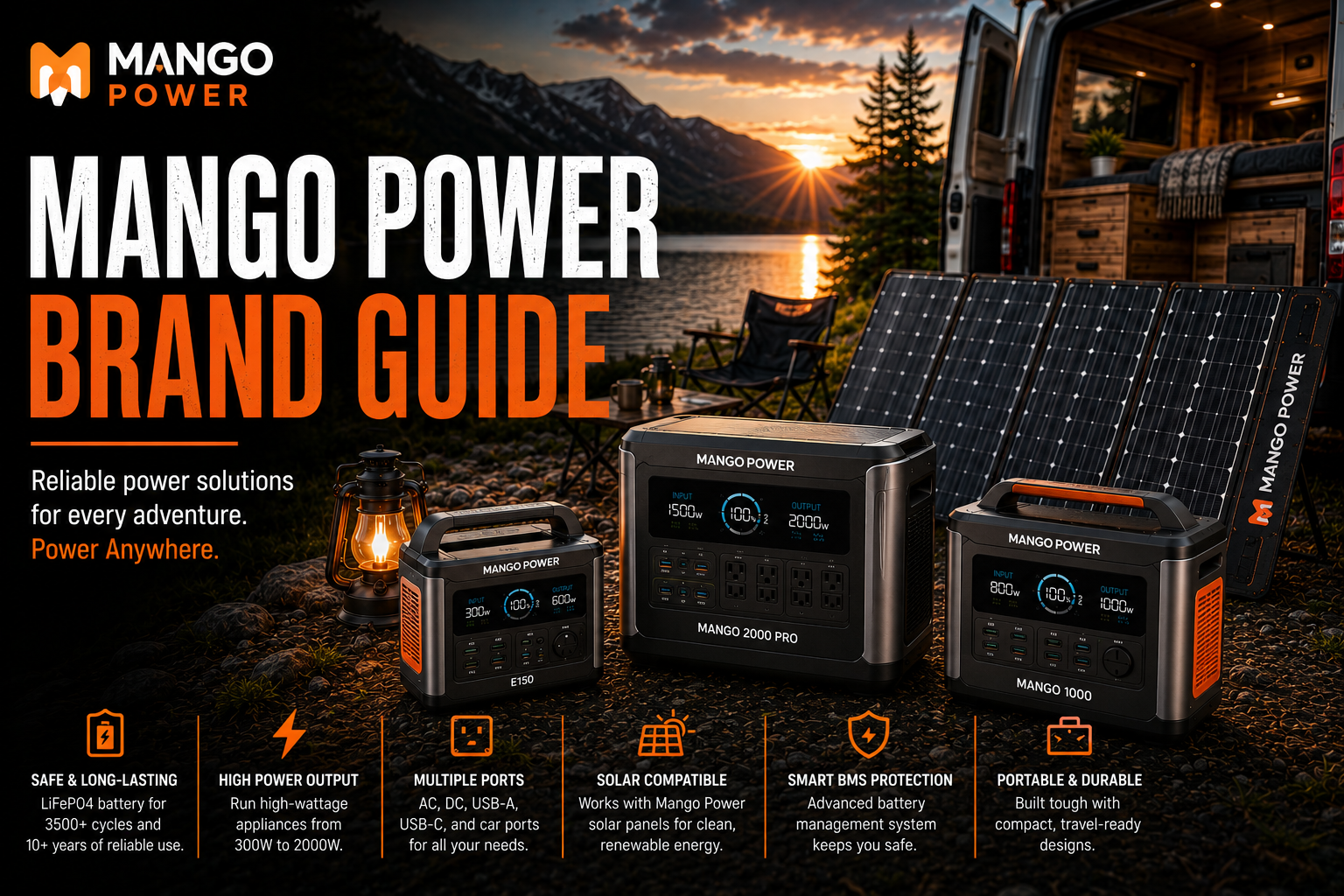
Our top recommendation is the Mango Power E for buyers who want a self-contained power station today and the option to expand later. Its 3,533Wh LiFePO4 battery and 3,000W rated inverter make it a capable starting point. But if you already own a Power E, an expansion battery may be the smarter purchase than another station.
This guide deliberately compares complete system paths, not five supposedly interchangeable power stations. The E Expansion Battery adds energy, mSocket Pro enables a compatible two-unit 240V arrangement, mPanel Pro supports selected household circuits, and Mango Power M is a separately installed home-energy platform.
The Best Mango Power System for Each Need
Best overall — Mango Power E: A 3,533Wh, 3,000W station for selected home appliances, RV use and backup power.
Best runtime upgrade — Mango Power E Expansion Battery: Adds another 3,533Wh, doubling one compatible Power E system to 7,066Wh without increasing the inverter's 3,000W rating.
Best 240V upgrade — Mango Power mSocket Pro: Combines two compatible Power E stations for 120/240V split-phase output and up to 6,000W system power.
Best for selected home circuits — Mango Power mPanel Pro: A dedicated electrical distribution and transfer accessory for compatible Power E and Union configurations.
Best permanently installed platform — Mango Power M: A hybrid-inverter and modular battery system for homeowners planning a professionally installed solar-plus-storage project.
Mango Power System Comparison
| System | Battery Capacity | Power / Function | Best For | Main Trade-Off |
|---|---|---|---|---|
| Power E | 3,533Wh | 3,000W, 120V | Portable backup | Approximately 100 lb |
| Power E + E Battery | 7,066Wh | 3,000W, 120V | Longer outages | Does not increase output |
| Two Power E units + mSocket Pro | 7,066Wh before added batteries | Up to 6,000W, 120/240V | Compatible 240V loads | Requires two stations and proper matching |
| Power E + mPanel Pro | Depends on connected batteries | Selected circuit transfer | Home essentials | Professional electrical installation |
| Power M | 15–20kWh per documented cabinet configuration | 12kVA-class hybrid inverter | Permanent home storage | Installed system, not portable |
These rows represent different configurations, not five independent portable stations. Ratings come from Mango Power's documentation; the maximum output of an entire system must not be confused with the rating of an individual outlet or circuit.
Best Mango Power Systems Reviewed
1. Mango Power E
The foundation of the brand's modular portable-backup ecosystem.
The Mango Power E is the most versatile starting point in the lineup because it works independently or as the center of a larger backup arrangement.
It uses CATL LiFePO4 battery cells, offers 3,533Wh of energy storage and supplies 3,000W of rated 120V AC output. Mango Power lists 16 output ports, including four AC receptacles, USB-A, USB-C, DC outputs and a TT-30 RV receptacle.
The manufacturer's battery-cycle specification is greater than 70% remaining capacity after 6,000 cycles under its stated test conditions. This is a published laboratory-style rating, not a promise that every owner will experience an identical lifespan.
The station weighs approximately 100.1 pounds. Its wheeled format helps around a garage or level surface, but loading it into a vehicle is a different matter. Buyers expecting frequent carrying should consider a smaller portable station instead.
Mango Power publishes up to 3,000W AC charging and a maximum 2,000W solar input, with a 60–150V solar input range. High-speed AC charging may require the correct circuit and optional charging cable.
- Large 3.5kWh-class battery
- 3,000W rated inverter
- LiFePO4 battery chemistry
- Dedicated E Battery expansion
- Optional home and split-phase integration
- Useful RV outlet and multiple DC outputs
- Approximately 100 pounds
- 120V from a single station
- 240V requires another compatible station and hardware
- Additional batteries and panels increase system cost
- IP21 rating does not make it weatherproof
Best for: Homeowners who need backup for selected appliances, RV owners with compatible loads and buyers who want to expand their system over time.
Skip it if: You need something light enough to carry regularly or want a permanently wired whole-home system from the outset.
Check Price2. Mango Power E Expansion Battery
More stored energy without buying another AC inverter.
The E Expansion Battery is the most direct upgrade for a Power E owner who keeps running out of battery energy but is satisfied with the station's 3,000W output.
One expansion battery adds 3,533Wh, producing a 7,066Wh combined system. It connects through Mango Power's designated E+ connection and does not function as a separate 3,000W power station.
That distinction matters. Adding capacity extends runtime at a given load; it does not allow a single Power E to supply a larger continuous AC load.
Mango Power identifies the expansion battery as compatible with the Power E, and the product package includes the connection cable. Do not assume compatibility with Power Union, Power M or unrelated battery products.
- Doubles one Power E's energy storage
- No need to purchase a second inverter
- Manufacturer-specific connection system
- Useful for longer backup periods
- Cannot power AC appliances independently
- Does not raise the 3,000W inverter rating
- Compatible with Power E only
- Adds significant size, weight and cost
Best for: Existing Power E owners who need more hours of backup for refrigerators, networking equipment and other compatible loads.
Skip it if: Your problem is insufficient inverter wattage rather than insufficient battery capacity.
Check Price3. Mango Power mSocket Pro
A split-phase accessory for a properly configured pair of Power E stations.
A single Mango Power E produces 120V AC. The mSocket Pro enables a manufacturer-supported split-phase arrangement using two compatible Power E stations.
Mango Power lists 120/240V output and up to 6,000W combined system power for this configuration. The mSocket Pro's documentation also specifies a maximum output current of 30A.
This can be valuable for a compatible 240V pump or other appliance, but the purchase decision must start with the appliance's actual voltage, running current and startup requirements—not simply the 6,000W headline.
Important compatibility detail: Mango Power's documentation for mSocket Pro describes a two-Power-E configuration and provides specific connection instructions. Its technical overview references Power E units paired with E Batteries. Confirm the exact required battery configuration and cabling in the current manual before ordering components.
- Enables 120/240V split-phase output
- Combines two compatible inverter systems
- Can support selected higher-voltage appliances
- Manufacturer-documented integration path
- Requires two Power E stations
- Must follow exact connection requirements
- 30A output limitation still applies
- Not a substitute for a transfer switch
- Significant total system cost
Best for: Buyers who have verified 240V equipment requirements and are building a compatible dual-Power-E system.
Skip it if: Your backup loads are all 120V or you only own one Power E and do not intend to buy a second.
Check Price4. Mango Power mPanel Pro
An electrical distribution and backup switching accessory for compatible Mango Power systems.
The mPanel Pro addresses a different problem from the mSocket Pro: getting backup power to selected household circuits through an appropriate distribution and transfer arrangement.
Mango Power documents four 15A load outputs, a 50A mains input and two 30A backup input connections. Rotary switches select grid or backup supply for the four output circuits.
This makes the panel relevant to homeowners who would rather back up predetermined circuits than run extension cords across the house. The correct system design depends on the number of Power E stations, their configuration and the actual circuit loads.
The mPanel Pro is an electrical accessory—not an energy storage device. It does not create battery capacity or increase the output rating of the connected stations.
- Purpose-built home circuit integration
- Four documented 15A load outputs
- Supports compatible Power E configurations
- Reduces reliance on extension cords
- Professional installation is necessary
- Only selected circuits are supported
- Does not add battery capacity
- Compatibility is limited to specified systems
Best for: Homeowners planning a fixed backup arrangement for selected essential circuits.
Skip it if: You only want to plug appliances directly into a portable station.
Check Price5. Mango Power M
A dedicated home solar-and-storage platform rather than a movable power station.
Mango Power M is designed for a fundamentally different customer: someone planning permanent battery storage integrated with a home's electrical system and possibly rooftop solar.
Mango Power's US system documentation describes a 12kW-class hybrid inverter, CATL LiFePO4 battery modules, and cabinet configurations with approximately 15–20kWh of storage. The wider platform supports additional cabinet arrangements subject to system design.
Unlike a Power E, this is not something you wheel into the living room during an outage. It requires equipment selection, site assessment, electrical design, permitting where applicable and professional installation.
The system may suit homeowners with large backup requirements, existing solar panels or plans for a long-term energy-storage installation. It is unnecessary for someone who only needs to keep a refrigerator and router running temporarily.
- Purpose-built for permanent home storage
- Large modular battery configurations
- Hybrid solar and grid integration
- 120/240V household applications
- Not portable
- Professional design and installation required
- Higher project complexity
- System and regional specifications vary
- Needs a detailed installed-system quotation
Best for: Homeowners planning permanent solar-plus-storage or substantial backup capacity.
Skip it if: You want a plug-and-play battery for occasional outages, camping or RV use.
Check PriceThis model is an installed system. A product-specific marketplace search may not provide a complete installed-system quotation.
Build the Right Mango Power System
The most useful way to compare Mango Power is to start with the electrical problem you need to solve. More batteries do not always mean more usable power, and an extra inverter does not automatically provide household circuit integration.
Portable Backup
Buy: One Mango Power E.
Use its onboard outlets for compatible 120V appliances. This is the simplest arrangement and requires no expansion hardware.
Longer Runtime
Buy: Power E + E Expansion Battery.
Increase capacity from 3,533Wh to 7,066Wh while retaining the same 3,000W inverter.
240V Split-Phase
Buy: Two compatible Power E systems + mSocket Pro.
Follow the manufacturer's exact pairing and battery requirements to obtain a supported 120/240V arrangement.
Selected Home Circuits
Buy: Compatible Power E system + mPanel Pro.
Have an electrician configure appropriate household circuits and transfer equipment.
How Long Will a Mango Power E Run?
A Power E stores 3,533Wh of nominal energy. For a simple AC runtime estimate, multiply that figure by an assumed usable-efficiency factor and divide by the average load in watts.
Estimated hours = battery capacity (Wh) × 0.85 ÷ average load (W).
The 85% factor is a conservative planning assumption, not a measured efficiency result for these exact configurations. Actual runtime changes with inverter overhead, load variation, temperature and battery condition.
| Average AC Load | Power E · 3,533Wh | Power E + Battery · 7,066Wh |
|---|---|---|
| 100W | 30.0 hours | 60.1 hours |
| 200W | 15.0 hours | 30.0 hours |
| 500W | 6.0 hours | 12.0 hours |
| 1,000W | 3.0 hours | 6.0 hours |
| 2,000W | 1.5 hours | 3.0 hours |
These are mathematical estimates for constant loads, not laboratory results or guaranteed appliance runtimes. Very small loads may experience proportionally greater inverter standby losses. Appliances with compressors or motors also require startup-power verification.
Example: Refrigerator, Router and Lighting
Suppose a refrigerator averages 90W over time, a router draws 15W and LED lighting averages 25W. Their combined average demand would be approximately 130W. Using the same 85% planning assumption, a Power E could provide around 23 hours of runtime.
That does not establish that a particular refrigerator is compatible. Its compressor startup demand, actual duty cycle and daily energy use still need to be checked.
Solar Charging: What Works With Mango Power E?
Mango Power specifies a maximum 2,000W solar charging input for the Power E and a 60–150V input range. These numbers determine which panel arrays are electrically suitable.
Solar panel wattage alone is not enough. Before connecting panels, check the array's open-circuit voltage, operating voltage, current and wiring arrangement. The open-circuit voltage can rise in cold weather, potentially exceeding a station's permitted limit.
Is a 2,000W Solar Array Necessary?
Not necessarily. A smaller array can be useful for topping up batteries during extended outages, provided it meets the input requirements. A larger array may recharge faster under favorable conditions, but real production depends on sunlight, orientation, shading and temperature.
The rated maximum input is an electrical ceiling, not a promise that the battery will continuously receive 2,000W throughout the day.
Power E vs Power Union vs Power M
Mango Power has also documented the Power Union, a hybrid portable/home arrangement made from a stationary Power Home component and a detachable Power Move module.
| Platform | Basic Design | Best Match |
|---|---|---|
| Power E | Standalone wheeled station with optional expansion | Portable and flexible backup |
| Power Union | Stationary 4.6kWh Power Home + detachable 2.3kWh Power Move | Combined home and detachable power needs |
| Power M | Installed hybrid inverter and battery cabinets | Permanent household energy storage |
The Power Union's documented combined capacity is approximately 6.9kWh, with 4,000W continuous system output. Its detachable Power Move portion is a smaller 2.3kWh, 2,000W-class unit.
These are different product architectures. Buyers should not assume batteries, expansion cables or control accessories are interchangeable. Check current regional availability and support before choosing an older platform.
Warranty and Ownership Considerations
Battery warranty terms deserve particular attention with modular systems because different components may have different coverage periods.
Mango Power's documentation lists a five-year product warranty for the Power E in its technical specifications. Its separate warranty policy also describes 10-year coverage for qualifying Power E CATL battery cells, with exclusions for certain integrated electronics. These are not equivalent to a blanket 10-year warranty on every part.
The E Expansion Battery, mSocket Pro and mPanel Pro have their own warranty entries. Check the current written warranty, seller authorization, purchase location and claim procedure before ordering.
Before Buying
- Verify the exact product and generation.
- Confirm accessory compatibility.
- Check the complete system cost.
- Read the warranty exclusions.
- Verify shipping and service coverage.
Before Installing
- List all intended appliances and circuits.
- Measure or verify peak startup loads.
- Confirm 120V versus 240V requirements.
- Use the approved connection equipment.
- Hire a qualified electrician for home wiring.
Common Buying Mistakes
Confusing Capacity With Output
Doubling the battery capacity doubles theoretical stored energy, not the inverter's rated watts.
Assuming One Power E Provides 240V
A single Power E is a 120V station. The supported split-phase setup requires two compatible units and additional hardware.
Ignoring Total Installed Cost
The station price may exclude expansion batteries, solar panels, cables, a home panel and labor.
Treating a 100 lb Unit as Lightweight
Wheels help on suitable surfaces. They do not make a heavy power station convenient to lift.
Frequently Asked Questions
Which Mango Power system is best overall?
Mango Power E is the most flexible starting point for portable backup because it works independently and supports compatible expansion and home-integration accessories.
Can I expand a Mango Power E?
Yes. One compatible E Expansion Battery increases storage from 3,533Wh to 7,066Wh. It does not increase the single station's 3,000W rated AC output.
Can Mango Power E provide 240V?
A single Power E supplies 120V AC. Mango Power documents 120/240V split-phase output using two compatible Power E systems and mSocket Pro or supported home-panel equipment.
Can Mango Power E power a refrigerator?
It can power compatible refrigerators when running wattage, startup demand and total energy use are within the station's limits. Check the appliance specifications before relying on it for outage backup.
Does Mango Power E support solar panels?
Yes. Mango Power specifies up to 2,000W solar input with a 60–150V input range. Any panel array must also satisfy the manufacturer's current and connection requirements.
Is mPanel Pro required for every Power E?
No. You can power compatible devices directly from the station's outlets. mPanel Pro is intended for supported home-circuit integration.
Is Mango Power M portable?
No. Power M is a permanently installed hybrid inverter and battery-storage platform, not a wheeled portable station.
Can a Mango Power station replace a dedicated UPS?
Not automatically. Backup transfer behavior depends on the exact model and operating mode. Sensitive electronics may require a dedicated UPS with an appropriate transfer specification.
Are Mango Power batteries interchangeable?
No. The Power E Expansion Battery is designed for the Power E system. Do not assume compatibility with Power Union or Power M components.
Final Verdict: Start With the System You Actually Need
For most buyers considering Mango Power, the Power E is the logical starting point. It provides 3,533Wh of storage, a 3,000W rated inverter and several documented paths for future expansion.
Add the E Expansion Battery if your main problem is runtime. Investigate mSocket Pro if you have verified 240V requirements. Choose mPanel Pro for an appropriately installed selected-circuit backup arrangement.
If your goal is permanent solar-plus-storage rather than portable backup, compare installed platforms such as Mango Power M with other professionally designed home-battery systems.
The smartest purchase is not necessarily the largest configuration. It is the one whose battery capacity, continuous output, electrical connections and installation requirements match your actual loads.
Compare Current OptionsSources and Editorial Methodology
This guide uses published manufacturer specifications, product manuals and compatibility documentation. It compares systems by their actual roles: portable power, added storage, 240V output, home circuit integration and permanent installation. No firsthand testing or performance measurements are claimed. Runtime figures are clearly labeled calculations.
- Mango Power — Power E Technical Specifications — Capacity, output, solar charging, weight, battery chemistry and warranty.
- Mango Power — E Expansion Battery — Battery compatibility and expansion capacity.
- Mango Power — mSocket Pro Documentation — Split-phase configuration and electrical requirements.
- Mango Power — mPanel Pro Specifications — Circuit outputs and connection ratings.
- Mango Power — Power M System — Installed inverter and battery configurations.
- Mango Power — Warranty Policy — Component-specific coverage and exclusions.
Product availability, regional specifications and warranty terms may change. Verify the exact model and current documentation before purchase. Home electrical connections should be designed and installed by qualified professionals.