
Portable Power Station Runtime Chart: Hours by Battery Size and Appliance Watts
Use practical watt-hour math to estimate how long a portable power station can run lights, laptops, refrigerators and household appliances. Separate stored energy from inverter output before choosing a model.
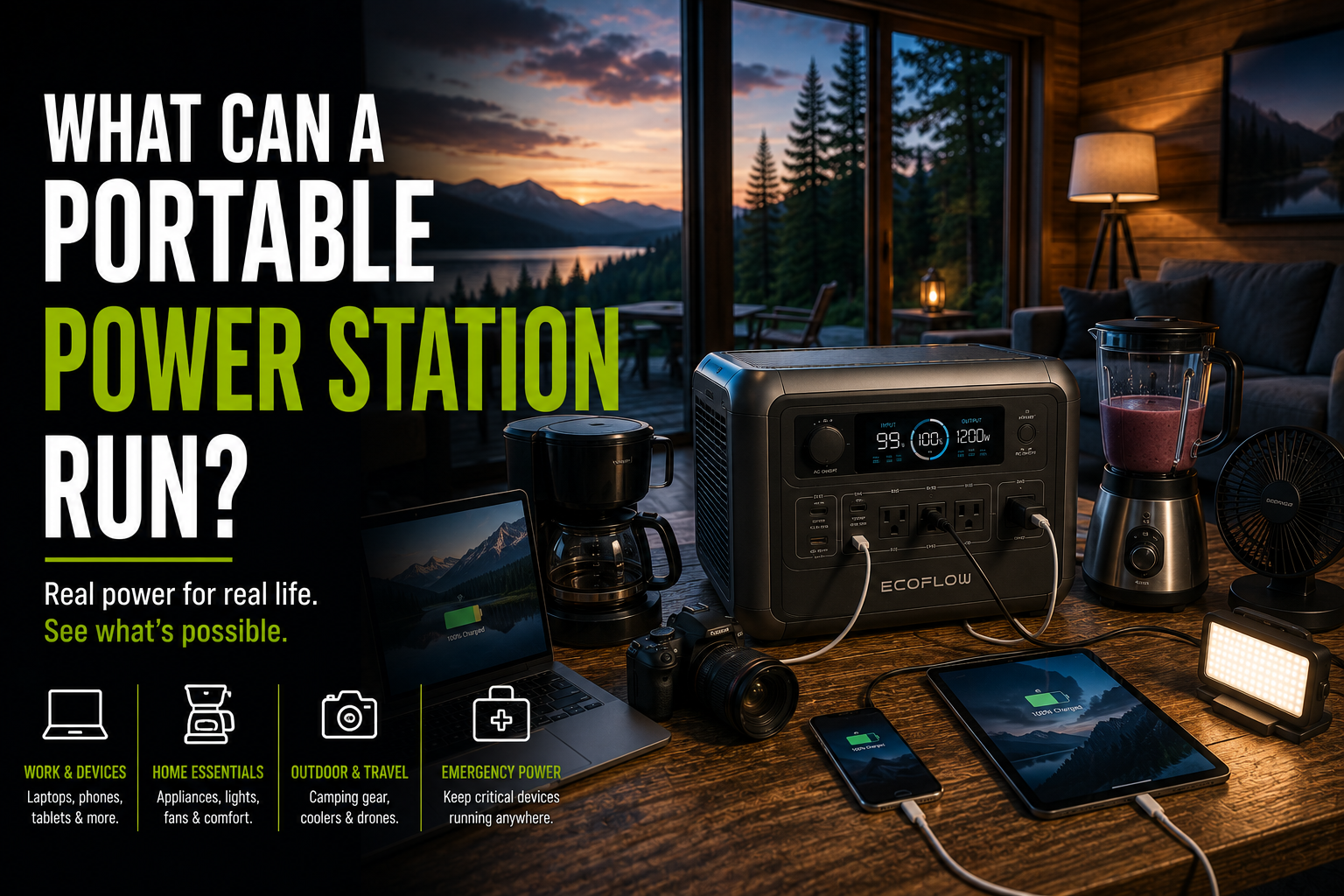
This guide uses transparent calculations rather than claiming measured runtimes. The tables apply an illustrative 85% AC-delivery factor; this is not a tested efficiency value for any particular station. Two manufacturer-documented models illustrate why watt-hours and AC output are separate purchase decisions.
For cycling devices, use measured average watts over several hours. Real results vary with idle inverter draw, temperature, battery aging, power factor, load cycling and reserve settings.
Runtime = Usable Battery Energy ÷ Average Load Watts
For a 1,000Wh battery powering a steady 100W AC appliance, an illustrative 85% usable-energy assumption gives 8.5 hours. A 500W appliance would run about 1.7 hours on the same assumptions.
First check: the station's continuous output and startup surge must support the appliance. A battery with ample watt-hours still cannot power a load that exceeds its inverter rating.
Portable Power Station Runtime Chart (Estimated AC Hours)
The chart below assumes a constant AC load and that 85% of nominal battery watt-hours reach the appliance. Values are planning estimates, not promises of real-world runtime.
| Nominal battery | 25W load | 50W load | 100W load | 200W load | 500W load | 1,000W load | 1,500W load |
|---|---|---|---|---|---|---|---|
| 300Wh | 10.2 h | 5.1 h | 2.5 h | 1.3 h | 31 min | 15 min | 10 min |
| 500Wh | 17.0 h | 8.5 h | 4.2 h | 2.1 h | 51 min | 26 min | 17 min |
| 1,000Wh | 34.0 h | 17.0 h | 8.5 h | 4.2 h | 1.7 h | 51 min | 34 min |
| 1,500Wh | 51.0 h | 25.5 h | 12.8 h | 6.4 h | 2.5 h | 1.3 h | 51 min |
| 2,000Wh | 68.0 h | 34.0 h | 17.0 h | 8.5 h | 3.4 h | 1.7 h | 1.1 h |
| 3,000Wh | 102.0 h | 51.0 h | 25.5 h | 12.8 h | 5.1 h | 2.5 h | 1.7 h |
Two Documented Power Stations for Runtime Planning
These are concrete manufacturer-documented examples, not a claim that they are the only or objectively best options. Their similar capacities but different inverter ratings help demonstrate the runtime/output distinction.
Jackery Explorer 1000 v2
A practical reference point for a compact backup station: a documented 1,070Wh LFP battery and 1,500W continuous AC inverter.
EcoFlow DELTA 2
The DELTA 2 combines a 1,024Wh LFP battery with an 1,800W pure-sine-wave inverter; it provides more output headroom than some similar-capacity stations, not more stored energy.
Manufacturer-Documented Specifications
| Model | Nominal battery | Continuous AC | Solar input max. | Weight | 100W AC estimate |
|---|---|---|---|---|---|
| Jackery Explorer 1000 v2 | 1,070Wh LFP | 1,500W | 400W | 23.8 lb | 9.1 h |
| EcoFlow DELTA 2 | 1,024Wh LFP | 1,800W | 500W | 27 lb | 8.7 h |
Detailed Power Station Reviews and Runtime Analysis
Jackery Explorer 1000 v2
Documented power and energy specifications for realistic runtime planning
A practical reference point for a compact backup station: a documented 1,070Wh LFP battery and 1,500W continuous AC inverter. A battery's watt-hour rating controls its theoretical energy budget, while the inverter's continuous watts determine whether an appliance can run at all.
Worked runtime example: At 100W steady AC draw, 1,070Wh × 0.85 ÷ 100W = approximately 9.1 hours. At 500W, the same calculation gives 1.8 hours. Neither figure is a measured result; both assume 85% usable AC delivery and no other load.
At low appliance wattage, inverter overhead can be a material share of consumption. For a cycling refrigerator, the correct input is the measured average over a full operating cycle, not the compressor nameplate alone. High surge loads must be evaluated separately.
- 1,070Wh LFP battery with 1,500W rated AC output.
- Approximately 23.8 lb for portable emergency and travel use.
- Manufacturer lists up to 400W total solar input across two ports.
- A 1,500W inverter cannot sustain a 1,800W resistive appliance.
- Actual runtime depends on inverter losses, idle consumption and load cycling.
- Confirm the exact 1,070Wh variant; some marketing summaries show a different capacity.
Best for: Buyers whose measured energy demand and appliance output requirements match this station. Not ideal for: Users expecting the calculated runtime to be a guaranteed field result or needing unsupported loads.
Check PriceEcoFlow DELTA 2
Documented power and energy specifications for realistic runtime planning
The DELTA 2 combines a 1,024Wh LFP battery with an 1,800W pure-sine-wave inverter; it provides more output headroom than some similar-capacity stations, not more stored energy. A battery's watt-hour rating controls its theoretical energy budget, while the inverter's continuous watts determine whether an appliance can run at all.
Worked runtime example: At 100W steady AC draw, 1,024Wh × 0.85 ÷ 100W = approximately 8.7 hours. At 500W, the same calculation gives 1.7 hours. Neither figure is a measured result; both assume 85% usable AC delivery and no other load.
At low appliance wattage, inverter overhead can be a material share of consumption. For a cycling refrigerator, the correct input is the measured average over a full operating cycle, not the compressor nameplate alone. High surge loads must be evaluated separately.
- Documented 1,800W continuous AC and 2,700W surge ratings.
- 500W maximum solar input and optional compatible extra battery.
- Two 100W USB-C outputs can reduce AC inverter use for compatible devices.
- Higher inverter output does not lengthen runtime on the same load.
- X-Boost is not a substitute for full-rated output on every appliance.
- Approximately 27 lb and model-generation differences matter.
Best for: Buyers whose measured energy demand and appliance output requirements match this station. Not ideal for: Users expecting the calculated runtime to be a guaranteed field result or needing unsupported loads.
Check PriceHow to Calculate Portable Power Station Runtime
Start with the nominal battery capacity in watt-hours (Wh). Estimate usable AC energy after conversion and system losses. Divide that energy by the appliance's average wattage, not the peak wattage printed on its label.
Use the exact station model specification; 1,000W inverter output does not mean 1,000Wh of storage.
Use a plug-in power meter for cycling appliances, or calculate watt-hours over a full day.
AC conversion and inverter overhead reduce delivered energy. DC use may differ.
Example: 60W laptop, 120W television and 10W router
With all three operating together, the combined steady load is 190W. A nominal 1,024Wh station at the illustrative 85% factor provides 870.4Wh usable AC energy: 870.4 ÷ 190 = 4.6 hours. Turning off the television lowers the load to 70W and raises the idealized estimate to 12.4 hours; actual inverter overhead may shorten that low-load estimate.
Example: refrigerator with a cycling compressor
If a refrigerator consumes 1.2kWh in 24 hours, its measured average is 1,200Wh ÷ 24 = 50W. A nominal 1,024Wh station would provide about 17.4 hours at the simplified 85% factor. Compressor startup surge must still be supported; ambient temperature, door openings and defrost cycles can change consumption.
Appliance Wattage: What Changes the Runtime?
| Appliance / scenario | Illustrative average load | 1,000Wh at 85% | Key caution |
|---|---|---|---|
| LED lighting set | 25W | 34.0 h | Count every bulb and power adapter. |
| Laptop work setup | 60W | 14.2 h | Charging demand changes as the battery fills. |
| Television and streaming | 120W | 7.1 h | Screen brightness affects consumption. |
| Portable fan | 45W | 18.9 h | Speed setting changes draw. |
| Refrigerator (measured average) | 50W | 17.0 h | Startup surge and cycling vary. |
| Electric blanket (active draw) | 100W | 8.5 h | Thermostat cycling and safety rules matter. |
| Coffee maker while heating | 1000W | 0.8 h | Short heating cycle, not an all-day load. |
| Space heater | 1500W | 0.6 h | Very short runtime; verify inverter rating. |
Illustrative loads are not universal appliance specifications. For short-use equipment such as kettles and coffee makers, calculate energy per use: watts × minutes ÷ 60. For appliances with thermostats, measure watt-hours over representative operating conditions.
Buying and Safety Checklist
- Measure the appliance's typical watt-hours and startup surge.
- Match continuous inverter output to the simultaneous running load.
- Budget for AC conversion losses and battery reserve.
- Check exact solar voltage, current and connector limits before connecting panels.
- That a 2,000Wh battery necessarily has a 2,000W inverter.
- That a 2,000W surge rating permits sustained 2,000W operation.
- That an EPS/UPS label means uninterrupted power for sensitive devices.
- That a power station can backfeed household wiring safely.
Final Verdict: Use the Chart to Size Energy, Then Check Output
Battery watt-hours determine how long an appliance may run; continuous inverter watts determine whether it can run at all. A 1,000Wh station can theoretically supply about 8.5 hours at 100W under the illustrative 85% assumption, but measured load and inverter losses decide the real result. For household essentials, calculate daily watt-hours first, allow a reserve, and confirm startup surge before buying.
Frequently Asked Questions
How long does a 1,000Wh power station last?
About 8.5 hours at a constant 100W AC load using an illustrative 85% delivery factor. Different loads, inverter idle consumption and battery conditions change the result.
Can a 500Wh station run a refrigerator?
Possibly, if the inverter supports compressor startup and continuous running power. Runtime depends on measured average consumption, not simply the compressor nameplate.
Is 1,000W the same as 1,000Wh?
No. Watts describe instantaneous power; watt-hours describe stored energy. A station may have a 1,000W inverter and a battery with a different Wh rating.
Why is actual runtime shorter than the chart?
AC conversion losses, idle inverter draw, temperature, reserve settings, battery age and appliance cycling all affect the delivered energy.
Does using USB-C extend runtime?
It can avoid AC inverter losses when the device and station support suitable direct DC/USB-C power. Actual savings depend on the hardware and load.
Can I run a 1,500W heater on a 1,000Wh station?
Only if the station inverter supports at least 1,500W continuous output. At an illustrative 85% delivery factor, 1,000Wh provides about 34 minutes at 1,500W before other losses.
How do I size a station for overnight backup?
Add the measured watt-hours required for the entire night, allow for conversion losses and reserve, then check the combined continuous and startup power requirements.
Sources and Editorial Methodology
Manufacturer documents support the model specifications. The runtime tables are transparent mathematical estimates, not hands-on tests. Appliance wattages are labeled illustrative; no live pricing, independent lab efficiency results, or keyword volumes were verified.