
Best Quiet Portable Generators: 5 Models Worth Comparing
A quiet generator should give you enough usable power without turning a campsite, RV stop or backyard into an engine-noise problem. We compare published sound ratings, continuous output, portability and fuel options—and explain why the lowest advertised decibel number does not always mean the quietest experience.
Quick verdict: The Honda EU2200i is our premium compact choice for low-noise operation and light loads. The Champion 2500W Dual Fuel (201323) is especially attractive when fuel flexibility matters. For greater continuous output without moving to a very large generator, the Honda EU3200i deserves consideration. The right choice depends on the watts you actually need—not just the advertised sound level.
Which Quiet Generator Should You Buy?
Best Premium Compact
Honda EU2200i
1,800W rated output and a manufacturer
noise range of 48–57 dB(A), depending
on load.
Choose for: Light camping, small appliances and premium compact portability.
Best Dual-Fuel Compact
Champion 201323
1,850W running on gasoline,
1,665W on propane and a
published 53 dB(A) rating.
Choose for: Camping and light backup where propane is useful.
Best Lightweight Gas Option
Champion 201490
1,850W running output,
53 dB(A) published sound
level and a 37.7 lb
manufacturer weight.
Choose for: Carrying convenience when gasoline-only operation is acceptable.
Best Higher-Output Premium
Honda EU3200i
2,600W rated output,
54–58 dB(A) published range
and 59.1 lb dry weight.
Choose for: RV and appliance loads that exceed compact-generator capacity.
Quiet Portable Generator Comparison
This table deliberately separates starting watts from continuous running watts. It also identifies the exact model because generators with similar names can have different fuel options, outlets, sound ratings and weights.
| Generator | Starting / Running Watts | Published Noise | Fuel | Dry Weight | Best Fit |
|---|---|---|---|---|---|
| Honda EU2200i | 2,200 / 1,800W | 48 dB(A) at ¼ load; 57 dB(A) at rated load | Gasoline | 47.4 lb | Premium light-load use |
| Champion 201323 | Gas: 2,500 / 1,850W Propane: 2,500 / 1,665W |
53 dB(A), manufacturer rating from 23 ft | Gasoline / propane | 43.2 lb | Fuel flexibility |
| Champion 201490 | 2,500 / 1,850W | 53 dB(A), manufacturer rating from 23 ft | Gasoline | 37.7 lb | Lightweight carrying |
| Honda EU3200i | 3,200 / 2,600W | 54 dB(A) at ¼ load; 58 dB(A) at rated load | Gasoline | 59.1 lb | Higher-output RV use |
| Honda EU3000iS | 3,000 / 2,800W | 50–57 dB(A), depending on load | Gasoline | 130.7 lb | Longer events and electric start |
Figures are manufacturer-published specifications. They are not directly comparable independent acoustic test results. Weight excludes fuel and accessories. Sound changes with load and conditions. Verify the exact model and revision before purchasing.
Best Quiet Portable Generators: Detailed Reviews
Honda EU2200i
An enclosed inverter generator with documented low-load sound performance and compact dimensions.
The EU2200i stands out because Honda publishes sound measurements at two operating points: 48 dB(A) at quarter load and 57 dB(A) at rated load. That helps buyers understand how much noise may change as electrical demand rises.
Honda lists a 0.95-gallon gasoline tank, approximately 8.1 hours at quarter load and 3.2 hours at rated load. The unit weighs 47.4 lb dry and provides 120V AC output.
- Low published quarter-load noise
- Compact enclosed design
- Load-dependent Eco Throttle
- CO-MINDER system
- 1,800W continuous ceiling
- Gasoline only
- 120V output, not 240V
- Premium-priced category
Buy it for: A premium compact generator when light-load sound performance matters.
Avoid it if: You need 2,500W or more continuously, propane operation or a 240V supply.
Check PriceChampion 2500W Dual Fuel — 201323
A quiet compact inverter with the flexibility to operate on gasoline or propane.
Champion's model 201323 is an attractive camping choice because it combines a published 53 dB(A) sound rating from 23 feet with gasoline and propane operation.
The fuel choice matters. Champion rates the unit at 1,850 running watts on gasoline but 1,665 running watts on propane. That difference can affect appliance compatibility and how many devices you can operate together.
Manufacturer runtime figures are up to 11.5 hours at quarter load on gasoline and up to 25 hours at quarter load using a 20 lb propane cylinder. These are different fuel configurations, not equal-size energy reserves.
- Gasoline or propane
- 53 dB(A) published rating
- 43.2 lb dry weight
- CO Shield protection
- Lower output on propane
- 120V only
- Recoil starting
- Limited heavy-appliance capacity
Buy it for: Light camping, tailgating and propane-friendly backup planning.
Avoid it if: Your intended loads exceed its continuous output, particularly when operating on propane.
Check PriceChampion 2500W Inverter — 201490
A useful alternative when portability is more important than dual-fuel capability.
Champion's model 201490 is notably light for a 2,500-starting-watt enclosed inverter. Its 37.7 lb dry weight is an advantage when lifting the generator into a vehicle or moving it around a campsite.
Champion publishes a 53 dB(A) sound rating from 23 feet, 1,850 running watts and up to 11.5 hours at quarter load on a 1.05-gallon gasoline tank.
Compared with the 201323 dual-fuel model, the principal trade-off is straightforward: you give up propane compatibility in exchange for a lighter gasoline-only unit.
- Lightweight carrying
- Documented 53 dB(A) rating
- Enclosed inverter design
- CO Shield system
- No propane option
- Limited continuous output
- No built-in 30A RV outlet
- 120V only
Buy it for: Frequent transport, lighter camping loads and gasoline-only simplicity.
Avoid it if: Propane storage or a dedicated RV outlet is essential.
Check PriceHonda EU3200i
More usable continuous power without abandoning the enclosed, quiet inverter-generator format.
The EU3200i is an interesting step up for buyers who need more running watts than compact 1,800W-class generators provide. Honda specifies 3,200W maximum and 2,600W rated output.
Published sound levels are 54 dB(A) at quarter load and 58 dB(A) at rated load. At 59.1 lb dry, it is heavier than the EU2200i but remains relatively portable for its output class.
Honda lists a 120V 30A locking receptacle and a 120V household duplex outlet. It is not a 120/240V split-phase generator.
- 2,600W continuous power
- Published load-specific noise
- 30A 120V locking outlet
- CO-MINDER system
- Heavier than compact picks
- Gasoline only
- 120V, not 240V
- Premium cost category
Buy it for: Higher-output 120V RV or appliance loads with a strong emphasis on portability.
Avoid it if: You require propane, 240V output or a much larger home-backup system.
Check PriceHonda EU3000iS
A heavier enclosed inverter for users who prioritize operating duration and electric-start convenience.
The EU3000iS illustrates why quieter operation and easier portability are not always the same thing.
Honda lists a 50–57 dB(A) sound range and up to 19.6 hours of runtime, depending on load. That makes it attractive for long outdoor events and suitable 120V loads.
The trade-off is weight: at approximately 130.7 lb dry, this is substantially less convenient to lift than the EU2200i or EU3200i.
- Quiet published sound range
- 2,800W rated output
- Electric start
- Longer runtime potential
- Very heavy for one-person lifting
- Gasoline only
- More storage space required
- Not 240V split-phase power
Buy it for: Longer outdoor events, 120V loads and electric-start convenience.
Avoid it if: You frequently carry a generator by hand or have limited storage space.
Check PriceHow Quiet Is a Quiet Portable Generator?
A generator's advertised decibel figure is useful, but it is only one part of the buying decision. Sound pressure depends on distance, engine speed, load, terrain, nearby walls and how the manufacturer conducts its measurement.
48–53 dB(A)
This range includes several manufacturer ratings for compact enclosed inverter generators operating under specified conditions.
It does not mean the generator will stay at that level under heavy demand.
54–60 dB(A)
Some quiet inverter generators move into this range as engine load increases.
Two generators with similar low-load ratings may sound different at higher output.
60+ dB(A)
Higher-output and open-frame designs may be noticeably louder, although construction and test conditions still matter.
Compare sound specifications at equivalent loads.
Why Decibel Differences Can Be Misleading
Decibels use a logarithmic scale. A 10 dB increase corresponds to ten times the sound intensity at the measurement point, but it does not mean people perceive the sound as exactly ten times louder.
Tone also matters. A generator with a low-pitched steady hum may be less intrusive than one with a prominent high-pitched whine, even when their measured A-weighted levels are similar.
Published Honda Noise at Different Loads
Honda's load-specific figures provide a useful illustration of how sound changes as a generator works harder.
| Model | ¼-Load Noise | Rated-Load Noise | Difference |
|---|---|---|---|
| Honda EU2200i | 48 dB(A) | 57 dB(A) | +9 dB |
| Honda EU3200i | 54 dB(A) | 58 dB(A) | +4 dB |
Manufacturer figures are provided for the stated operating conditions. They are not a prediction of sound levels at your campsite or property.
Choose Running Watts Before Choosing the Quietest Model
A small generator may be exceptionally quiet at quarter load, but if your appliances push it close to full output, it can become louder and less suitable.
Running Watts
The continuous power the generator can supply while operating normally. This is the primary number for sustained electrical loads.
Starting Watts
The short-duration power available for startup demands. Refrigerators, pumps and air conditioners may require additional startup power.
Example: A Light Camping Setup
| Load | Illustrative Running Power |
|---|---|
| Portable refrigerator | 70W while operating |
| Two fans | 100W combined |
| Lighting | 40W |
| Phone and laptop charging | 120W |
| Total running load | 330W |
In this illustrative scenario, the running load is well below the continuous capacity of the compact generators in our shortlist. Actual appliance labels, startup demands and simultaneous operation must still be checked.
Gasoline vs Propane: Output Is Not Always Equal
Dual-fuel capability is useful for flexibility, but the continuous wattage may be lower on propane.
Champion 201323: Fuel Output Example
The propane rating is 90% of the gasoline running-watt rating for this specific model. Other dual-fuel generators may have different reductions.
Quiet Generator for Camping, RV or Home Backup?
Prioritize Portability
For lighting, charging, fans and small appliances, a compact 1,800W-class inverter may be enough.
Check campground generator hours, noise restrictions and permitted fuel use.
Check Outlets and Startup Loads
An RV outlet does not automatically mean the generator can run every appliance in the trailer.
Verify 120V compatibility, available running watts and air-conditioner starting demand.
Plan the Whole Load
A small inverter generator may run selected appliances through appropriately rated cords or a professionally installed transfer system.
It is not a substitute for a correctly sized whole-home generator.
How to Make a Portable Generator Less Intrusive
Reduce Unnecessary Electrical Load
Turn off appliances you do not need. Many inverter generators can reduce engine speed at lighter loads, lowering noise and fuel consumption.
Use Economy Mode When Appropriate
Economy modes can help under steady light loads, but follow the manual when connecting equipment with substantial starting current or fluctuating demand.
Choose a Safe Outdoor Position
Place the generator on stable ground, well away from occupied spaces, openings and combustible materials. Never compromise exhaust safety for lower noise.
Maintain the Engine
Follow the specified oil, spark-plug, air-filter and service schedule. Mechanical problems can affect noise, performance and reliability.
Do Not Build an Improvised Sound Box
Homemade enclosed soundproofing boxes can trap heat, restrict cooling and accumulate deadly exhaust. Use only manufacturer-approved arrangements that maintain all required clearances and ventilation.
Quiet Generator Safety: What Never Changes
A quiet generator is still a combustion engine. Low sound output does not make its exhaust safe.
Carbon Monoxide Warning
Never operate a gasoline, propane or other fuel-powered portable generator indoors. This includes garages, basements, sheds, carports and partially enclosed porches, even when doors or windows are open.
CDC guidance says to operate portable generators outdoors, more than 20 feet from windows, doors and vents, with exhaust directed away from occupied spaces. Follow any more restrictive manufacturer instructions and local requirements.
Use working battery-powered or battery-backup carbon monoxide alarms. Automatic CO shutdown technology is an additional safeguard, not permission to operate in an unsafe location.
Electrical Safety
- Never backfeed a household outlet.
- Use properly rated outdoor cords.
- Keep plugs and connections dry.
- Respect generator and outlet limits.
- Use a qualified electrician for transfer equipment.
Fuel and Placement
- Shut down and cool before refueling.
- Store fuel in approved containers.
- Keep exhaust away from openings.
- Maintain manufacturer clearances.
- Follow local fire and noise regulations.
Quiet Portable Generator FAQs
What is the quietest type of portable generator?
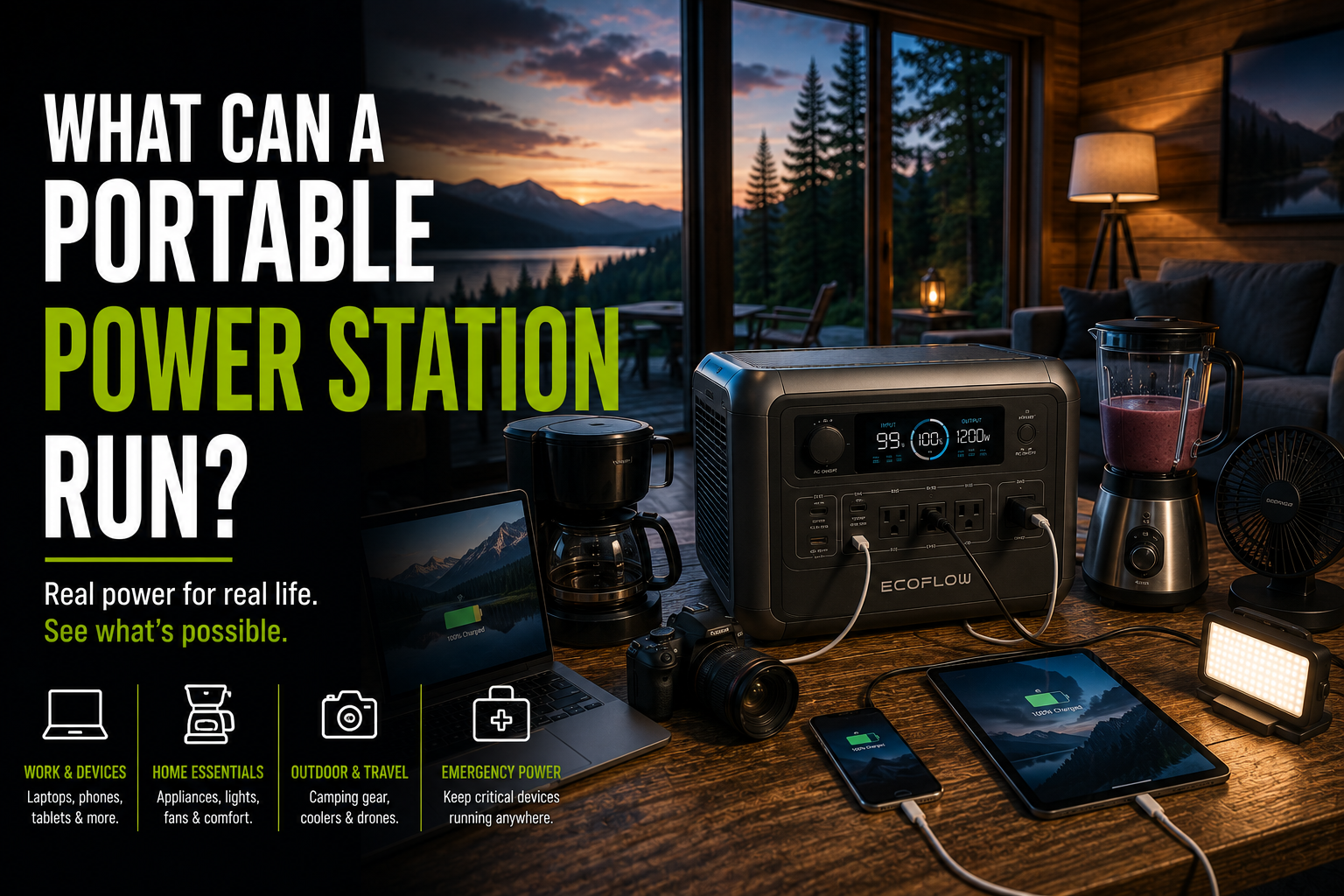
Enclosed inverter generators are often among the quieter engine-powered portable designs, particularly under light loads. Actual noise depends on the model, electrical demand, test distance and surroundings. A battery power station is quieter because it has no combustion engine.
Is 50 dB(A) quiet for a generator?
A manufacturer rating around 50 dB(A) is relatively low for an operating combustion generator. However, the measurement distance and load are essential for interpreting that number.
Are inverter generators quieter than conventional generators?
Often, yes. Many enclosed inverter generators use variable engine speed and sound-reducing housings. However, not every inverter generator is quieter than every conventional model, particularly at high load.
Does a generator get louder as more appliances are connected?
Generally, engine speed and mechanical noise increase as load rises, although the exact behavior depends on generator design and operating mode.
Is propane quieter than gasoline?
Not necessarily. Fuel type alone does not establish a meaningful noise advantage. Compare published sound data for the exact generator and operating conditions.
Can a quiet portable generator run an RV air conditioner?
Some can, provided continuous output, startup capability, outlet configuration and appliance requirements are compatible. Check the specific air conditioner, generator and any manufacturer-approved starting equipment.
Can I use a quiet generator overnight?
Only where operation is permitted and safe outdoor placement, fuel, ventilation and monitoring requirements are met. Campgrounds and residential areas may impose quiet hours or restrictions. A battery power station may be more appropriate for silent overnight power.
Can I put a generator in a soundproof enclosure?
Do not use improvised enclosed boxes. They can cause overheating and carbon monoxide accumulation. Follow manufacturer instructions for approved weather protection, ventilation and clearance.
Final Verdict: Which Quiet Portable Generator Is Best?
For premium compact power: Choose the Honda EU2200i when its 1,800W continuous rating meets your needs and low-load sound performance is a priority.
For fuel flexibility: The Champion 201323 offers gasoline and propane operation in a relatively light, enclosed inverter design. Remember that propane reduces its rated continuous output.
For easier carrying: The gasoline-only Champion 201490 is worth considering at 37.7 lb dry.
For more power: Compare the Honda EU3200i if you need a 2,600W continuous-output generator while retaining an enclosed inverter format.
The best purchase is not simply the generator with the lowest advertised decibel rating. It is the quietest suitable model at the electrical load you actually intend to operate.
Compare Current OptionsSources and Editorial Methodology
Recommendations are based on published manufacturer specifications, intended applications, fuel options and practical ownership trade-offs. We have not represented manufacturer sound claims as independently measured side-by-side results.
- Honda — EU2200i Specifications — rated output, noise at specified loads, runtime and weight.
- Champion — Model 201323 — gasoline and propane output, noise, weight and runtime.
- Champion — Model 201490 — gasoline output, noise, dry weight and fuel capacity.
- Honda — EU3200i Specifications — rated output, noise, receptacles and weight.
- Honda — Portable Generator Comparison — EU3000iS and related model specifications.
- CDC — Carbon Monoxide Poisoning Prevention — safe generator placement and carbon monoxide precautions.
Generator specifications, model revisions and retailer listings can change. Confirm the exact model, current manual, local emissions requirements, electrical compatibility and applicable safety rules before purchasing.