
Best Portable Power Stations Under $500
A $500 budget can buy a lightweight station for phones and laptops—or, with the right deal, a substantially larger battery capable of running compatible small appliances. The trick is knowing when extra capacity matters more than portability.
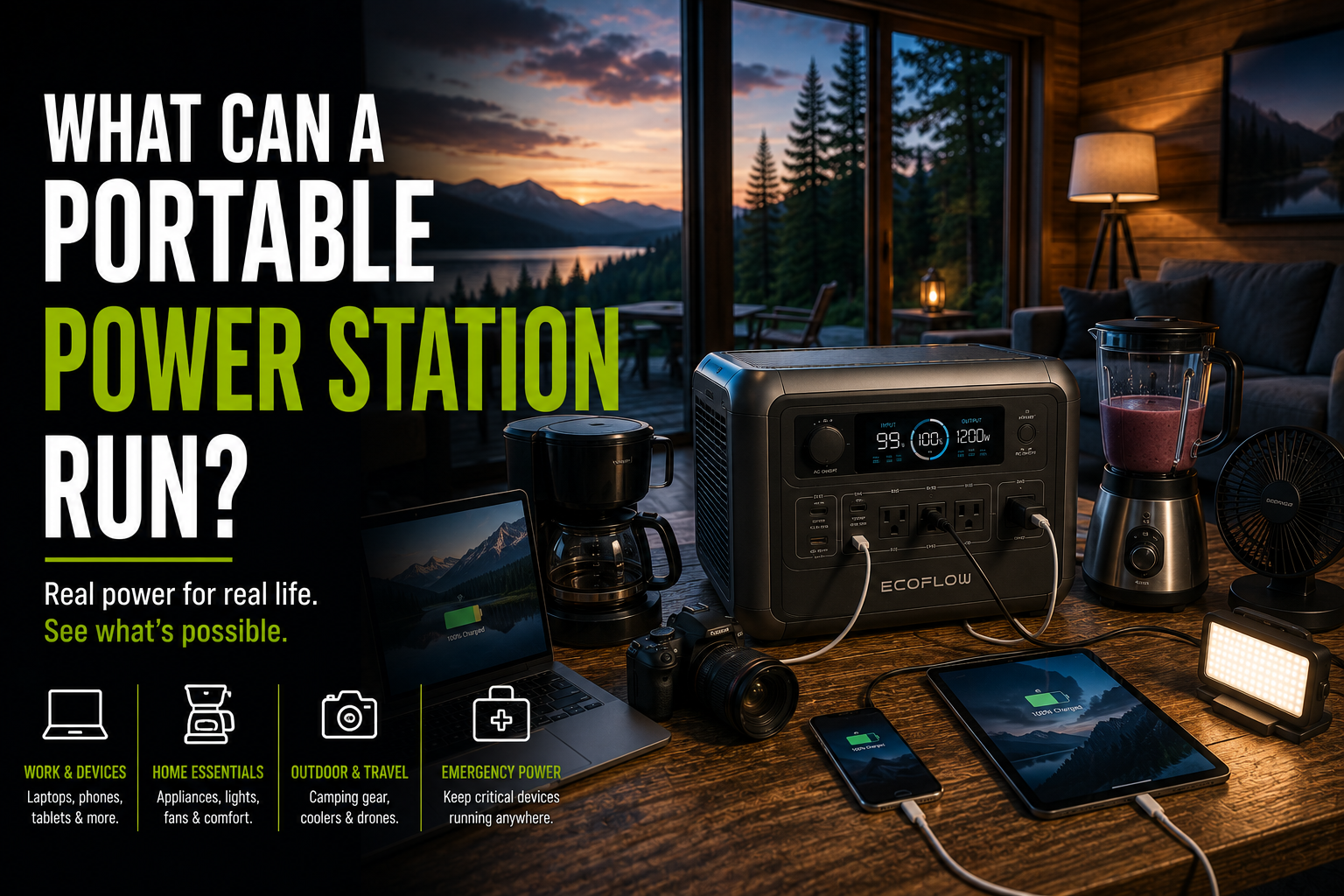
Our best overall compact pick is the EcoFlow RIVER 3 Plus. It offers 286Wh of LiFePO4 storage, 600W continuous AC output and optional battery expansion. But if the BLUETTI AC70 is actually available below $500, its 768Wh battery and 1,000W inverter make it the more capable choice for appliance runtime.
Don't Spend $500 on a 300Wh Station Without Comparing 700Wh Models
Compact power stations are convenient, but this price category changes dramatically during promotions. A 700–800Wh model can provide more than twice the stored energy of a 286–288Wh station.
Choose compact when you need easy carrying, laptop charging or occasional camping power. Choose larger capacity when you want longer operation for a fan, television, CPAP device with approved settings, or a compatible small refrigerator.
The budget applies to the actual checkout price of the exact unit. Some larger models qualify only during sales; solar panels, expansion batteries and taxes can push the total above $500.
Our Top Portable Power Station Picks Under $500
EcoFlow RIVER 3 Plus
286Wh · 600W AC
Best for electronics, short outages and buyers who want optional expansion.
Read evaluationBLUETTI AC70
768Wh · 1,000W AC
A stronger appliance-oriented buy when the actual price is under $500.
Read evaluationAnker SOLIX C300 DC
288Wh · DC Only
A smart choice for laptops, cameras and USB-powered equipment.
Read evaluationJackery Explorer 300 Plus
288Wh · 300W AC
Straightforward portable AC power for modest outdoor loads.
Read evaluationAnker SOLIX C800
768Wh · 1,200W AC
A compelling alternative if a verified discount brings the unit below the budget cap.
Read evaluationPortable Power Stations Under $500: Comparison Chart
This table compares published US-market specifications. Prices are intentionally excluded because they vary by retailer, promotion and configuration.
| Model | Capacity | Continuous AC | Solar Input | Approx. Weight | Buyer Fit |
|---|---|---|---|---|---|
| EcoFlow RIVER 3 Plus | 286Wh | 600W | 220W max | 10.4 lb | Compact AC and expansion |
| BLUETTI AC70 | 768Wh | 1,000W | 500W max | 22.5 lb | Longer runtime and small appliances |
| Anker SOLIX C300 DC | 288Wh | No AC outlets | 100W max | About 6.2 lb | USB-C and DC electronics |
| Jackery Explorer 300 Plus | 288Wh | 300W | 100W max | 8.3 lb | Lightweight camping AC |
| Anker SOLIX C800 | 768Wh | 1,200W | 300W max | 23.1 lb | Higher-output sale purchase |
All five models use LiFePO4 battery chemistry. Solar input figures are maximum ratings, not expected output in every weather condition. The C300 DC's 300W total DC rating must not be confused with AC inverter output.
Detailed Reviews: Which Budget Power Station Should You Buy?
EcoFlow RIVER 3 Plus
The most versatile compact choice for buyers who prioritize portability and a future upgrade path.
The RIVER 3 Plus combines a 286Wh LiFePO4 battery with a 600W pure sine wave inverter, 100W USB-C output and a 220W maximum solar input. At approximately 10.4 pounds, it is practical for regular transport.
Its biggest advantage over a basic 300Wh power station is flexibility. Compatible EcoFlow extra batteries can increase capacity to as much as 858Wh, although that upgrade costs extra and may exceed this guide's budget.
EcoFlow also advertises less than 10ms UPS transfer. That is useful for some electronics, but it does not guarantee uninterrupted operation for every connected device.
- 600W continuous AC output
- Optional battery expansion
- 220W solar input
- 100W USB-C charging
- Compact 10.4-pound design
- Fast AC recharging
- Only 286Wh in the base unit
- Expansion increases total cost
- Not suited to prolonged heavy loads
- X-Boost has appliance limitations
Best for: Laptops, Wi-Fi equipment, lights, modest camping loads and short backup sessions.
Skip it if: You need overnight appliance runtime from the base battery alone.
Check PriceBLUETTI AC70
A meaningful step up from 300Wh-class stations when the selling price fits the budget.
The BLUETTI AC70 offers 768Wh of LiFePO4 storage and 1,000W continuous AC output. That gives it much more flexibility for compatible small appliances than most compact 300Wh models.
Its published specifications include 500W solar input, 950W maximum AC input, two 100W USB-C ports and an approximate weight of 22.5 pounds.
The AC70 is our stronger capacity-first choice whenever the exact model is genuinely offered for less than $500. It is not the best choice for someone who needs a station they can carry effortlessly.
- 768Wh of storage
- 1,000W rated inverter
- 500W maximum solar input
- Two 100W USB-C ports
- LiFePO4 battery
- Heavier than compact models
- Price and stock fluctuate
- Power Lifting is load-dependent
- Not intended for native 240V loads
Best for: Longer electronics use, camping appliances and selected emergency loads.
Skip it if: It exceeds your actual $500 ceiling or you prioritize lightweight travel.
Check PriceAnker SOLIX C300 DC
The specialized choice for electronics users who do not need household AC outlets.
The SOLIX C300 DC is designed for USB-C and 12V equipment. It provides a 288Wh battery, two 140W bidirectional USB-C ports and 300W total output across its supported DC connections.
It weighs approximately 6.2 pounds and supports up to 100W solar charging. For laptops and other DC-powered electronics, avoiding an AC inverter can also avoid some conversion losses.
Do not buy this model expecting a wall outlet. The C300 DC is different from the SOLIX C300 AC version. Model names are similar, but their intended uses differ.
- Lightweight design
- Two 140W USB-C ports
- 288Wh battery
- DC-focused power delivery
- Useful for remote work
- No AC inverter outlets
- 100W solar input ceiling
- Not suitable for AC appliances
- Charging accessories may be needed
Best for: USB-C laptops, cameras, tablets, phones and compatible 12V electronics.
Skip it if: You need to plug in a standard AC appliance.
Check PriceJackery Explorer 300 Plus
A lightweight, straightforward battery for modest AC and USB loads.
The Explorer 300 Plus provides a 288Wh LiFePO4 battery, a 300W pure sine wave AC outlet and 100W maximum solar input. Its relatively low weight makes it attractive for campsite electronics.
It is a sensible option when you need simple charging for smaller devices rather than the higher AC output of the RIVER 3 Plus.
The key limitation is its 300W continuous inverter rating. Many kettles, coffee makers, heaters and other kitchen appliances exceed that limit.
- Lightweight and compact
- 288Wh LiFePO4 battery
- Pure sine wave AC output
- USB-C charging
- Simple portable design
- 300W continuous AC limit
- Only 288Wh of storage
- 100W solar input maximum
- No large expansion system
Best for: Camping lights, phones, laptops and smaller AC electronics.
Skip it if: You need more than 300W continuously or substantial overnight appliance runtime.
Check PriceAnker SOLIX C800
A higher-output option worth checking when promotional pricing enters the sub-$500 category.
The SOLIX C800 uses a 768Wh LiFePO4 battery and a 1,200W continuous pure sine wave inverter. Its higher inverter rating can accommodate compatible appliances that exceed the AC70's 1,000W continuous limit.
Anker specifies 300W maximum solar input, 100W USB-C output and a weight of approximately 23.1 pounds. Its advertised SurgePad capability is not a substitute for the normal 1,200W rating.
Compared with the AC70, the C800 offers more rated AC output, while the AC70 offers a higher published solar input ceiling. Both have 768Wh batteries.
- 1,200W continuous output
- 768Wh LiFePO4 battery
- Fast AC charging
- 100W USB-C output
- Strong mid-size capability
- Must verify a sub-$500 offer
- 23.1-pound weight
- 300W solar input ceiling
- SurgePad is load-dependent
- Not intended for 240V appliances
Best for: Buyers who want more continuous AC power without stepping into a much larger system.
Skip it if: Its actual checkout price exceeds your budget or you need a lightweight station.
Check PriceHow Much Runtime Can You Expect Under $500?
Battery capacity in watt-hours is the starting point for runtime calculations. A station with 768Wh of storage generally lasts longer than a 288Wh station at the same sustained load.
The 85% factor is an illustrative allowance for conversion losses. It is not a measured efficiency rating for any of these models.
| Battery Size | 50W AC Load | 100W AC Load | 200W AC Load |
|---|---|---|---|
| 286Wh | 4.9 hours | 2.4 hours | 1.2 hours |
| 288Wh | 4.9 hours | 2.4 hours | 1.2 hours |
| 768Wh | 13.1 hours | 6.5 hours | 3.3 hours |
Constant-load estimates only. The Anker C300 DC has no AC inverter, so the 288Wh AC row does not apply to that model. Actual DC runtime depends on device and conversion efficiency.
How to Choose the Best Portable Power Station Under $500
Identify Your Highest-Wattage Device
Check the appliance's normal running watts and startup requirements. A battery with enough watt-hours can still fail to operate a device if its inverter is undersized.
Calculate Your Energy Requirement
Multiply the average load in watts by the desired runtime in hours. Then allow for conversion losses and reserve capacity.
Compare Actual Checkout Prices
Confirm the exact model, included accessories, seller, warranty, shipping and tax. A discounted larger station may offer substantially better value.
AC or DC: Which Do You Really Need?
If your equipment charges over USB-C or runs from compatible DC power, a DC-focused station can be an efficient, lightweight choice.
If you need conventional wall outlets, buy a model with a properly rated AC inverter. The Anker SOLIX C300 DC does not provide AC outlets.
How Important Is Solar Charging?
Solar input limits differ significantly. The Jackery Explorer 300 Plus supports up to 100W solar input, while the BLUETTI AC70 supports up to 500W.
More solar input capability can reduce recharge time in favorable conditions, but panels must match the power station's voltage, current, polarity and connector requirements.
Do You Need UPS Capability?
Some compact stations advertise rapid transfer during utility outages. EcoFlow lists less than 10ms for the RIVER 3 Plus, while BLUETTI and Anker publish model-specific transfer ratings.
This does not make every portable power station a substitute for a dedicated UPS protecting sensitive equipment. Confirm transfer behavior, bypass limits and connected-device requirements.
What About Battery Lifespan?
The models compared here use LiFePO4 battery chemistry, generally associated with strong cycle durability. Manufacturer cycle-life claims use specific testing conditions and should not be interpreted as guaranteed years of service.
Warranty coverage also varies. Check the actual seller's terms and any registration requirements before buying.
Which Size Is Best for Your Situation?
Choose 250–300Wh
Best when carrying weight and USB-C output matter more than running household appliances.
Models to compare: Anker SOLIX C300 DC, Jackery Explorer 300 Plus.
Choose Compact AC With Expansion
A 600W-class inverter offers more flexibility for smaller AC devices than a 300W-class unit.
Model to compare: EcoFlow RIVER 3 Plus.
Look for 700–800Wh on Sale
Higher storage and 1,000W-class output can make a substantial practical difference.
Models to compare: BLUETTI AC70, Anker SOLIX C800.
Consider a Larger Budget
If you need to support multiple appliances for many hours, a small power station may not provide sufficient storage.
Calculate your daily watt-hour requirement before buying.
Common Mistakes That Waste Your $500 Budget
Confusing Watts With Watt-Hours
A 1,200W inverter rating tells you the maximum continuous AC load—not how many hours the battery will last.
Buying a DC-Only Unit for AC Equipment
Check the actual outlet configuration. USB-C charging does not replace a household AC outlet.
Assuming Every Sale Bundle Fits the Budget
A low advertised starting price may refer to the base station rather than a solar or expansion bundle.
Ignoring Carrying Weight
A 22-pound station can be excellent for car camping but less convenient for frequent hand carrying.
Frequently Asked Questions
What is the best portable power station under $500?
The EcoFlow RIVER 3 Plus is a versatile compact choice. When the BLUETTI AC70 is priced below $500, its larger 768Wh battery and 1,000W inverter make it a stronger choice for many appliance-oriented uses.
Can a $500 power station run a refrigerator?
Some mid-size models may power compatible refrigerators, but running wattage, compressor startup requirements and actual daily energy consumption must be checked. Compact 300Wh stations generally provide limited refrigeration runtime.
Is 300Wh enough for camping?
It can be sufficient for phones, lights, laptops and modest electronics. It is not ideal for sustained high-power appliance use.
Is a 768Wh station worth the extra weight?
Usually when you need longer runtime or higher AC output. For occasional phone and laptop charging, a compact station may be more convenient.
Can I use a portable power station indoors?
Battery-powered stations can generally be operated indoors when the manufacturer permits it and ventilation, moisture and temperature requirements are followed. Fuel-powered generators must never be operated indoors.
Can I add solar panels later?
Yes, if the exact model supports solar charging. Match the panel configuration to its permitted voltage, current and connector specifications.
Should I buy a larger station instead of extra batteries?
Compare the total cost of the base unit plus expansion battery against a larger self-contained station. Expansion can offer flexibility, but it is not always the lowest-cost way to add watt-hours.
What should I check before paying?
Verify the exact model, continuous AC output, capacity, included accessories, current price, seller, warranty, shipping and return conditions.
Final Verdict: Where Should You Spend Your $500?
Choose EcoFlow RIVER 3 Plus if you want the best balance of compact size, 600W AC output and future battery expansion.
Choose BLUETTI AC70 when you can genuinely buy it below $500 and need longer runtime for compatible appliances.
Choose Anker SOLIX C300 DC if you mainly power USB-C and DC electronics. The Jackery Explorer 300 Plus is a straightforward lightweight AC alternative.
If you find an Anker SOLIX C800 within budget, compare its 1,200W rated output against the AC70's higher solar input capability.
The smartest purchase is the one that matches your real energy use—not simply the station with the biggest number on its product box.
Compare Current OptionsSources and Editorial Methodology
We compared manufacturer-published battery capacities, rated AC output, solar input, weight, expansion capability and practical limitations. Recommendations are editorial assessments of buyer suitability, not firsthand laboratory testing.
- EcoFlow RIVER 3 Plus Official Manual — Capacity, output, solar input, weight and battery chemistry.
- EcoFlow RIVER 3 Series — Product differences, expansion and UPS features.
- BLUETTI AC70 Official Product Specifications — Battery, inverter, solar input, ports and weight.
- Anker SOLIX C300 DC Official Documentation — DC outputs, capacity and solar charging.
- Jackery Explorer 300 Plus Technical Information — Capacity, AC output, battery chemistry, solar input and weight.
- Anker SOLIX C800 US User Guide — Rated output, charging specifications, battery capacity and UPS behavior.
- Power Gear Guide: Original Budget Buying Guide — Original article and retained WordPress imagery.
Price-policy note: This article targets a $500 maximum equipment budget. Models described as sale-dependent are recommendations only when the exact unit's actual selling price meets that threshold. No fixed price or inventory status is guaranteed. Runtime calculations are illustrative, not measured results.