
Best Portable Power Stations for Power Tools
Match a power station to the tool’s running watts, motor startup demand and work-session energy. We compare practical battery options for drills, saws, chargers and light-duty jobsites—without confusing surge ratings with sustained output.
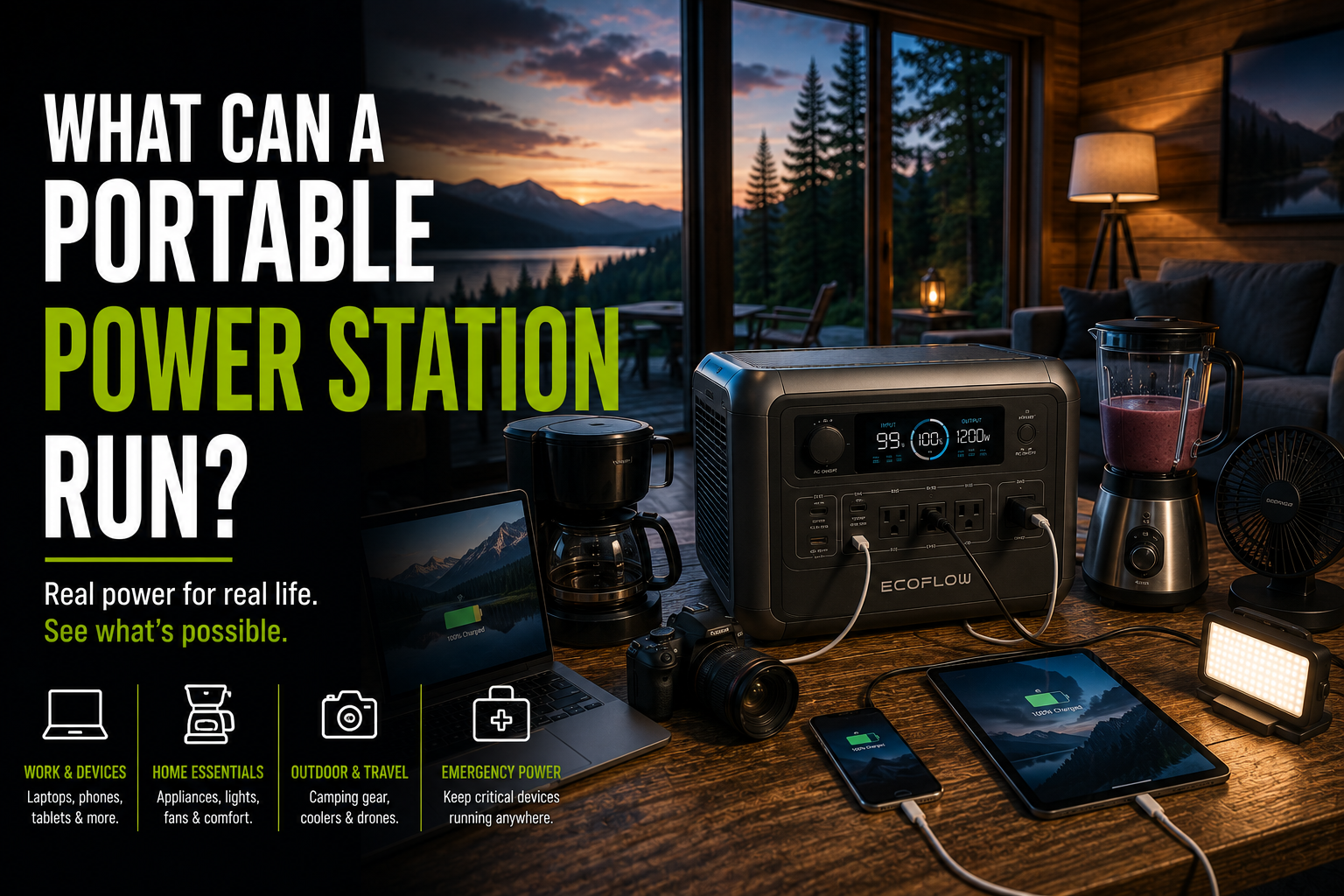
We reviewed published manufacturer specifications for the EcoFlow DELTA 3 Plus, BLUETTI AC180 and Jackery Explorer 1000 v2. Tool power and duty-cycle scenarios below are illustrative, not field measurements. We have not run these stations with workshop tools in a controlled test.
Choose the Station by the Hardest Tool to Start
For cordless-tool battery chargers and modest drills, a 1,000W-class inverter may suffice. For many corded saws, grinders and shop vacuums, start with a documented 1,800W continuous pure-sine-wave station, then verify the tool’s startup behavior. High-current table saws, compressors and simultaneous tools can exceed these compact stations’ limits.
Watts decide whether the tool starts; watt-hours decide how long you can work. Never assume a high surge rating guarantees reliable motor starts.
Best Power Stations for Power Tools: Quick Picks
Jackery Explorer 1000 v2
1,500W continuous AC, 1,070Wh battery. Choose based on tool startup and active runtime.
EcoFlow DELTA 3 Plus
1,800W continuous AC, 1,024Wh battery. Choose based on tool startup and active runtime.
BLUETTI AC180
1,800W continuous AC, 1,152Wh battery. Choose based on tool startup and active runtime.
Power Station Specifications for Tool Use
| Model | Battery | Continuous AC | Solar input | Approx. weight |
|---|---|---|---|---|
| Jackery Explorer 1000 v2 | 1,070Wh | 1,500W | 400W solar maximum | about 23.8 lb |
| EcoFlow DELTA 3 Plus | 1,024Wh | 1,800W | Up to 1,000W solar input | about 27.6 lb |
| BLUETTI AC180 | 1,152Wh | 1,800W | 500W solar maximum | about 35.3 lb |
Detailed Reviews: Portable Power for Tools
Jackery Explorer 1000 v2
Manufacturer-published specifications; not a hands-on tool test.
A sensible carry-first choice for cordless battery charging, lighting and smaller corded tools with known running and startup demands. A motor labeled near 1,500W is not a comfortable match simply because the inverter is rated at 1,500W.
Illustrative runtime: a 600W tool used for 20 minutes consumes about 200Wh at the outlet; at 85% overall conversion efficiency, that draws roughly 235Wh of nominal battery capacity. Actual performance varies with duty cycle, load and temperature.
- Lower carrying weight than the other reviewed models; LFP battery
- 1,500W output leaves less headroom for motor starts; limited battery energy for sustained saw work
EcoFlow DELTA 3 Plus
Manufacturer-published specifications; not a hands-on tool test.
The DELTA 3 Plus offers useful AC headroom for occasional corded tools, and its 1,800W rating is supported by the official manual. Check whether motor inrush is within its capabilities; X-Boost should not be treated as a guaranteed solution for inductive loads.
Illustrative runtime: a 600W tool used for 20 minutes consumes about 200Wh at the outlet; at 85% overall conversion efficiency, that draws roughly 235Wh of nominal battery capacity. Actual performance varies with duty cycle, load and temperature.
- 1,800W continuous AC rating; two solar input ports; relatively portable
- 1,024Wh is modest for long continuous cutting sessions; X-Boost is not equivalent to higher rated AC output
BLUETTI AC180
Manufacturer-published specifications; not a hands-on tool test.
The AC180 trades more carry weight for a slightly larger battery than the other two. It can be a practical choice for intermittent saw and drill use when the tool’s actual draw and startup are within the inverter limits.
Illustrative runtime: a 600W tool used for 20 minutes consumes about 200Wh at the outlet; at 85% overall conversion efficiency, that draws roughly 235Wh of nominal battery capacity. Actual performance varies with duty cycle, load and temperature.
- 1,152Wh battery; 1,800W continuous pure-sine-wave output
- Heavier to move between work areas; Power Lifting mode does not guarantee motor compatibility
How Many Watts Do Power Tools Need?
Tool labels can list input watts or amperes. For a 120V tool, a rough upper-bound estimate is volts times input amperes, but power factor, load and motor design complicate real draw. A 12A nameplate corresponds to 1,440VA, not a promise of 1,440W steady operation.
| Example tool | Illustrative running draw | What to verify |
|---|---|---|
| Cordless battery charger | 60–300W | Actual charger input label |
| Compact drill or oscillating tool | 300–800W | Load spikes and startup |
| Circular saw or angle grinder | 900–1,800W | Starting surge, blade load and speed |
| Compressor / large shop vacuum | Highly variable | Motor inrush; often unsuitable for compact stations |
Estimate Battery Runtime for Real Work Sessions
Energy depends on the minutes the motor is actually running—not the elapsed time you spend measuring, cutting and repositioning. A saw used in bursts may consume much less energy than one operated continuously.
| Illustrative task | AC energy | Battery energy at 85% |
|---|---|---|
| 500W drill, 30 active minutes | 250Wh | 294Wh |
| 1,200W saw, 15 active minutes | 300Wh | 353Wh |
| 1,500W grinder, 20 active minutes | 500Wh | 588Wh |
For example, a 1,024Wh station theoretically supplies about 870Wh of AC energy at the assumed 85% efficiency. That is roughly 43 minutes at a constant 1,200W, provided the tool starts and the inverter sustains the load. Reserve margin for losses, battery condition and changing demand.
Is a power station better than spare cordless batteries?
For intermittent cordless work, additional manufacturer-approved tool batteries can be lighter and more convenient. A power station is more compelling when you need multiple chargers, AC-only tools, lighting or mixed electronics away from utility power.
What if the saw trips the inverter?
Stop and check overload guidance. Reduce competing loads, inspect the tool and compare startup requirements. Repeatedly forcing restarts or bypassing protections is not a safe workaround.
Power Tool and Jobsite Safety Checklist
Final Verdict: Buy for the Most Demanding Tool, Not the Average One
For a mixed set of chargers, drills and occasional corded tools, the EcoFlow DELTA 3 Plus and BLUETTI AC180 offer documented 1,800W continuous AC output; the Jackery Explorer 1000 v2 is lighter but limited to 1,500W. None should be assumed to start every compressor or large saw. Check the exact tool’s startup behavior, calculate active-use energy and choose sufficient reserve—or use a more suitable generator for demanding continuous work.
- Use properly rated, undamaged cords and manufacturer-approved chargers.
- Check the station’s AC outlet and total-output limits.
- Keep dust away from air intakes and provide ventilation.
- Assuming surge watts equal continuous watts.
- Operating in rain or wet concrete dust without suitable protection.
- Backfeeding building circuits or bypassing protective devices.
Frequently Asked Questions
Can a portable power station run a circular saw?
Sometimes. Compare the saw’s rated input and startup surge with the station’s continuous and transient AC limits. A 1,800W rating alone does not guarantee motor starts.
How large a battery do I need for a cordless drill charger?
Read the charger input label and multiply watts by charging hours, allowing for conversion losses. Most chargers need much less continuous power than corded saws.
Can I use two power tools at once?
Only if the combined running and starting demands stay within the station’s total AC limits. Avoid starting two motors together.
Will a 1,000Wh station power a 1,500W grinder for an hour?
No. Even at 85% assumed AC efficiency, 1,000Wh nominal energy yields about 850Wh at the outlet—roughly 34 minutes at 1,500W if the inverter supports it.
Is Power Lifting or X-Boost the same as higher inverter wattage?
No. These modes may alter voltage or load behavior and are not a substitute for checking compatibility with motors and electronics.
Sources and Editorial Methodology
Specifications are taken from official manufacturer documentation, not independent bench tests. Tool draw ranges and runtime scenarios are explicitly illustrative; no current price, field-tested performance or universal motor-start guarantee is asserted. Reviewed November 2026.