
Best Portable Generators: Top Picks for Home Backup, RVs & Camping
Compare six gasoline, dual-fuel, and tri-fuel generators by actual running watts, startup capacity, noise considerations, fuel flexibility, and the loads they can realistically support.
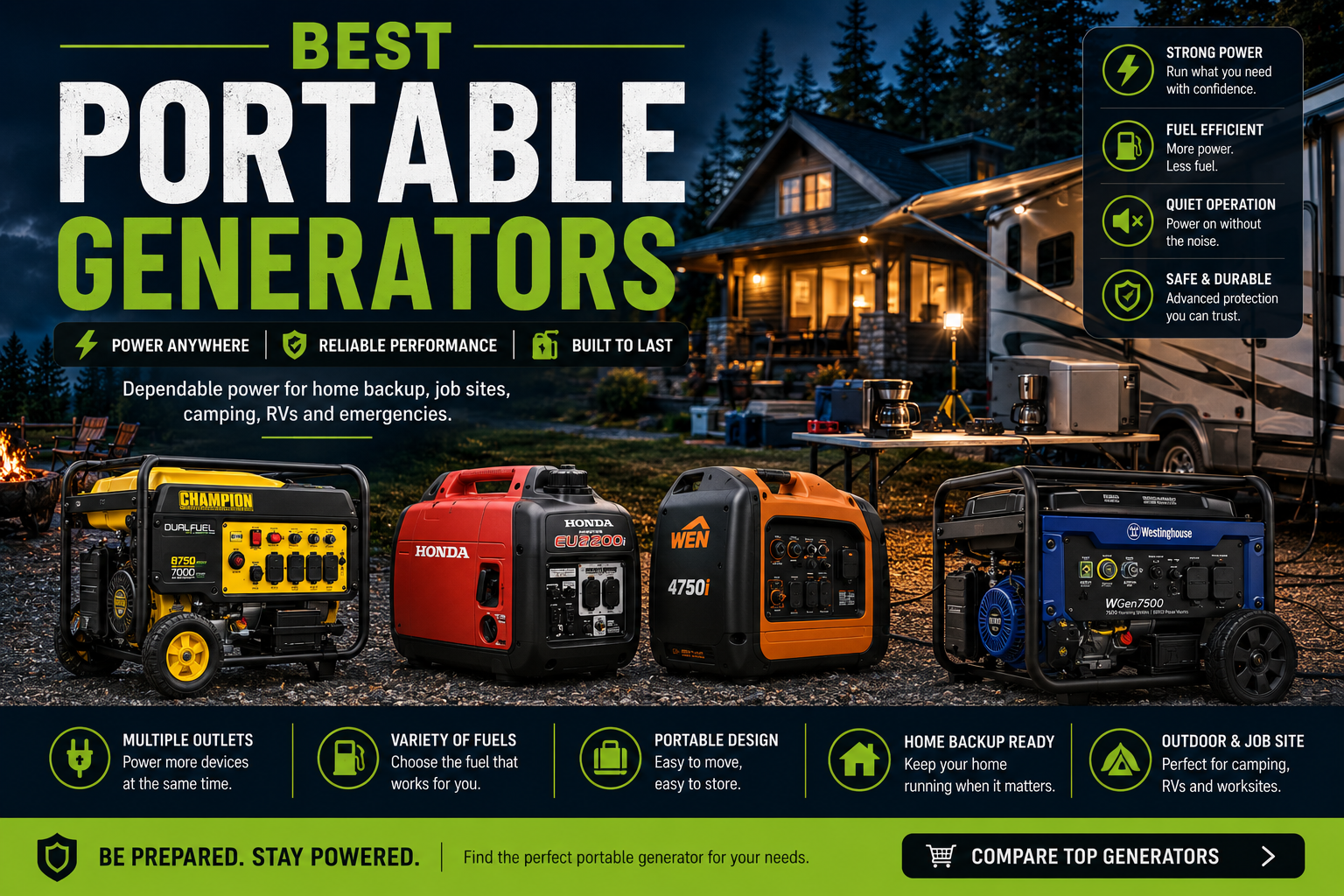
Which Portable Generator Is Best?
Best premium inverter: The Honda EU7000iS combines 5,500 running watts, 120/240V output, electric start, and a fully enclosed inverter design. It is a strong premium choice when noise and power quality matter and its price and 263-pound dry weight are acceptable.
Best for large home-backup loads: The Westinghouse WGen11500TFc supplies 11,500 running watts on gasoline and supports propane and natural gas. It is more appropriate for substantial household circuits than for quiet recreation.
Best for RVs: The Champion 4500W Dual Fuel Inverter, specifically model 201319, provides 3,500 running watts on gasoline or 3,150 on propane, plus a TT-30R RV outlet.
Best conventional essentials backup: The Generac GP6500 offers 6,500 running watts without the cost and weight of a large enclosed inverter.
No single generator wins every category. The correct purchase depends on continuous electrical demand, starting loads, fuel availability, noise restrictions, and safe connection requirements.
Best Portable Generators at a Glance
Honda EU7000iS
Refined enclosed inverter power for buyers prioritizing quieter operation, electrical quality, and 120/240V flexibility.
Read ReviewWestinghouse WGen11500TFc
High running output and three fuel choices for a properly planned emergency-backup setup.
Read ReviewChampion 4500W Inverter
A more portable recreational choice with dual-fuel flexibility and a dedicated RV connection.
Read ReviewGenerac GP6500
Conventional generator capacity for selected household circuits and occasional emergency use.
Read ReviewDuroMax XP13000HX
High-output alternative for demanding loads when gasoline and propane are the preferred fuels.
Read ReviewYamaha EF2200iS
A small-load recreational option, provided the exact 120V regional version and local availability are confirmed.
Read ReviewPortable Generator Comparison: Running Watts Matter Most
Running watts describe the sustained load a generator can support. Starting or peak watts describe temporary capacity and should never be treated as continuous output.
| Generator | Running Watts | Starting / Maximum Watts | Fuel | Best Use |
|---|---|---|---|---|
| Honda EU7000iS | 5,500W | 7,000W | Gasoline | Premium inverter backup |
| Westinghouse WGen11500TFc | 11,500W gas 10,500W propane 9,500W natural gas |
14,500W gas 13,500W propane 12,000W natural gas |
Tri-fuel | High-output home backup |
| Champion 201319 | 3,500W gas 3,150W propane |
4,500W | Dual fuel | RV and camping |
| Generac GP6500 | 6,500W | 8,125W | Gasoline | Selected home essentials |
| DuroMax XP13000HX | 10,500W gas 10,000W propane |
13,000W gas 12,500W propane |
Dual fuel | Heavy-duty loads |
| Yamaha EF2200iS | 1,800W | Check regional variant | Gasoline | Small recreational loads |
Detailed Portable Generator Reviews
1. Honda EU7000iS
The Honda EU7000iS is the strongest premium choice in this shortlist for buyers who need meaningful backup capacity but also care about quieter operation and inverter-regulated power.
Honda specifies 5,500 rated watts and 7,000 maximum watts with 120/240V capability. Its enclosed design, electric start, electronic fuel injection, and CO-MINDER system distinguish it from basic open-frame generators.
Honda lists 52 dB(A) at one-quarter load and 58 dB(A) at rated load under its stated measurement conditions. Those figures should not be compared blindly with noise claims taken at different distances or loads.
- Enclosed inverter design
- 120/240V output
- Electric start and fuel injection
- Published three-year residential warranty
- Premium purchase cost
- Very heavy for frequent transport
- Gasoline only
- 5,500 running watts may not support a large whole-home load plan
Best for: homeowners and RV owners who value inverter output and quieter operation more than maximum watts per dollar.
Skip it if: you need 9,000–11,000 running watts or want propane/natural-gas capability.
Compare Current Listings Official Specifications2. Westinghouse WGen11500TFc
For substantial emergency-backup loads, the WGen11500TFc offers a more appropriate output class than the Honda. It also provides three fuel choices, which can be useful when gasoline supplies are disrupted.
Westinghouse specifies 11,500 running watts on gasoline, 10,500 on propane, and 9,500 on natural gas. Peak output is 14,500W, 13,500W, and 12,000W respectively.
The generator provides 120/240V output and transfer-switch-ready connections. However, outlet ratings and circuit protection still limit the power available through any individual receptacle. A large total wattage rating does not mean every connected circuit can draw that entire amount.
- High continuous output
- Three fuel options
- 120/240V connections
- Remote and electric start
- CO-sensing shutdown feature
- Heavy open-frame machine
- More noise than enclosed inverter alternatives
- Lower power output on propane and natural gas
- Home hookup requires proper electrical planning
Best for: households with a documented high-output emergency-load plan and access to more than one fuel source.
Skip it if: you primarily need a small RV or camping generator.
Compare Current Listings Official Specifications3. Champion 4500W Dual Fuel Inverter — Model 201319
Champion's 201319 is better suited to RV and recreational use than the much larger home-backup generators in this comparison.
The manufacturer lists 4,500 starting watts and 3,500 running watts on gasoline, or 3,150 running watts on propane. It includes a 120V TT-30R RV outlet, a household duplex outlet, and an optional parallel-expansion arrangement.
Champion advertises 61 dBA measured from 23 feet under its stated conditions. Its CO Shield system is an added safety feature, not permission to operate the unit inside a camper, tent, garage, or other enclosed space.
- Gasoline or propane operation
- Dedicated RV outlet
- Inverter output
- CO Shield automatic shutdown
- Three-year limited warranty
- Not a large-home backup generator
- Lower running output on propane
- Air-conditioner startup compatibility must be checked
- Parallel operation requires compatible equipment
Best for: RV owners and campers with a 120V power plan that fits within the generator's actual running and startup limits.
Skip it if: your application needs 240V household circuits or sustained loads above its rating.
Compare Current Listings Official Model 2013194. Generac GP6500
The GP6500 offers a practical middle ground between smaller recreational inverter generators and the very large dual- or tri-fuel home-backup models.
Generac's published GP6500 COsense specifications list 6,500 running watts and 8,125 starting watts. It is a conventional open-frame generator, so buyers should not expect the same acoustic refinement as an enclosed inverter.
Exact GP6500 model numbers differ in starting equipment and accessories. Check the manufacturer model and variant shown in the listing rather than relying on “GP6500” alone.
- Useful output for selected household essentials
- Motor-starting headroom
- Established manufacturer support network
- COsense-equipped versions available
- Gasoline only
- Open-frame noise
- Not an enclosed inverter
- Specific outlets and starting system depend on variant
Best for: buyers needing conventional backup power for a defined group of household circuits.
Skip it if: quiet campsite operation or propane storage is a primary requirement.
Compare Current Listings Official Specifications5. DuroMax XP13000HX
The XP13000HX is a high-output dual-fuel alternative for homeowners who want gasoline and propane operation but do not require natural gas.
DuroMax lists 10,500 running / 13,000 peak watts on gasoline and 10,000 running / 12,500 peak watts on propane. These fuel-specific figures matter: the advertised 13,000W figure is not the machine's sustained output.
Its 120/240V capability is useful for appropriately connected household loads. However, its weight, fuel consumption, and open-frame design make it a poor match for buyers primarily seeking quiet, compact recreational power.
- Substantial sustained output
- Gasoline and propane flexibility
- Electric start
- CO Alert system
- Large and heavy
- High fuel requirements at substantial loads
- Not designed for quiet camping
- No natural-gas capability on this HX model
Best for: substantial emergency loads where dual-fuel operation is sufficient.
Skip it if: natural gas is essential; compare a verified tri-fuel model instead.
Compare Current Listings Official Specifications6. Yamaha EF2200iS
The EF2200iS represents the compact end of the generator category. Yamaha's regional documentation identifies a 1.8kVA rated-output inverter, making it relevant for small electrical loads rather than major home backup.
There is an important purchase consideration: Yamaha publishes EF2200iS versions for different regional voltages and frequencies. A model intended for a 220V or 230V market is not interchangeable with a US 120V unit.
For that reason, treat this as a compact alternative only when the exact 120V/60Hz configuration and US availability are confirmed. Do not purchase based on the model name alone.
- Compact inverter category
- Suitable output class for smaller loads
- Economy-control feature in published documentation
- Insufficient for major household loads
- Regional electrical variants require care
- US retail availability must be checked
Best for: small recreational loads when a correctly specified regional model is available.
Skip it if: you need a readily confirmed high-output US home-backup generator.
Check Regional SpecificationsHow to Size a Portable Generator Without Guessing
Start with the equipment you actually plan to run. Generator sizing is a load calculation, not simply a choice between advertised “3,000W,” “7,000W,” or “13,000W” labels.
List Running Watts
Record the operating wattage of every device that might run at the same time. Use appliance labels, manuals, or actual measurements.
Account for Starting Loads
Motors and compressors can briefly demand more than their running wattage. Check their actual startup requirements.
Leave Practical Margin
Avoid designing a system that depends on operating at the generator's maximum rating continuously.
Worked Example: Essential Household Loads
Consider the following illustrative load plan. These are example values, not guaranteed appliance specifications.
| Appliance | Example Running Load | Simultaneous? |
|---|---|---|
| Refrigerator | 180W | Yes |
| Freezer | 150W | Yes |
| Furnace blower | 600W | Yes |
| Lights and electronics | 250W | Yes |
| Small microwave | 1,200W input | Occasional |
Example simultaneous running load: 180 + 150 + 600 + 250 + 1,200 = 2,380W.
Startup planning: If the largest relevant additional motor-starting requirement were 1,500W, the illustrative short-duration requirement could reach approximately 3,880W, depending on what is already operating.
Actual sizing must use your equipment's measured or documented startup behavior, outlet limits, and the generator's rated and surge capabilities.
For loads that cannot start simultaneously, a managed sequence may reduce the required generator size. But never assume motors will always start in the ideal order unless your setup controls that sequence.
For a more detailed calculation, use the existing Generator Size Calculator and confirm the final result against the equipment manuals.
Gasoline vs. Propane vs. Natural Gas
Gasoline
Widely supported and often delivers the highest published wattage on multi-fuel generators. Requires proper fuel storage, stabilizing practices where appropriate, and periodic maintenance.
Propane
Useful for planned fuel storage and dual-fuel flexibility. Published running output is often lower than on gasoline, and runtime depends on cylinder size and load.
Natural Gas
Can support extended operation where a suitable supply exists. Requires a compatible tri-fuel generator and properly sized, approved gas connections. Gas service may be interrupted during some emergencies.
Why Fuel Choice Changes the Winner
If you need a generator primarily for occasional camping, the lower noise and smaller footprint of a gasoline inverter may outweigh fuel flexibility. If you are preparing for prolonged outages, the ability to switch among fuels may matter more than enclosure refinement.
The Westinghouse WGen11500TFc provides three fuel options, while the DuroMax XP13000HX provides two. They should not be described as equivalent tri-fuel products.
Inverter vs. Conventional Portable Generators
Inverter Generator
Often better suited to recreational use, quieter operation, and stable power for electronics. Enclosed designs can be substantially heavier and more expensive at higher output levels.
Examples: Honda EU7000iS and Champion 4500W Dual Fuel Inverter.
Conventional Generator
Often delivers more sustained wattage for the purchase cost, particularly in large open-frame models. Noise, electrical characteristics, and fuel consumption vary significantly by product.
Examples: Generac GP6500, Westinghouse WGen11500TFc, and DuroMax XP13000HX.
Inverter technology is not a substitute for checking voltage, frequency, grounding, waveform requirements, and compatibility with a specific device. Conversely, not every conventional generator produces unsuitable power for electronics; check the manufacturer's actual electrical specifications.
For a deeper explanation, see Portable Generator vs. Inverter Generator.
Portable Generator Safety: Non-Negotiable Rules
Carbon Monoxide Can Kill Within Minutes
Never run a fuel-powered generator inside a house, garage, basement, tent, RV, carport, or enclosed or partially enclosed space—even with doors open.
The CDC advises operating generators outdoors, at least 20 feet from doors, windows, and vents, with exhaust directed away from occupied buildings. Maintain working battery-operated or battery-backup carbon-monoxide detectors.
Built-in CO shutdown technology is an additional safeguard. It does not make indoor or near-window operation safe.
Read CDC Carbon Monoxide Safety Guidance- No backfeeding: Never connect a generator to a home through a standard wall outlet.
- Use approved transfer equipment: Household circuit connections require appropriate transfer equipment and qualified electrical installation.
- Keep equipment dry: Follow the generator manufacturer's instructions for rain protection, ventilation, and safe operation.
- Check extension cords: Use correctly rated outdoor cords with appropriate conductor size and grounding.
- Refuel safely: Shut the engine down and allow it to cool before refueling, following manufacturer instructions.
- Check outlet ratings: A 10,000W-class generator may still have individual outlets with much lower current limits.
- Verify medical-device backup separately: Do not assume a generator will operate a particular medical device safely without checking its requirements and maintaining an emergency plan.
For additional safety guidance, see the site's Portable Generator Safety Guide.
How We Evaluated These Generators
PowerGearGuide compares published specifications and practical ownership considerations. The editorial recommendations are based on:
Useful Running Output
Continuous wattage appropriate to real household, RV, and recreational loads.
Fuel Resilience
Fuel compatibility, storage considerations, and the reduction in output on gaseous fuels.
Electrical Compatibility
Inverter design, 120/240V needs, outlet types, and safe home connection requirements.
Portability and Noise
Weight, enclosure design, mobility, and the conditions attached to manufacturer noise claims.
Safety Features
CO sensing, low-oil protection, and the limitations of built-in protective systems.
Ownership Practicality
Maintenance, warranty documentation, accessories, and whether a product is appropriate for the intended buyer.
These are research-based evaluations. No product has been assigned a numerical PowerGearGuide score, and no firsthand testing is claimed.
Frequently Asked Questions
What size generator do I need for a house?
It depends on the circuits you plan to power, their combined running watts, and the starting requirements of motor-driven appliances. A generator for selected essentials may be much smaller than one intended for multiple large 240V loads.
Is a 7,000W generator enough for home backup?
Possibly for selected circuits, but a “7,000W” advertised peak rating may correspond to significantly less continuous output. For example, Honda rates the EU7000iS at 5,500 running watts. Compare the running rating against your actual load plan.
Are inverter generators better for electronics?
Inverter generators are often attractive for their controlled electrical output, but device compatibility still depends on the generator's published specifications and the equipment's power requirements.
Can I run a generator in the garage with the door open?
No. Carbon monoxide can accumulate or enter the home even when a garage door is open. Use the generator outdoors, at least 20 feet from building openings, following CDC and manufacturer guidance.
Does a tri-fuel generator produce the same power on every fuel?
No. The Westinghouse WGen11500TFc, for example, is rated at 11,500 running watts on gasoline, 10,500 on propane, and 9,500 on natural gas.
Can a portable generator power an RV air conditioner?
It may, but the air conditioner's running watts, startup surge, available generator output, outlet configuration, and other simultaneous RV loads must all be considered. A compatible soft-start device can change startup requirements, but its effectiveness should not be assumed without evidence.
Final Verdict: Choose the Generator for Your Load Plan
The Honda EU7000iS is the premium inverter recommendation when refinement, 120/240V capability, and published noise performance matter more than purchase price.
For substantial home-backup loads, the Westinghouse WGen11500TFc offers much higher continuous output and three fuel choices. For RVs, the Champion 4500W Dual Fuel Inverter is a more practical size. The Generac GP6500 suits selected essential circuits, while the DuroMax XP13000HX is an alternative for heavy-duty gasoline/propane use.
The most important purchasing decision is not the largest peak-watt number. It is whether the generator can sustain your loads, start your motors, use a fuel you can reliably obtain, and connect safely to your intended equipment.
Review the Comparison TableRelated PowerGearGuide Resources
Portable Generator Buying Guide
Learn how to choose between fuel types, generator technologies, and output classes.
Read the Guide →Best Portable Generators for Home Backup
Focus specifically on larger residential backup generators and home connection planning.
Compare Home Backup Options →Best Portable Generators Under $1,000
Explore a narrower budget-oriented shortlist.
Explore Budget Options →Manufacturer and Safety References
Technical information reviewed October 19, 2026. Specifications refer to the identified models and configurations; manufacturers may revise products and documentation.
- Honda EU7000iS — Official Specifications
- Westinghouse WGen11500TFc — Official Specifications
- Champion Model 201319 — Official Specifications
- Generac GP6500 — Official Model Information
- DuroMax XP13000HX — Official Specifications
- Yamaha — 120V/60Hz Regional Generator Lineup
- CDC — Carbon Monoxide Poisoning Prevention
Editorial attribution: PowerGearGuide Editorial Team. Manufacturer-documentation-based comparisons and editorial analysis; no hands-on testing implied.