
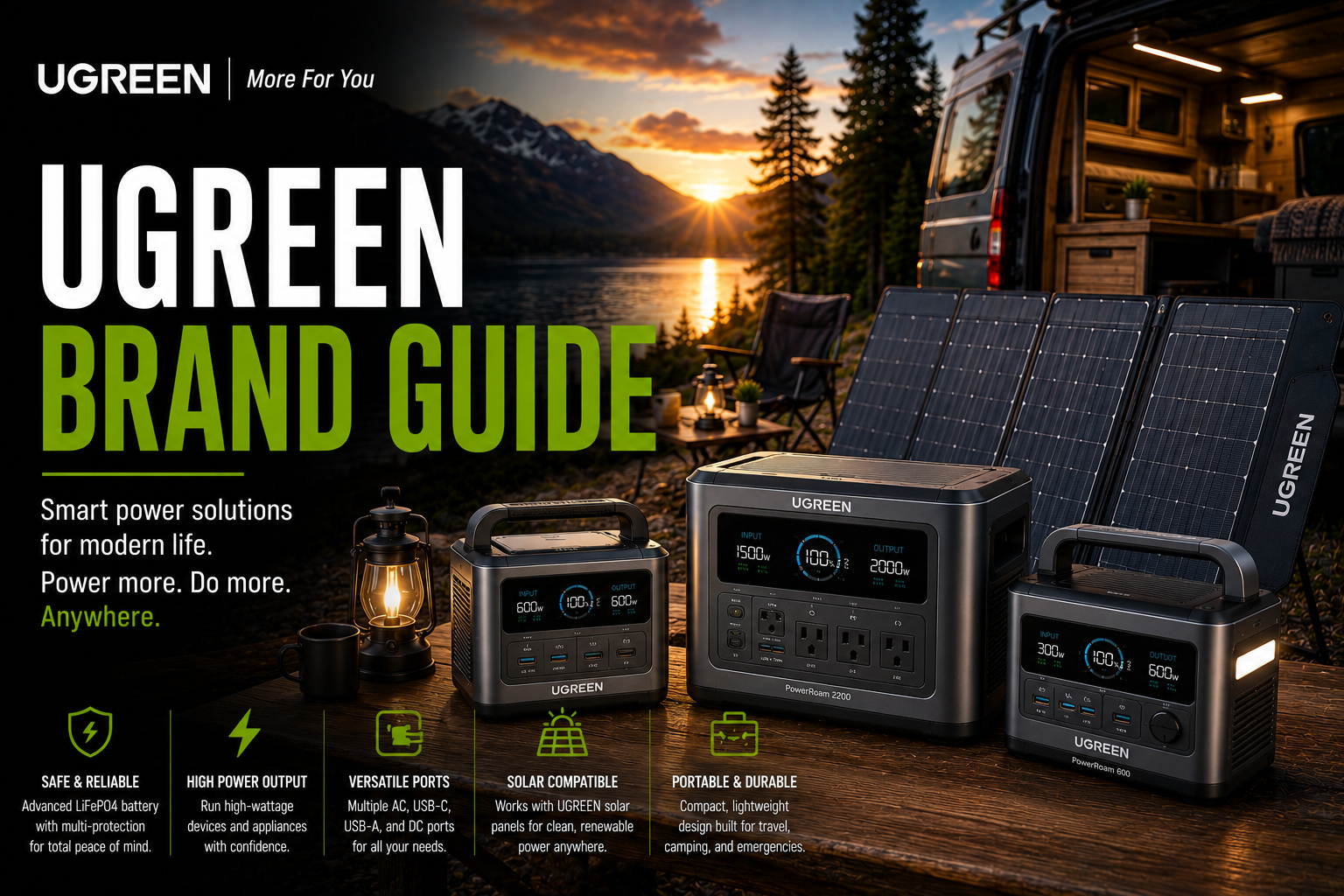
UGREEN Portable Power Station Buying Guide
Choose UGREEN by rated output, runtime, charging speed, expansion availability, seller support and the difference between U-Turbo and continuous power.
PowerRoam products are straightforward on paper, but a smart 2026 purchase requires checking whether the ecosystem is actively supported in your region.
This guide explains capacity, charging, expansion and ownership risk before purchase.
Choose PowerRoam 1200 for Portability and 2200 for Expansion
Do not buy PowerRoam 2200 primarily for expansion until compatible batteries are confirmed in stock.
Buying Guidance
PowerRoam 1200 is the safer standalone purchase. PowerRoam 2200 is the stronger system only when accessories and warranty support are verified.
Start With the Use Case
Light Camping
PowerRoam 600.
Refrigerator and Office
PowerRoam 1200.
RV and Long Outages
PowerRoam 2200.
High-Watt Resistive Loads
Understand U-Turbo limitations.
Expansion Planning
Verify battery stock.
Long-Term Ownership
Prefer authorized sellers.
Rated Output vs U-Turbo
PowerRoam 1200 is rated at 1,200W and PowerRoam 2200 at roughly 2,400W. U-Turbo can support selected resistive loads above those ratings by adjusting voltage; it should not be treated as full continuous output for every motor or electronic device.
Charging and Solar
| Model | Wall Charging | Solar Role | Best Charging Use |
|---|---|---|---|
| PowerRoam 600 | Fast-charge family | Compact arrays | Camping |
| PowerRoam 1200 | About 1.5h full claim | Portable panels | General use |
| PowerRoam 2200 | About 1.5h full claim | Larger array support | RV/home |
Ownership and Availability
UGREEN’s two-year warranty positioning and broad electronics support are positives, but PowerRoam inventory differs sharply by country. A deeply discounted discontinued or region-limited model may be a poor value if expansion batteries or replacement cables are unavailable.
Common Buying Mistakes
Buying From Output Boost Alone
Use rated watts.
Ignoring Availability
Check regional stock.
Assuming 1200 Expands
It does not use the 2200 battery system.
Overbuying Solar
Station input controls charging.
Skipping Warranty Checks
Marketplace sellers differ.
Ignoring Weight
PowerRoam 2200 is about 56 lb.
Frequently Asked Questions
Who should buy a UGREEN power station?
Buy it when UGREEN’s compact design, fast charging, app control and current sale price fit your needs.
Who should skip a UGREEN power station?
Skip it when you need the easiest current U.S. availability, a very broad expansion ecosystem or native 240V output.
How should UGREEN runtime be estimated?
Multiply rated watt-hours by roughly 0.80 to 0.90 for usable AC energy, then divide by the appliance’s average load.
Can UGREEN run a refrigerator?
PowerRoam 1200 and 2200 can generally run common refrigerators when startup remains within their surge or U-Turbo behavior.
Can third-party solar panels be used?
Often yes, provided voltage, current, polarity and connector requirements remain within the station’s input limits.
Does UGREEN support UPS use?
PowerRoam models include emergency backup features, but transfer behavior should be verified for sensitive servers or medical devices.
How long do PowerRoam batteries last?
UGREEN positions the LFP batteries for roughly 3,000 cycles to 80% capacity and around a decade of typical use.
Is PowerRoam 1200 expandable?
Not with the large multi-battery architecture offered by PowerRoam 2200.
Is PowerRoam 2200 still easy to buy?
Availability varies significantly by country and retailer, so base-unit and expansion-battery stock should be checked together.
What is the biggest UGREEN buying mistake?
Buying an older discounted base station without first confirming accessory, warranty and regional support availability.
Is U-Turbo the same as rated output?
No. It is a special mode for selected loads.
Which is best for an RV?
PowerRoam 2200 when expansion support is available.