
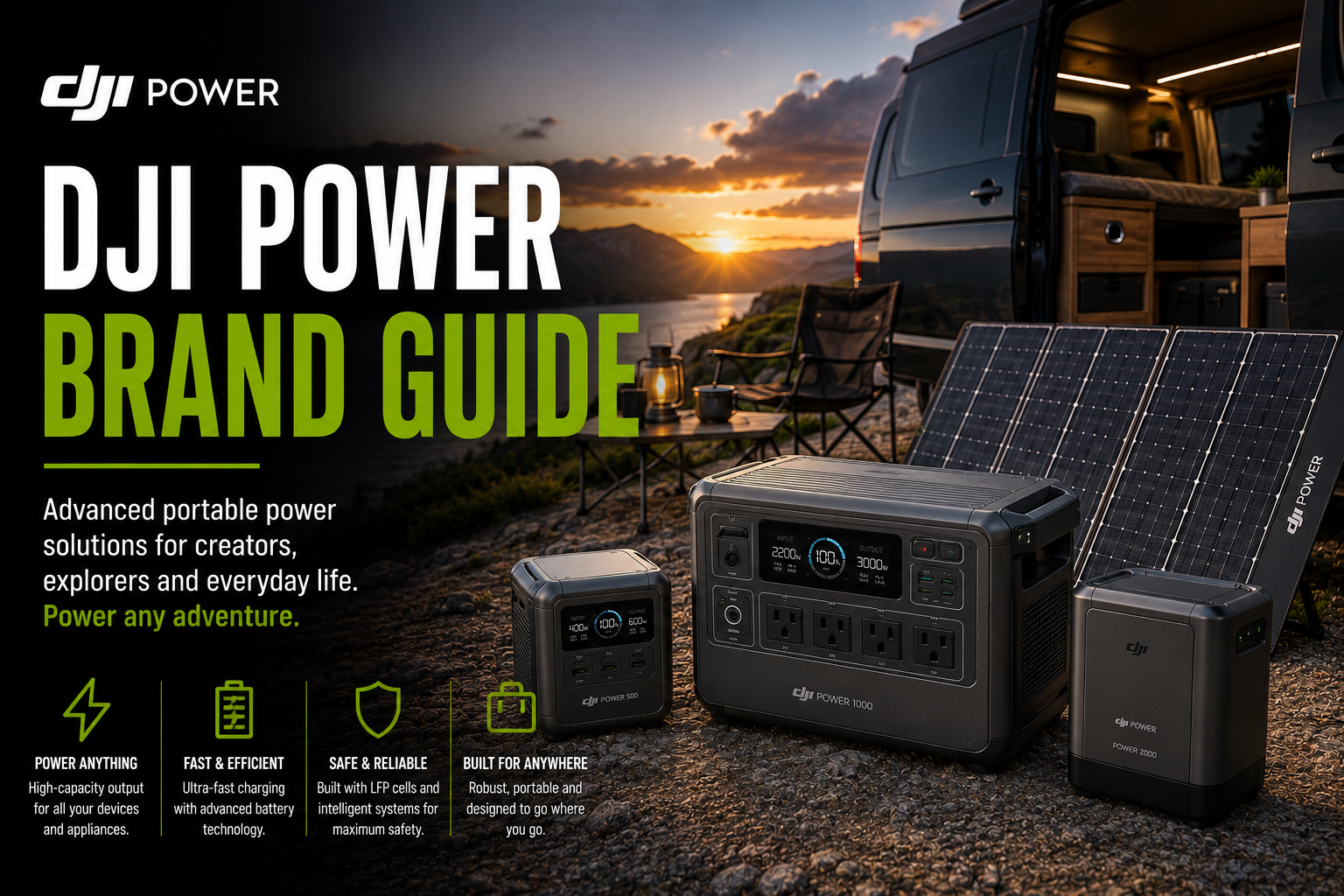
Are DJI Power Stations Worth It?
DJI Power is worth considering for buyers who value high inverter output, quiet operation, drone charging and fast vehicle or solar recovery.
DJI’s stations are not simply batteries with outlets; they are optimized for demanding mobile workflows and high-watt appliances.
That specialization creates excellent value for some buyers and unnecessary cost for others.
Worth It for Creators, RV Users and High-Output Buyers
Power 1000 V2 and Power 2000 justify their price when their unusually strong inverter and charging ecosystem are used regularly.
Editor's Verdict
DJI Power is worth buying for performance-focused users. Buyers prioritizing 240V home backup, ultra-low weight or maximum outlet count should compare alternatives.
Why DJI Power Can Be Worth It
Output Density
Very high watts for 1kWh and 2kWh stations.
Quiet Operation
Useful indoors, at night and on sets.
Drone Integration
Fast SDC charging for compatible aircraft.
Fast Recovery
Rapid AC, solar and vehicle options.
LFP Longevity
4,000-cycle class current products.
Expansion
Power 2000 and current V2 systems scale upward.
Reasons to Consider Alternatives
Limited Native 240V
Home integration is less complete.
Outlet Count
Some rivals provide more AC receptacles.
Accessory Cost
Expansion and chargers add expense.
Brand-Newer Power Ecosystem
Less history than established battery brands.
Weight
High-output models are not class-leading light.
Proprietary SDC Hardware
Benefits depend on using DJI accessories.
Where the Premium Makes Sense
DJI Power is easiest to justify for filmmakers, drone operators, RV users and buyers who genuinely need 2,600–3,000W output from compact stations. Casual phone-and-laptop users will not benefit from the same engineering priorities.
Best Buyers
DJI Drone Owners
Gain fast aircraft charging.
Film Crews
Need quiet, high-output mobile power.
RV Owners
Benefit from fast vehicle charging.
Homeowners
Use Power 2000 for essentials.
Tool Users
Need strong inverter headroom.
Not Minimalists
Small-load users can buy cheaper stations.
Frequently Asked Questions
Who should buy a DJI Power station?
Buy it when DJI’s unusually high inverter output, quiet operation, SDC charging or drone-battery integration solves a real need.
Who should skip a DJI Power station?
Skip it when you need native 240V output, the lowest weight in class or a broader third-party accessory market.
How should DJI Power runtime be estimated?
Multiply rated watt-hours by roughly 0.80 to 0.90 for usable AC energy, then divide by the appliance’s average running watts.
Can DJI Power run a refrigerator?
Power 1000-class and Power 2000 models can generally run refrigerators when compressor startup remains within inverter limits.
Can DJI Power charge from solar panels?
Yes, through compatible DJI MPPT or super-fast solar/car charging accessories and panels that remain within voltage and current limits.
Can DJI Power work as a UPS?
DJI supports UPS-style operation on current models, but transfer behavior and compatibility should be verified for sensitive medical or server equipment.
How long do DJI Power batteries last?
Current LFP models are generally rated to retain more than 80% capacity after 4,000 cycles.
Are DJI Power accessories universal?
No. SDC and SDC Lite capabilities differ, and expansion compatibility varies by model generation.
Can DJI Power fast-charge drone batteries?
Yes. Model-specific SDC cables support fast charging for selected DJI consumer and enterprise drone batteries.
What is the biggest DJI Power buying mistake?
Choosing only from inverter watts while ignoring base energy, expansion cost, outlet count and accessory compatibility.
Is DJI Power good value for non-drone owners?
Yes when high output and quiet operation matter, but less so for light USB-only use.
Should I buy the original Power 1000 or V2?
Choose V2 for expansion and sustained 2,600W output; choose the original only at a meaningful discount.