
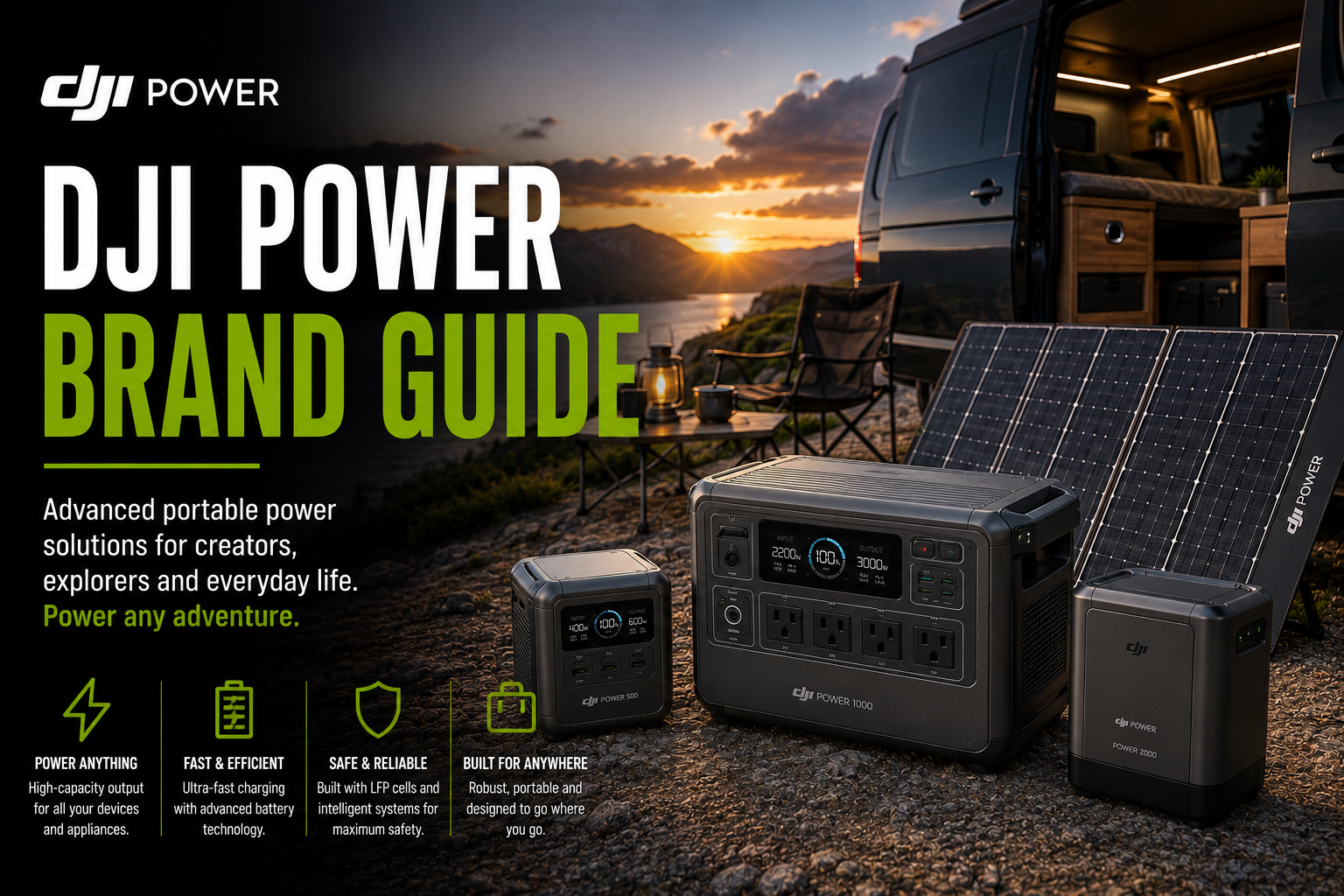
Best DJI Power Stations
Power 2000 is best overall, Power 1000 V2 is best in the 1kWh class, Power 500 is best compact and the original Power 1000 is the value pick.
DJI Power stations stand out because their inverter output is unusually high relative to battery capacity.
This ranking separates appliance capability from runtime so buyers do not confuse a powerful inverter with a large battery.
Best Overall: DJI Power 2000
Its 2,048Wh battery, 3,000W output, fast recharge and multi-pack expansion create the most complete DJI system.
Editor's Verdict
Power 2000 is the best long-term buy. Power 1000 V2 is better when compact size matters more than two-day runtime.
Top DJI Power Picks
DJI Power 2000
2,048Wh, 3,000W output, fast charging and multi-battery expansion.
DJI Power 1000 V2
1,024Wh with continuous 2,600W output and expansion support.
DJI Power 500
512Wh, 1,000W output and a 16-pound travel-friendly chassis.
DJI Power 1000
1,024Wh, 2,200W stable output and 4,400W peak capability.
DJI Power Expansion Battery 2000
2,048Wh stackable battery for compatible DJI Power systems.
DJI Power Comparison
| Model | Capacity | Output | Best For |
|---|---|---|---|
| DJI Power 2000 | 2,048Wh | 3,000W | Home, RV and production backup |
| DJI Power 1000 V2 | 1,024Wh | 2,600W | High-output 1kWh systems |
| DJI Power 500 | 512Wh | 1,000W | Camping and electronics |
| DJI Power 1000 | 1,024Wh | 2,200W | General high-output backup |
| DJI Power Expansion Battery 2000 | 2,048Wh | Dual SDC | Longer runtime |
DJI Power 2000
2,048Wh, 3,000W output, fast charging and multi-battery expansion.
Power 2000 is DJI’s strongest all-around station. It combines 2kWh capacity, 3,000W appliance output, quiet operation, rapid charging and compatibility with up to five 2,048Wh expansion batteries.
Why It Stands Out
- 3,000W stable output
- 0–80% in about 45 minutes
- Expandable beyond 10kWh
- Compact 2kWh chassis
- Strong car/solar charging ecosystem
What to Consider
- Heavy
- Premium total-system cost
- No native 240V split phase
- Expansion batteries add bulk
Best for: RVs, home essentials, jobsites and long production days.
DJI Power 1000 V2
1,024Wh with continuous 2,600W output and expansion support.
Power 1000 V2 upgrades DJI’s 1kWh platform with sustained 2,600W output, broader app management and compatibility with the Expansion Battery 2000 ecosystem.
Why It Stands Out
- Class-leading continuous output
- Expandable system
- LFP 4,000-cycle claim
- DJI Home app
- Drone and vehicle charging options
What to Consider
- Heavier than original Power 1000
- Premium pricing
- Accessory-driven ecosystem
- Only 1kWh base runtime
Best for: buyers needing large appliance power from a compact 1kWh base.
DJI Power 500
512Wh, 1,000W output and a 16-pound travel-friendly chassis.
Power 500 is the easiest DJI model to carry and store. Its 1,000W output is unusually strong for a 512Wh station, making it useful for kettles, camera gear, laptops, lights and compact outdoor setups.
Why It Stands Out
- Strong output for size
- Two 100W USB-C ports
- Quiet operation
- LFP battery
- DJI drone fast-charge support
What to Consider
- Short runtime under high loads
- No large-battery expansion
- Lower solar ceiling than larger models
- Only two AC outlets
Best for: camping, filmmaking, laptops and short emergency use.
DJI Power 1000
1,024Wh, 2,200W stable output and 4,400W peak capability.
The original Power 1000 remains a powerful 1kWh station with output well above many competitors in the same capacity class. It is especially attractive when discounted below the newer V2.
Why It Stands Out
- Very high 1kWh output
- Dual 140W USB-C
- Quiet at light load
- SDC ecosystem
- Fast AC charging
What to Consider
- Original model is less expandable
- Fewer AC outlets than some rivals
- Heavier than Jackery 1000 v2
- Accessory availability matters
Best for: appliances, RVs, production gear and discounted-value buyers.
DJI Power Expansion Battery 2000
2,048Wh stackable battery for compatible DJI Power systems.
Expansion Battery 2000 is the core of DJI’s scalable runtime strategy. It adds energy without duplicating AC outlets, screens and inverters, making it more efficient for stationary or vehicle-based systems.
Why It Stands Out
- 2kWh per pack
- Stackable form
- Multiple-pack support
- Shared charging ecosystem
- Compact relative to capacity
What to Consider
- No standalone AC output
- Requires compatible DJI base
- Adds major system weight
- Premium proprietary accessory
Best for: multi-day outages, RVs and extended production work.
How to Choose
Base Capacity
Choose from 512Wh, 1,024Wh or 2,048Wh.
Continuous Output
DJI models are differentiated heavily by watts.
Expansion
Only current compatible systems support the 2kWh battery.
Vehicle Charging
Road users benefit from 1kW or 1.8kW chargers.
Drone Ecosystem
Choose the correct SDC cable.
Outlet Needs
DJI favors power density over maximum port count.
Frequently Asked Questions
Who should buy a DJI Power station?
Buy it when DJI’s unusually high inverter output, quiet operation, SDC charging or drone-battery integration solves a real need.
Who should skip a DJI Power station?
Skip it when you need native 240V output, the lowest weight in class or a broader third-party accessory market.
How should DJI Power runtime be estimated?
Multiply rated watt-hours by roughly 0.80 to 0.90 for usable AC energy, then divide by the appliance’s average running watts.
Can DJI Power run a refrigerator?
Power 1000-class and Power 2000 models can generally run refrigerators when compressor startup remains within inverter limits.
Can DJI Power charge from solar panels?
Yes, through compatible DJI MPPT or super-fast solar/car charging accessories and panels that remain within voltage and current limits.
Can DJI Power work as a UPS?
DJI supports UPS-style operation on current models, but transfer behavior and compatibility should be verified for sensitive medical or server equipment.
How long do DJI Power batteries last?
Current LFP models are generally rated to retain more than 80% capacity after 4,000 cycles.
Are DJI Power accessories universal?
No. SDC and SDC Lite capabilities differ, and expansion compatibility varies by model generation.
Can DJI Power fast-charge drone batteries?
Yes. Model-specific SDC cables support fast charging for selected DJI consumer and enterprise drone batteries.
What is the biggest DJI Power buying mistake?
Choosing only from inverter watts while ignoring base energy, expansion cost, outlet count and accessory compatibility.
Which DJI model has the best output-to-capacity ratio?
Power 1000 V2 with 2,600W continuous output from a 1,024Wh battery.
Is the expansion battery worth it?
Yes for long outages or RV use, but not for occasional short backup.